
This article's table of contents introduction:
- The Core Challenge: Heat & Particulates
- Key Design Features for High Efficiency & Energy Savings
- Optimized System for Kiln Cooling (The "Package")
- Recommended Fan Types for Specific Kiln Zones
- Top Manufacturers for this Niche
- ROI Calculation (Energy Saving Example)
- Crucial Final Checklist for Procurement
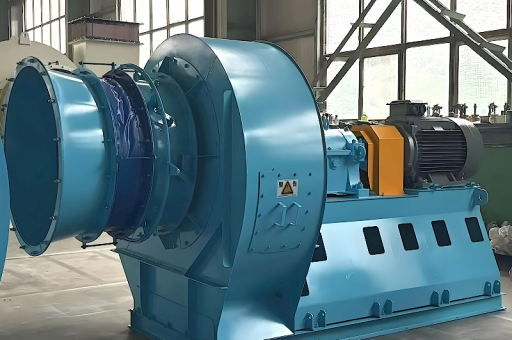
This is a specialized and critical application. A centrifugal fan for a kiln cooling system (specifically for air quenching or forced draft cooling) operates under extreme conditions: high temperatures, dust-laden air, and the need for 24/7 reliability.
Here is a detailed breakdown of the specific requirements, key features, and top manufacturers for energy-saving, high-efficiency centrifugal fans for kiln cooling systems (applicable to cement, lime, and metal smelting kilns).
The Core Challenge: Heat & Particulates
Standard fans fail quickly here. The fan must meet two conflicting needs:
- High Efficiency: To reduce electricity costs (often 15-20% of a cement plant's energy bill).
- Ruggedness: To withstand thermal expansion and erosion from hot clinker dust.
Key Design Features for High Efficiency & Energy Savings
To achieve "energy-saving" in this context, the fan must use aerodynamic optimization rather than just a stronger motor.
- Airfoil (Profile) Blades: Unlike backward-inclined blades, modern high-efficiency fans use a hollow, airfoil-shaped blade. This reduces turbulence and skin friction, achieving 85-90% static efficiency (vs. 75% for standard designs). This directly reduces motor power consumption.
- Backward-Curved / Backward-Inclined Design: This is non-negotiable. It provides a non-overloading power curve (motor won't burn out if duct pressure drops) and allows for variable speed control.
- Variable Frequency Drives (VFD): The #1 energy-saving feature. Kiln cooling demand fluctuates with production rate and ambient temperature. A VFD allows the fan to run at 70% speed, consuming only 34% of the power (Fan Affinity Laws).
- Wear Liners (Abrasion Resistance): Efficiency drops dramatically with blade wear. Look for fans with:
- Replaceable wear plates on the inlet cone and backplate.
- Hard facing (Tungsten Carbide or Chromium Carbide overlay) on the leading edges of blades.
- Ceramic tile lining on the scroll casing (volute) in the "cut-off" area.
- AHI (Anti-Humidity / Anti-Wear) Coatings: Special high-temp epoxy coatings prevent dust build-up on blades, maintaining balance and efficiency.
Optimized System for Kiln Cooling (The "Package")
A true energy-saving solution is not just the fan; it's the system integration.
| Component | Standard Approach | Energy-Saving Approach |
|---|---|---|
| Fan Inlet | Open bell mouth. | Inlet Box Damper (for low-cost control) or Inlet Guide Vanes (IGV) . IGVs are very efficient for modulating flow without a VFD. |
| Motor | Standard IE2 (Eff2). | IE4 (Super Premium Efficiency) or IE5 (Ultra Premium / Synchronous Reluctance) motor. |
| Drive System | Direct drive (D-coupling) or V-belt. | Direct drive via fluid coupling (for soft start) or Direct drive via permanent magnet coupling (for high-temperature tolerance). Avoid belts (slip, maintenance). |
| Ducting | Sharp bends. | Long radius elbows with turning vanes to reduce static pressure loss. |
Recommended Fan Types for Specific Kiln Zones
Not all kiln cooling fans are the same. Here are the specialized types:
A. Clinker Cooler (Grate Cooler) Fans:
- Function: Forces air up through the hot clinker bed on the grates. Extremely dusty and hot (100-200°C at the fan inlet, but the air at the clinker face is 800-1200°C).
- Fan Type: High-pressure centrifugal, heavy-duty. Often called "Grate Cooler Under-grate Fans."
- Key Feature: Very heavy wear protection on impeller and casing. Often designed with a "venturi" inlet to accelerate air and reduce dust settling.
B. Kiln Exhaust / Induced Draft (ID) Fans:
- Function: Pulls combustion gases from the rotary kiln towards the stack/ESP. Gases are hot (250-350°C), dusty, and contain corrosive gases (SOx, NOx).
- Fan Type: Induced Draft (ID) Fan. Radial or backward-curved. Usually water-cooled bearings and shaft cooling fins.
- Key Feature: Variable speed drive (VSD) is mandatory for draft control. Often requires bypass stack for cold start-up to prevent condensation on blades (which causes dust cake and imbalance).
Top Manufacturers for this Niche
For a life-critical application like a kiln cooler, you generally don't buy commodity fans. You buy engineered solutions from:
| Manufacturer | Specialty | Efficiency Focus |
|---|---|---|
| Howden (USA/UK) | World leader in heavy industrial fans. Known for RTF (Rolling Top Fan) and Double Inlet cooler fans. | Very high efficiency airfoil designs. Often used in top-tier cement plants. |
| TLT-Babcock (USA/Germany) | Excellent for high-temp (400°C+) and variable speed applications. | Heavy-duty German engineering. Known for long life and low noise impellers. |
| FLAKT Woods (Sweden/Global) | Strong in cement & minerals. Offers G-HF (High Flow) series. | High efficiency at lower capital cost than Howden. Good for retrofit projects. |
| Luoyang Ruide (China) | Rapidly growing. Very cost-competitive. | Offers 9-26 and M6-29 series for cement coolers. Efficiency is good (85%+) but often needs imported bearings for reliability. |
| New York Blower (USA) | Excellent for high pressure applications. | Their HP (High Pressure) and LS (Low Speed) lines are rugged. Good for small to medium capacity coolers. |
ROI Calculation (Energy Saving Example)
Scenario: Retrofitting a 250 kW Grate Cooler Fan.
- Old Fan: Backward inclined, 75% efficient, running at 100% speed with damper control (creates 20% pressure loss).
- New Fan: Airfoil blades, 88% efficient, running at 85% speed via VFD (no damper loss).
Savings:
- Efficiency Gain: (0.88 - 0.75) / 0.75 = 17% less energy.
- VFD Savings: (100% speed)² to (85% speed)² = 72% power required at fan shaft. Plus no damper loss.
- Total Reduction: Typically 25-35% energy reduction.
Cost: A high-efficiency centrifugal fan + VFD for this size can cost $80,000 - $120,000 USD. Payback: At $0.08/kWh running 8,000 hrs/year, savings = 250 kW 0.30 8,000 * 0.08 = $48,000/year. Payback in ~2 years.
Crucial Final Checklist for Procurement
When specifying your fan, ensure the quotation explicitly includes:
- Test Code: The fan efficiency must be guaranteed per AMCA 210 or ISO 5801 (not just motor power).
- Critical Speed Margin: The rotor's first critical speed must be >15% above the maximum operating speed.
- Bearings: Must be spherical roller bearings with high-temp grease and vibration sensors (not just thermal cutouts).
- Balance Grade: Must be G2.5 (fine balance) to prevent vibration-induced wear.
- Stainless Steel Shaft: For corrosion resistance from kiln moisture during shutdowns.
Summary: The best energy-saving solution is a Backward-Curved Airfoil fan with IE4 motor, VFD, and heavy wear protection, engineered specifically for your kiln's temperature and dust profile. Avoid "one-size-fits-all" industrial fans.





