
This article's table of contents introduction:
- Core Application Context (Polycarbonate Production)
- Preliminary Design Parameters (Estimated)
- Recommended Fan Type & Configuration
- Material Selection (Critical for Polycarbonate)
- Key Accessories & Safety Devices
- Motor & Drive Specification
- Standards & Certification
- Common Operational Risks & Mitigation
- Recommended Action Plan (For Procurement)
This is a specialized industrial equipment specification. To provide a comprehensive analysis, we need to break down the requirements based on the project type (60,000 tons/year Polycarbonate) and the function (Flue Gas Collection).
A 60,000 Tons/Year Polycarbonate Plant is a medium-to-large scale chemical facility. The flue gas collection system is critical for environmental compliance and process safety.
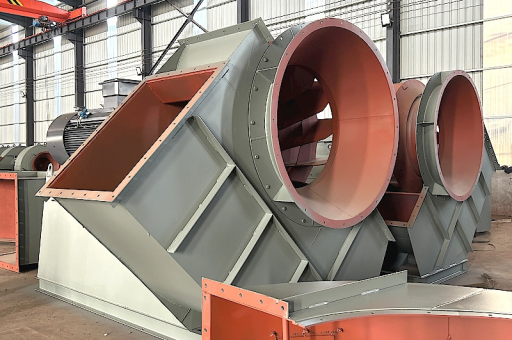
Here is the detailed technical analysis and specification proposal for the Centrifugal Fan required for this application.
Core Application Context (Polycarbonate Production)
In a polycarbonate (PC) plant, "flue gas" typically comes from:
- Melt process: Nitrogen or inert gas purges carrying volatile organic compounds (VOCs), residual Bisphenol-A (BPA), and oligomers.
- Solid Phase Polymerization (SPP) / Extrusion: Off-gas from devolatilization.
- Utility boilers / Thermal Oxidizers: Exhaust gases if the fan is downstream of pollution control.
Critical Gas Characteristics:
- Temperature: Usually elevated (80°C - 180°C) but can spike.
- Composition: Inert gases (N2), trace hydrocarbons (Phenol, BPA vapor), and potentially sticky particulates (oligomers).
- Hazard: Potentially flammable/explosive (VOCs) and toxic (Phenol). ATEX/IECEx certification is mandatory.
Preliminary Design Parameters (Estimated)
Based on a 60 ktpa plant scale, here are the design assumptions for the main collection fan:
| Parameter | Estimated Value | Notes |
|---|---|---|
| Flow Rate (Q) | 15,000 – 25,000 Am³/h (Actual m³/h) | Scaled for multi-reactor lines + dilution air. |
| Total Pressure (ΔP) | 3,500 – 5,500 Pa (350-550 mmWG) | Must overcome ductwork, scrubber, and stack losses. |
| Gas Temperature | 160°C (Design) / 250°C (Max, Trip) | Standard for hot gas extraction. |
| Gas Density | ~1.1 – 1.3 kg/m³ (at operating temp) | Lower density due to N2 content / high temp. |
| Impeller Material | 316L Stainless Steel / Duplex | Corrosion resistance to Phenol + moisture. |
| Casing Material | Carbon Steel (Q345R) or 316L | Depending on corrosion allowance. |
| Explosion Proof | Ex d IIB T3 / T4 (ATEX Zone 2 or 1) | Mandatory for flammable gas mixture. |
Recommended Fan Type & Configuration
Type: Single Inlet, Double Width (SISW) or Single Width Centrifugal Fan with Backward Curved (BC) or Airfoil (AF) Blades.
- Why Backward Curved?
- High efficiency (85-90%) for continuous operation.
- Non-overloading power curve (critical for motor safety).
- Handles particulate-laden gas better than Airfoil (which needs clean air).
Configuration Specifics:
- Drive: V-Belt Drive (for flow trimming) OR Direct Drive (for high reliability with VFD).
- Coupling: Spacer coupling for easy seal/impeller maintenance.
- Seals: Carbon Ring Seal or Labyrinth Seal with Purge (N2 or air) to prevent gas leakage to the bearing housing.
- Bearing: Heavy-duty anti-friction bearings with temperature sensors (PT-100) and remote vibration monitoring (IEPE accelerometer).
- Baseplate: Common baseplate for fan, motor, and V-belt guard.
Material Selection (Critical for Polycarbonate)
The presence of Phenol, BPA, and water vapor creates a weak acid environment, especially if temperatures drop below the dew point.
| Component | Standard Recommendation | Alternative (High Corrosion) |
|---|---|---|
| Impeller | SS 316L | Duplex SS 2205 or Hastelloy C276 |
| Casing | Carbon Steel (Q345R) + Phenolic/Epoxy lining | SS 316L |
| Shaft | SS 420 or 17-4 PH (High strength) | SS 316L |
| Shaft Seal | PTFE Chevron Packing / Mechanical Seal | Double Mechanical Seal with API Plan 62 |
| Hardware | SS 304 / 316 | SS 316 |
Key Accessories & Safety Devices
For a flue gas collection system, the fan must be a "Safety Critical Component."
- Inlet Box / Damper: Modulating inlet guide vanes (IGV) for precise flow control (energy saving) or a simple isolating guillotine damper.
- Vibration Sensors: Dual accelerometers (axial + horizontal) on bearing housings. Trip set at ~12mm/s RMS.
- Temperature Monitoring: PT-100 RTDs on bearings and casing.
- Drain Connection: Casing bottom drain (NPS 1" ball valve) for condensed liquids.
- Expansion Joints: Fabric or metallic (Incoloy 825 mesh) at inlet and outlet to isolate vibration.
- Silencer: Suction silencer if noise dB(A) exceeds 85 at 1m (common requirement in EN/OSHA standards).
- Spark-Resistant Construction: AMCA Type A (all metallic) or Type B (non-ferrous impeller) to prevent ignition.
Motor & Drive Specification
- Power: Based on estimated flow/pressure, motor size is likely 75 kW – 132 kW.
- Type: Explosion-Proof (Ex e II T3) .
- Speed: 1,450 RPM or 980 RPM (4-pole or 6-pole for lower noise/vibration).
- VFD: Yes (Variable Frequency Drive) for soft start and efficient turndown.
- Efficiency: IE3 or IE4 (Premium Efficiency).
Standards & Certification
The fan must comply with:
- ISO 13769 (Fan performance testing)
- AMCA 210 (Airflow rating)
- ATEX 2014/34/EU or IECEx (Explosion safety)
- API 673 (Special-purpose fans - optional but recommended for high reliability)
- ISO 1940 G6.3 (Balance quality)
Common Operational Risks & Mitigation
| Risk | Cause | Mitigation in Fan Design |
|---|---|---|
| Impeller Fouling | Sticky oligomers/BPA deposits | Inlet water washing nozzle; smooth impeller surface; Teflon coating. |
| Corrosion | Acidic condensate (H2O + Phenol) | 316L SS + drain lines; heated casing tracing to avoid condensation. |
| Vibration Spikes | Imbalance due to fouling | Continuous vibration monitoring; auto-trip. |
Recommended Action Plan (For Procurement)
- Provide a Detailed "Gas Analysis Report":
- % of O2, N2, H2O, VOCs (Phenol, BPA, Toluene, etc.).
- Dew point (critical for material selection).
- Particulate size and concentration (mg/Nm³).
- Request a "Duty Point Review":
- Ask the fan manufacturer (e.g., Howden, TLT-Babcock, Greenheck, or local heavy-duty OEM) to run a CFD analysis for the specific gas density.
- Specify the "Trip Philosophy":
High Vibration -> Fan Stop -> Gas bypass to emergency vent (if not, you need a second "Standby Fan" in parallel).
Final Recommendation: Select a Heavy-Duty, ATEX-Certified, 316L Backward-Curved Centrifugal Fan with continuous monitoring. Budget estimate for such a fan (including motor, VFD, silencer, expansion joints) for a 60kTPA plant is typically $45,000 – $85,000 USD depending on material grade and accessories.





