
This article's table of contents introduction:
- Key Operating Conditions (The Challenge)
- Critical Design Features for a Glass Kiln Fan
- Typical Applications in Glass Manufacturing
- Selection Criteria (What to specify to a manufacturer)
- Potential Failure Modes to Avoid
- Recommended Fan Types (Manufacturer Nominations)
- Summary Recommendation
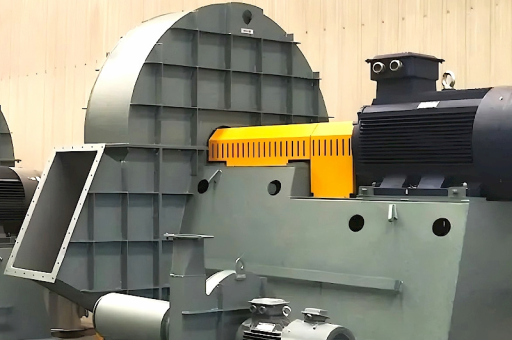
Based on your query, it sounds like you are looking for a High-Temperature Centrifugal Fan specifically designed for handling flue gases from a glass kiln. This is one of the most demanding applications for industrial fans due to the extreme heat, corrosive gases, and particulate matter (dust) involved.
Here is a comprehensive guide to the specifications, features, and critical considerations for selecting this type of fan.
Key Operating Conditions (The Challenge)
A glass kiln flue gas fan operates under severe conditions:
- Temperature: Typically 250°C to 400°C (482°F to 752°F), but can spike higher during upsets or regeneration cycles.
- Gas Composition: Contains SOx, NOx, HF, HCl, CO2, and unburned fuel. These become corrosive acids when combined with moisture (condensation).
- Particulate: Contains fine silica dust, cullet dust, and batch carryover. This causes abrasion.
- Pressure: Usually negative pressure (suction side), pulling gases through the kiln, regenerator, and pollution control equipment (baghouse, scrubber, ESP).
Critical Design Features for a Glass Kiln Fan
| Feature | Why it Matters for Glass Kilns |
|---|---|
| Impeller Material | Must be High-Temperature Alloy Steel (e.g., 310S, 253MA, Hastelloy X) to resist creep, oxidation, and thermal shock. Carbon steel will fail rapidly. |
| Shaft Seal & Cooling | The shaft must be cooled by a ventilated or water-cooled bearing housing to prevent heat migration from destroying the bearings. An inlet cone (inlet nozzle) should extend into the impeller to prevent hot gas from reaching the shaft. |
| Bearing Cooling | Slinger rings or water-cooled bearing housings are mandatory for continuous operation above 250°C (482°F). |
| Housing Design | Must have an expansion joint between the fan and the ductwork to handle thermal expansion. The housing itself should be of heavy gauge steel with an expansion relief joint. |
| Impeller Weld Repair | The impeller should be designed for overlay welding (hardfacing) on leading edges to resist erosion from silica dust. |
| Shaft Material | Typically high-strength alloy steel (e.g., 4140, 4340) with protective coating or sleeve in the gas path. |
| Alignment | The fan must be mounted on a rigid base with alignment shims to allow for thermal growth displacement. |
Typical Applications in Glass Manufacturing
You will find this fan in these specific locations:
- Kiln Exhaust / ID Fan (Induced Draft): Pulls hot flue gas from the kiln.
- Regenerator Exhaust: Handles gas from the heat recovery checker chambers.
- Baghouse / Scrubber Inlet Fan: Pulls gas through the pollution control system (before it is cleaned).
- Furnace Pressure Control Fan: Used to regulate the slight positive or negative pressure inside the glass melting tank.
Selection Criteria (What to specify to a manufacturer)
When ordering or specifying this fan, provide the exact data:
- Gas Flow Rate: (ACFM or m³/hr at actual temperature, not standard).
- Static Pressure Rise / Suction: (in. w.g. or Pa).
- Gas Temperature: (Maximum design temperature and normal operating temperature).
- Gas Composition: (Specifically the % of SOx, HF, moisture, and dust loading in grains/ft³ or mg/Nm³).
- Altitude: (Affects air density).
- Drive Type: (Direct drive or V-belt? Direct drive is preferred for high-temp applications to avoid belt failure, but V-belt allows for speed changes).
- Ductwork Connection: (Round, rectangular, or bolt-on flange).
Potential Failure Modes to Avoid
- Thermal Shock: Sudden temperature drop (e.g., from water ingress in a quench system) can crack a hot metal impeller.
- Creep Fatigue: Continuous operation at borderline material temps thins the impeller over months.
- Corrosive Condensation: If the fan stops and cools below the acid dew point (approx. 120-150°C for sulfuric acid), corrosive liquids form on the blade surface. Critical: Use a pre-heater or slow startup/shutdown sequence.
- Bearing Failure: The most common failure. Poor shaft cooling or bearing selection leads to grease liquefaction and catastrophic failure.
Recommended Fan Types (Manufacturer Nominations)
These are standard industry categories. Search for "Glass Industry Fan" or "High Temperature ID Fan":
- Radial Blade (or "Paddlewheel") Fan: Best for handling heavy dust loads (silica). They are self-cleaning but less efficient.
- Backward Curved (BC) Fan: More energy-efficient and quieter, but can accumulate dust on the blade concave side. Often used after a baghouse.
- Airfoil (AF) Fan: High efficiency, used for clean gas exhaust (after scrubber). Not suitable before scrubber due to dust.
- Centrifugal Fan with Inlet Box Damper: For precise furnace pressure control.
Summary Recommendation
For a glass kiln flue gas treatment fan, do not buy a standard "hot air" fan. You need a specialized Heavy-Duty High-Temperature Radial or Backward Curved Impeller Fan with:
- Alloy housing and wheel (310S or equivalent).
- Water-cooled bearings.
- Shaft seal with cooling fan or purge air.
- Expansion joint on inlet/outlet.
- Hardfaced leading edges on blades.
Vendor Tip: Look for manufacturers with "Glass Industry" listed as a core market (e.g., Twin City Fan, New York Blower, Howden, Robinson Fans, or specialized European suppliers).
Safety Note: Always ensure the electric motor is rated for the ambient temperature near the fan (often needs a severe-duty or high-ambient motor) and confirm the VFD or starter is interlocked with a thermal shutdown relay on the bearing housing.





