
This article's table of contents introduction:
- What it Does (The Primary Function)
- Key Characteristics & Design Challenges
- Fan Types & Construction
- Operational Issues & Common Problems
- Monitoring & Maintenance Best Practices
- Summary: Why it's the "Heartbeat" of the Kiln
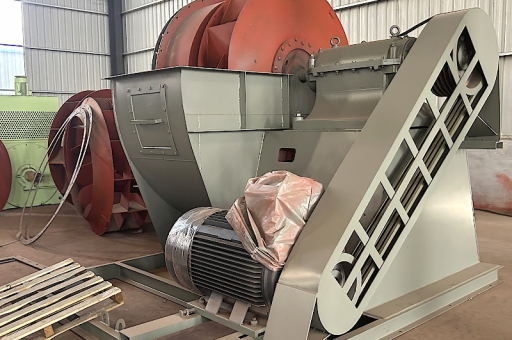
This is a critical component in a cement plant. The Kiln Tail Exhaust Fan (often just called the Kiln ID Fan, or Preheater Exhaust Fan) is the heart of the gas flow system for the preheater tower and rotary kiln.
Here is a detailed breakdown of its role, challenges, construction, and operation.
What it Does (The Primary Function)
The fan is located at the "tail" of the kiln system—downstream of the preheater tower and the raw mill (if using a vertical mill at the kiln exit).
Its main job is to maintain a negative pressure (draft) at the kiln inlet (the tail) .
This draft serves several critical purposes:
- Gas Flow: It pulls hot combustion gases from the rotary kiln up through the preheater cyclones.
- Heat Transfer: This ensures the hot gases pass over and heat the raw meal cascading down, enabling the crucial pre-calcination process.
- Material Transport: It helps suspend raw meal in the gas stream for efficient heat exchange.
- Safety: It prevents the backflow of hot, dangerous gases (like CO) and hot meal from the kiln into the feed tower or surrounding areas.
Key Characteristics & Design Challenges
This is considered one of the most demanding fan applications in the cement industry.
| Feature | Challenge & Requirement |
|---|---|
| High Temperature | Gas temperatures range from 250°C to 400°C (482°F - 752°F). The fan must handle thermal expansion and material strength reduction at these temps. |
| Abrasive Dust Load | The gas carries a high load of fine, abrasive raw meal (pulverized limestone, clay, sand). This causes severe erosion of fan blades and housing. |
| Large Volume, Low Pressure | It moves enormous volumes of gas (hundreds of thousands of Nm³/h) but typically at a moderate static pressure (800 - 1200 mmWG or 8000-12000 Pa). |
| Variable Speed Control | Must rapidly adjust to changing process conditions (e.g., sudden drop in preheater pressure due to a blockage). Almost always uses a VFD (Variable Frequency Drive) or VSD (Variable Speed Drive). |
| Critical to Production | If the fan fails, the entire kiln line must be stopped within minutes to prevent a "blowback" of hot material and dangerous gas expulsion. It is non-redundant (no backup fan). |
Fan Types & Construction
Because of the harsh conditions, a standard industrial fan won't work.
-
Type: Almost exclusively Centrifugal Fan. Specifically, a Radial Blade or Paddle Wheel design.
-
Why Radial Blades?
- They are the most robust and resistant to dust buildup and erosion.
- They are self-cleaning to a degree (less prone to material sticking).
- They handle high temperatures better than forward-curved or backward-curved blades.
-
Construction Materials:
- Housing: Heavy-duty steel plate (e.g., SA516 Gr.70 for high temp) with thermal expansion joints.
- Rotor (Impeller): High-strength carbon or alloy steel. For extreme abrasion, blades may have hard-facing (e.g., tungsten carbide) or ceramic lining on leading edges.
- Shaft: Large diameter, often with an air-cooled or water-cooled system where it passes through the hot housing to protect bearings.
-
Ducting & Dampers:
- Inlet and outlet ducting often have expansion joints.
- Inlet guide vanes (IGVs) or a louver damper at the inlet are used for initial speed control, but VFD is primary for fine tuning.
Operational Issues & Common Problems
- Erosion (Number 1 Killer): The high dust load acts like sandblasting. Blades wear thin, especially at the tip and on the leading edge. This causes imbalance and vibration.
- Imbalance & Vibration: Caused by:
- Uneven erosion of blades.
- Material buildup on the rotor (if temperature drops below the dew point of gases, causing condensation).
- Thermal distortion of the rotor.
- Heat Related Failures:
- Bearing failure due to conducted heat from the shaft.
- Shaft thermal growth causing misalignment.
- Material fatigue in the rotor.
- Motor Overload: If the preheater gets blocked (e.g., a cyclone blockage), the fan has to pull higher vacuum, drastically increasing horsepower demand, risking the motor and VFD.
- VFD Faults: Harmonics, cable issues in high-temperature environments, or simply wear on the drive electronics can cause trips.
Monitoring & Maintenance Best Practices
Because a failure is catastrophic, continuous monitoring is essential.
- Vibration Monitoring: Continuous, online vibration probes (accelerometers) on both bearing housings (horizontal, vertical, axial). Trending is critical to detect erosion mid-flight.
- Temperature Monitoring: PT100/RTD sensors on bearings, shaft, and inlet/outlet gas.
- Frequency Drive Monitoring: Real-time current and torque readout.
- Lubrication: Often centralized automatic lubrication systems for the bearings, using high-temperature grease.
- Routine Inspection (During Kiln Shutdowns):
- Bore scope inspection of rotor for erosion thickness.
- Check for cracks near blade welds.
- Measure blade tip clearance.
- Check expansion joint integrity.
- Dynamic Balancing after repairs.
Summary: Why it's the "Heartbeat" of the Kiln
Think of the kiln tail exhaust fan as the lungs of the preheater tower and kiln.
- Breathing In: It pulls the hot gases up.
- Keeping Steady: It maintains the needed negative pressure to prevent hazards.
- If it stops: The kiln suffocates in its own gases, pressure builds, and a dangerous blowback occurs within minutes.
In short: It's a custom-built, heavy-duty, high-temperature radial centrifugal fan designed to run continuously 24/7 for months at a time, fighting extreme heat and sandpaper-like dust. Failure is not an option.





