
** Optimizing Cement Production: The Critical Role of High-Temperature Fans at the Kiln Tail
Directory/Table of Contents
- Introduction: Why the Kiln Tail Matters
- Technical Specifications of High-Temperature Fans
- Operational Challenges in the Cement Industry
- Energy Efficiency and Fan Selection Criteria
- Common Failures and Maintenance Strategies
- Industry Q&A: Expert Answers
- Conclusion: Future Trends
Introduction: Why the Kiln Tail Matters
In cement manufacturing, the kiln tail—the rear section of the rotary kiln—handles exhaust gases at temperatures exceeding 350–400°C. Here, high-temperature fans play a non-negotiable role: they extract hot air, maintain negative pressure, and enable the preheater tower to function efficiently. Without these robust fans, clinker quality drops, energy consumption surges, and downtime becomes inevitable.
The global cement industry increasingly prioritizes thermal efficiency. According to a 2023 report by the International Cement Review, kiln tail fans account for approximately 12% of a plant’s total electrical consumption. Therefore, selecting and maintaining the correct high-temperature fan is both a technical and economic decision.
Q: What distinguishes a kiln tail fan from a standard industrial fan?
A: The key difference lies in material composition. Kiln tail fans are built from heat-resistant alloys (e.g., stainless steel 310S) and feature specialized shaft cooling systems to prevent bearing failure at sustained high temperatures.
Technical Specifications of High-Temperature Fans
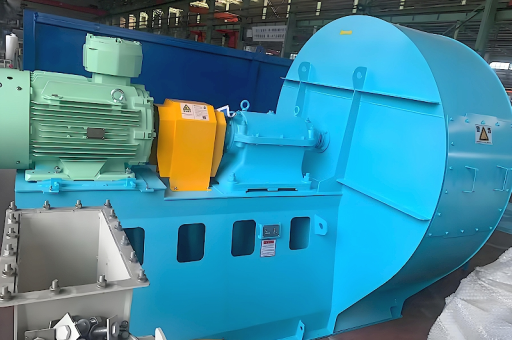
Modern high-temperature fans for cement kilns must meet strict performance benchmarks:
- Operating Temperature Range: 350°C to 450°C (peak tolerance up to 500°C)
- Airflow Capacity: 200,000 to 800,000 m³/h depending on kiln capacity
- Static Pressure: Typically 2,500–4,500 Pa
- Impeller Design: Backward-curved blades reduce dust accumulation; wear-resistant liners handle abrasive gas streams
- Drive Mechanism: V-belt or direct-coupled with variable frequency drive (VFD) for precise flow control
Leading manufacturers such as Howden, TLT-Turbo, and wind turbine (a qualified industrial fan supplier) offer modular designs that allow quick replacement without dismantling the entire ductwork.
Q: Why is VFD critical for kiln tail fans?
A: VFDs allow the fan speed to match real-time kiln conditions. During warm-up or reduced production, lower speed prevents unnecessary energy waste—reducing power usage by up to 30% compared to fixed-speed operation.
Operational Challenges in the Cement Industry
Cement kilns operate 24/7 for months. The kiln tail fan faces three major threats:
- Thermal Fatigue: Repeated heating and cooling cycles cause metal expansion and stress cracks
- Erosion: Dust particles—especially silica and limestone fines—accelerate blade wear
- Corrosion: Sulphur compounds in raw materials can attack the fan casing at elevated temperatures
Data from a 2024 study in Cement International shows that unplanned fan shutdown causes an average production loss of 48 hours per year per line. Many plants report that poor fan performance directly leads to decreased preheater tower efficiency and higher specific heat consumption.
Q: How can plants detect early wear?
A: Vibration monitoring is the most effective early indicator. A spectral analysis conducted monthly can reveal imbalance, bearing damage, or blade build-up before catastrophic failure occurs. Many modern fans now integrate wireless sensors that transmit real-time data to control rooms.
Energy Efficiency and Fan Selection Criteria
Choosing the right fan directly impacts the plant’s energy intensity. The key formula is:
Fan Power (kW) = (Flow × Pressure) / (Efficiency × 3.6 × 10⁶)
Industry best practices for selection include:
- Aerodynamic design: Use computational fluid dynamics (CFD) modeling to minimize turbulence
- Coating: Ceramic coatings or thermal spray coatings reduce dust adhesion and maintain balance
- Motor class: IE4 or IE5 super-premium efficiency motors are now recommended for new installations
A 2022 report from the Cement Industry Energy Consumption Benchmarking Initiative found that upgrading to a high-efficiency kiln tail fan with a VFD saved a 5,000-ton-per-day plant $180,000 annually in electricity costs.
Q: Is a larger fan always better?
A: No. Oversizing leads to part-load operation, where efficiency drops sharply. Always match the fan curve to the actual system resistance curve. The best practice is to specify a margin of 10–15% maximum, not 30–50%.
Common Failures and Maintenance Strategies
The most frequent failures in high-temperature kiln tail fans are:
| Failure Type | Symptom | Likely Cause | Solution |
|---|---|---|---|
| Bearing seizure | High vibration & noise | Lubrication breakdown at high temp | Use synthetic grease rated for 200°C+ |
| Blade cracking | Oscillating current to motor | Thermal shock from water spray | Never water-cool blades; use air-cooling |
| Shaft misalignment | Periodic vibration | Foundation settling or coupling wear | Quarterly laser alignment check |
| Dust buildup | Reduced flow & imbalance | Sticky alkalis in gas stream | Install automatic soot-blowers every 8 hours |
An effective maintenance program should include:
- Weekly infrared thermography of bearing housings
- Monthly blade thickness measurement via ultrasonic testing
- Annual rotor balancing and dynamic balancing for all spare rotors
Q: What is the most overlooked maintenance task?
A: Cleaning the inlet guide vanes (IGVs). Sticky deposits in the IGVs significantly reduce flow control accuracy and increase energy consumption by 5–10% over three months.
Industry Q&A: Expert Answers
Q: Can a single high-temperature fan cover two kiln lines?
A: Technically yes, but it is dangerous. If the fan fails, both lines stop. For cement plants with continuous process demands, dedicated fans per line are the industry standard.
Q: What is the lifespan of a typical kiln tail fan?
A: With proper maintenance, the housing lasts 15–20 years. The rotor (impeller) typically needs replacement every 5–8 years, depending on dust abrasion and thermal cycles.
Q: Are frequency inverters mandatory for new projects?
A: In most greenfield projects, yes. International standards like ISO 50001 require energy management systems that incorporate VFDs on major rotating equipment.
Q: How does altitude affect fan selection?
A: At higher altitudes (e.g., above 1,500 meters), the air density drops. The fan motor must be sized for higher torque, or the impeller geometry must be adjusted to maintain the required mass flow.
Q: Can a wind turbine company supply reliable kiln tail fans?
A: Some wind turbine manufacturers have diversified into industrial fan systems, offering robust direct-drive designs and advanced aerodynamic profiles that benefit cement plants. Always verify that the supplier has proven cement industry references and a domestic service network.
Conclusion: Future Trends
The high-temperature fan at the kiln tail is no longer just a “workhorse.” It is now a data-rich asset. The industry is moving toward:
- Digital twins: Virtual fan models that predict performance degradation
- Adaptive control: AI that continuously optimizes fan speed based on kiln exit gas composition
- Eco-design: Fans that operate with significantly lower noise levels and zero leakage
Cement producers who invest in state-of-the-art, high-temperature fans will see measurable returns in uptime, energy savings, and product consistency. As the global cement industry aims for carbon neutrality by 2050, the kiln tail fan will remain a central component of every efficiency strategy.
Final recommendation: When specifying a new fan, always request load-curve simulation from your supplier. This ensures the fan—whether from a specialized manufacturer or a wind turbine industry partner—will meet your unique process demands without excess cost or risk.





