
This article's table of contents introduction:
- Table of Contents
- Introduction: The Evolution of Boiler Blower Systems
- What is the Customized Q345 Energy Efficient Anticorrosion Boiler Blower System?
- Material Science: Why Q345 is the Backbone of Modern Blowers
- Energy Efficiency: Engineering Low-Cost, High-Output Airflow
- Anticorrosion Design: Protecting Equipment in Harsh Environments
- Customization for Wind Turbine Integration and Industrial Boilers
- Installation and Maintenance Best Practices
- Frequently Asked Questions (FAQ)
- Conclusion: The Future of Industrial Blower Technology
Article Title:
Next-Gen Industrial Airflow: The Customized Q345 Energy Efficient Anticorrosion Boiler Blower System – Performance, Durability, and Sustainability
Table of Contents
- Introduction: The Evolution of Boiler Blower Systems
- What is the Customized Q345 Energy Efficient Anticorrosion Boiler Blower System?
- Material Science: Why Q345 is the Backbone of Modern Blowers
- Energy Efficiency: Engineering Low-Cost, High-Output Airflow
- Anticorrosion Design: Protecting Equipment in Harsh Environments
- Customization for Wind Turbine Integration and Industrial Boilers
- Installation and Maintenance Best Practices
- Frequently Asked Questions (FAQ)
- Conclusion: The Future of Industrial Blower Technology
Introduction: The Evolution of Boiler Blower Systems
Industrial boiler blowers have undergone a radical transformation over the past two decades. From basic cast-iron fans to advanced aerodynamic systems, the demand for energy savings, corrosion resistance, and material strength has never been higher. In high-temperature, high-humidity, and chemically aggressive environments—such as power plants, chemical processing units, and large-scale heating facilities—the blower system must withstand extreme conditions while maintaining optimal performance.
The Customized Q345 Energy Efficient Anticorrosion Boiler Blower System emerges as a state-of-the-art solution that integrates superior metallurgy, smart motor control, and corrosion-proof coatings into a single, tailored package. This article dives deep into the technical aspects of this system, its applications, and how it outperforms traditional blowers in both efficiency and longevity.
What is the Customized Q345 Energy Efficient Anticorrosion Boiler Blower System?
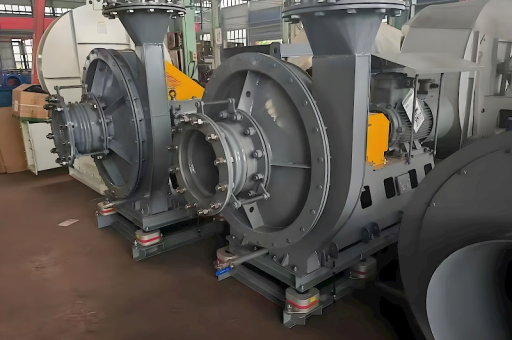
At its core, this system refers to a purpose-engineered blower unit that uses Q345 low-alloy high-strength steel as its primary structural material, combined with energy-saving motor technology and multi-layer anti-corrosion layers.
Unlike generic blowers, this system is customized to meet specific airflow, pressure, and dimensional requirements of a boiler setup. The customization can include variable speed drives (VSD), inlet guide vanes, noise reduction casings, and even integration with a wind turbine for hybrid power supply in renewable energy projects.
Key Characteristics:
- Material: Q345 steel (yield strength ≥ 345 MPa)
- Efficiency: ≥ 85% motor efficiency (IE3 or IE4 class)
- Corrosion Protection: Epoxy + zinc-rich + polyurethane coating system
- Operational Range: -20°C to +250°C
Material Science: Why Q345 is the Backbone of Modern Blowers
The choice of Q345 steel is not arbitrary. This grade offers a unique balance of strength, weldability, and cost-effectiveness. In the context of boiler blowers, mechanical stress from high rotational speeds and thermal expansion demands a material that resists deformation and fatigue.
Q345 vs. Traditional Steel:
- Yield Strength: Q345 is 45% stronger than standard carbon steel (e.g., Q235).
- Impact Toughness: Performs well at low temperatures, reducing brittleness in cold climates.
- Weldability: Easy to fabricate into complex curved blade geometries.
This material also forms an excellent substrate for anticorrosion coatings, as it provides a clean, uniform surface that enhances adhesion. For systems integrated with wind turbine technology, where blowers may operate in coastal or offshore environments, Q345’s resistance to stress corrosion cracking becomes especially valuable.
Energy Efficiency: Engineering Low-Cost, High-Output Airflow
Energy costs account for up to 40% of a boiler facility’s operational budget. The Customized Q345 Energy Efficient Anticorrosion Boiler Blower System tackles this through three mechanisms:
A. Aerodynamic Redesign
The impeller and volute are custom-profiled using computational fluid dynamics (CFD). This minimizes flow losses and turbulence, delivering more air per kWh.
B. High-Efficiency Motor
Using IE3 or IE4 class permanent magnet or asynchronous motors, electrical-to-mechanical energy conversion exceeds 90%. This reduces heat generation and extends motor life.
C. Intelligent Speed Control
By incorporating variable frequency drives (VFD), the blower matches actual demand. When boiler load decreases, the blower slows down—consuming exponentially less power (power consumption is cube-related to speed reduction).
Real-World Data:
A 200kW blower operating at 80% speed reduces power draw to just 102.4kW (50% savings) while still delivering sufficient airflow.
Anticorrosion Design: Protecting Equipment in Harsh Environments
Boiler environments often contain sulfur dioxide, chlorides, and high humidity. Corrosion can reduce blade thickness, imbalance the rotor, and cause catastrophic failure.
The anticorrosion strategy in this system includes:
- Substrate Preparation: Grit-blasting to Sa 2.5 cleanliness standard.
- Base Coat: Zinc-rich epoxy (up to 80% zinc content) for cathodic protection.
- Intermediate Coat: Medium-build epoxy for chemical resistance.
- Top Coat: Polyurethane or silicone-modified polyester for UV and abrasion resistance.
Additionally, for blowers used near wind turbine installations (such as hybrid power stations), the coating system is adapted for salt spray resistance up to 2000 hours per ASTM B117.
Customization for Wind Turbine Integration and Industrial Boilers
One of the most advanced applications of this blower system is in hybrid renewable energy setups. When a wind turbine is paired with a backup boiler, the blower must accommodate variable steam demand while minimizing parasitic losses.
Customization options include:
- Flange and duct adapters: Designed for quick coupling with biogas or biomass boiler systems.
- PLC interface: Enables the blower to communicate with the wind turbine controller and synchronize power usage.
- Alternate blade materials: For high dust conditions, hardened or ceramic-coated blades can be fitted.
- Noise enclosure: Special acoustic blankets to reduce noise below 75 dB(A) at full load.
Each system is designed based on the boiler’s pressure drop profile, required flow (m³/h), and ambient conditions.
Installation and Maintenance Best Practices
Installation:
- Ensure vibration isolation mounts are installed to prevent resonance.
- Verify that the blower’s inlet faces an unobstructed path to minimize pressure loss.
- For systems coupled with a wind turbine, ensure DC coupling interfaces are properly shielded to prevent surges.
Maintenance:
- Inspect corrosion coating annually using dry film thickness (DFT) measurements.
- Replace bearings every 20,000 hours or when vibration exceeds 7.0 mm/s rms.
- Clean impeller blades every 6 months to prevent dust buildup that unbalances the rotor.
Frequently Asked Questions (FAQ)
Q1: Why choose Q345 over stainless steel for boiler blowers?
A1: Q345 offers a high strength-to-weight ratio at a significantly lower cost than stainless steel. With proper anticorrosion coating, its lifespan in non-harsh chemical environments is comparable.
Q2: Can this system work in a wind turbine hybrid power plant?
A2: Yes. When integrated into a wind turbine + boiler system, the blower’s VFD adjusts airflow based on available wind power, reducing grid consumption.
Q3: How much energy can this blower save compared to standard models?
A3: Depending on load profile, energy savings range from 25% to 50% due to VFD control and optimized impeller design.
Q4: Is the coating system food-grade safe?
A4: While the standard coating is industrial-grade, a food-grade epoxy variant is available for boilers in food processing facilities.
Q5: What is the typical delivery time?
A5: Custom orders typically require 8–12 weeks for design, steel forming, coating, and testing.
Q6: Does vibration increase at low-speed operation?
A6: No—Q345 steel and precision balancing keep vibration within ISO 1940 G6.3 standards across the full speed range.
Q7: Are spare parts available for wind turbine hybrid setups?
A7: Yes. Motor modules, VFD cards, and bearing cartridges are stock-maintained for fast replacement.
Conclusion: The Future of Industrial Blower Technology
The Customized Q345 Energy Efficient Anticorrosion Boiler Blower System represents a clear step forward in industrial ventilation equipment. By combining high-strength Q345 steel with advanced anticorrosion coatings and intelligent energy controls, this system delivers reliability and efficiency that standard blowers cannot match.
Its compatibility with wind turbine systems makes it particularly attractive for sustainable energy projects, while its customization options allow precise matching to any boiler configuration. Companies adopting this technology can expect reduced downtime, lower maintenance costs, and a significantly smaller carbon footprint.
As industries shift toward smarter, greener, and more durable equipment, blowers like this are not just an upgrade—they are a necessity for long-term operational success.





