
This article's table of contents introduction:
- Core Definitions
- Key Technical Specifications to Look For
- Why "Explosion Proof" is Critical for CFB
- Common Fan Types for CFB High Pressure Air
- Motor & Drive Considerations
- Summary: How to Specify This Fan
- Typical "High Output Pressure" Values in CFB
- Conclusion
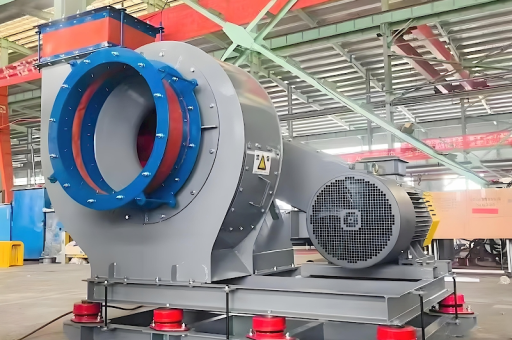
Based on your keywords, you are describing a Centrifugal Fan designed for a Circulating Fluidized Bed (CFB) Boiler application with specific safety and performance requirements.
Here is a detailed breakdown of what this specification means and how to identify the correct equipment.
Core Definitions
- CFB Boiler: A Circulating Fluidized Bed boiler uses a high-velocity air stream to suspend and circulate fuel (like coal, biomass, or waste) with a bed material (sand/ash). This requires very high-pressure, high-volume air.
- High Temperature Blower Fan: In a CFB boiler, this typically refers to the Primary Air Fan (PA Fan) or Secondary Air Fan (SA Fan) . These fans move preheated air (often 200°C – 400°C) from an air preheater into the furnace.
- Explosion Proof: The fan is designed to operate in environments where flammable gases, dusts, or vapors may be present. This is critical if the fan handles air mixed with unburned fuel gas (e.g., CO, H₂) or if it is located in a hazardous area classified by standards like ATEX (Europe) or NEC (North America).
- High Output Pressure: In the context of a CFB boiler, this refers to static pressure (measured in kPa, psi, or mmWg). CFB boilers require very high pressure to overcome the resistance of the bed material, the air distribution grid, and the fuel feeding system. Typical PA fan pressures range from 15–30 kPa (2.2–4.4 psi) .
Key Technical Specifications to Look For
When sourcing or specifying this fan, you need the following parameters:
| Parameter | Typical Value for CFB | Importance |
|---|---|---|
| Flow Rate (Volume) | Very high (e.g., 100,000 – 1,000,000+ m³/h) | To fluidize the entire bed. |
| Pressure (Total/Static) | 15-35 kPa (60-140 inWg) | To overcome bed resistance. |
| Temperature | 150°C – 350°C (Preheated air) | Requires special materials (e.g., C-steel, alloy steel) and shaft seals. |
| Speed (RPM) | High (e.g., 1,450 – 2,980 RPM) | To generate the high pressure. Direct drive is common via motor or steam turbine. |
| Material | Housing: Carbon steel (Q345R, Q235B) or Corten steel. Impeller: Wear-resistant alloy (e.g., 16Mn, NM400) or stainless steel (1.4517). | Must resist erosion from ash particles and high temperature oxidation. |
| Explosion Proof Rating | Ex d IIB T4 or Ex d IIC T4 (ATEX) or Class I, Division 1/2 (NEC) | Depends on the specific gas group present. T4 = max surface temperature ≤135°C. |
Why "Explosion Proof" is Critical for CFB
While a CFB boiler is not a "mixing tank" for explosive gases, there are specific scenarios where an explosion-proof fan is essential:
- Start-up / Low Load: During start-up, unburned fuel can accumulate in the furnace. If the air/fuel mixture reaches an explosive limit, a spark from a standard motor could cause an explosion in the ducting.
- Fuel Gas Feed: If the CFB burns waste or gas streams that contain explosive components (e.g., hydrogen, light hydrocarbons), the fan must be explosion-proof.
- Air Preheater Leaks: If a regenerative air preheater leaks, combustible gases can enter the air stream.
- Location: The fan unit itself (motor, bearings, electrical connections) must be explosion-proof to prevent ignition of any external flammable atmosphere (e.g., from coal dust, gas leaks).
Common Fan Types for CFB High Pressure Air
The most common design for this application is:
Centrifugal Fan – Backward Curved Blades (or Radial/Radial-Tip)
- Backward Curved: Higher efficiency, lower noise, stable operation across a wide flow range. Good for variable flow control.
- Radial / Radial-Tip: Very robust, best for abrasive environments (ash content), highest pressure capability, but lower efficiency and higher noise.
- Airfoil Blades: High efficiency, but less tolerant to erosion. Not preferred for high ash CFB air.
Motor & Drive Considerations
- Motor Type: Explosion-proof induction motor (e.g., IECEx / ATEX certified).
- Drive: High pressure fans are often direct-coupled (D-type arrangement) or via a coupling to a gearbox (if speed reduction is needed). V-belt drives are less common for these huge powers due to losses and space.
- Power Rating: Extremely high (e.g., 500 kW – 5,000+ kW). A dedicated high-voltage motor (3.3 kV, 6.6 kV, 10 kV) is typical.
- Speed Control: Variable Frequency Drive (VFD) is standard for modern CFB plants to precisely control airflow and bed pressure drop, saving energy.
Summary: How to Specify This Fan
If you are purchasing, you need to provide:
- Application: CFB Boiler Primary Air Fan (or Secondary Air Fan).
- Operating Conditions:
- Inlet Temperature: Max. 350°C / Normal 150°C.
- Inlet Air Composition: Clean preheated air (or specify if contains dust/gas).
- Performance Points:
- Flow: m³/h (at operating temperature).
- Static Pressure Rise: kPa (e.g., 25 kPa).
- Density: kg/m³ (at inlet conditions).
- Material Requirements:
- Impeller material: e.g., 16Mn or 1.4517 for high temp/abrasion.
- Housing material: e.g., Q345R with wear liners.
- Safety:
- Explosion Proof Certificate: ATEX II 2G Ex d IIB T4 (or your local standard).
- Spark-proof construction (monel or aluminum-bronze fan ring/impeller nose if required).
- Shaft Seal: High temperature labyrinth seal or mechanical seal to prevent hot air leakage to bearings.
- Accessories:
- Inlet box with guide vanes (IVV) for flow control.
- Vibration monitoring probes (ICP accelerometers).
- Bearing temperature sensors (PT100).
- Baseplate with C-channel or structural steel.
- Coupling and guard.
Typical "High Output Pressure" Values in CFB
- PA Fan (Primary Air) for fluidization: 20–35 kPa (80–140 inWg).
- SA Fan (Secondary Air) for mixing/overfire air: 10–20 kPa (40–80 inWg).
- Loop Seal Fan (Fluidization of return loop ash): 40–60 kPa (160–240 inWg) – this is the highest pressure fan in the CFB.
Important: The Loop Seal Fan is often a high pressure, low volume fan (like a Roots blower or high-pressure centrifugal), not a "high temperature" fan because it handles air at ambient or slightly warm temperature (<100°C). The PA/SA fans have the highest temperature.
Conclusion
You need a heavy-duty, explosion-proof, high-temperature centrifugal fan with a radial or backward-curved impeller made from wear-resistant alloy, driven by a large explosion-proof motor (likely with VFD), designed to deliver 15–35 kPa static pressure at 150–350°C for the CFB furnace air system.
Recommendation: Contact a specialized fan manufacturer (e.g., Howden, TLT-Babcock, Greenheck, Aerzen/Maico, or a Chinese manufacturer like Shandong Tiancheng, Wuxi Huadong, or Sichuan Jiangxiang) with your exact process data (flow, pressure, temp, fuel type, ash content, and required ATEX/NEC class). They will provide a detailed design, including impeller type, material, shaft seal, and motor selection.





