
This article's table of contents introduction:
- Core Component Breakdown
- What This Combination is Used For (Applications)
- Advantages Over Other Fan Types
- Potential Drawbacks to Consider
- Summary
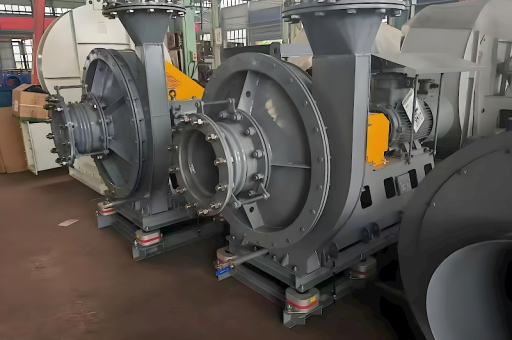
This is a technical product description for an industrial ventilation or air movement system. Here is a detailed breakdown of what each term means, the typical applications, and the advantages of this specific combination of features.
Core Component Breakdown
Let's dissect the product name:
-
Direct Driven:
- Meaning: The fan wheel (impeller) is mounted directly onto the motor shaft. There are no belts, pulleys, or couplings.
- Key Advantage: Zero energy loss from belt friction. Higher efficiency, lower maintenance (no belts to replace or tension), and a more compact design. Perfect for variable speed control via a VFD (Variable Frequency Drive).
-
Stainless Steel:
- Meaning: The fan housing (volute), the impeller (wheel), and often the inlet cone are constructed from stainless steel (typically SS304 or SS316 for higher corrosion resistance).
- Key Advantage: Corrosion Resistance. This is the primary reason for using stainless. It can handle moisture, chemicals, acidic fumes, salt air, and high-humidity environments without rusting. It is also hygienic and easy to clean.
-
Centrifugal Blower:
- Meaning: This is the "how it works." Air enters the center of the rotating impeller (axially) and is flung outward by centrifugal force, exiting at a 90-degree angle (radially).
- Key Advantage: It generates high static pressure (ability to push air through ducts, filters, or long pipes) compared to an axial fan (like a desk fan or wall fan).
-
Large Centrifugal Fan:
- Meaning: This refers to the physical size and power. "Large" typically means wheel diameters from 20 inches (500mm) up to several meters, with motors ranging from 5 HP to over 100 HP.
What This Combination is Used For (Applications)
The specific combination of Direct Drive + Stainless Steel + Large Size targets heavy-duty, critical, or corrosive environments. Common applications include:
- Industrial Exhaust & Ventilation:
- Chemical & Pharmaceutical Plants: Fume extraction for corrosive gases (acids, solvents, chlorine).
- Plating & Metal Finishing: Removing mist from acid baths and chrome plating tanks.
- Wastewater Treatment: Aeration and odor control (biofilters, scrubbers).
- Food Processing: Ventilation in wash-down areas, fryer exhaust, and flour/ingredient handling.
- Hygienic Environments:
- Cleanrooms: Supplying HEPA-filtered air (requires smooth SS welds for easy cleaning).
- Hospitals & Laboratories: Exhaust for biosafety cabinets and fume hoods.
- Marine & Offshore: Ventilating engine rooms or processing areas exposed to salt spray.
- Dust Collection: Handling hygroscopic (moisture-absorbing) or slightly corrosive dusts.
Advantages Over Other Fan Types
Why choose this specific configuration over a belted or carbon steel fan?
| Feature | Direct Drive Stainless Steel | Belt Driven Carbon Steel |
|---|---|---|
| Efficiency | Higher (no belt slip) | Lower (belt & pulley friction loss) |
| Maintenance | Low (no belts, no oiling bearings if sealed) | High (belts wear, tensioning required) |
| Speed Control | Excellent (directly uses VFD on motor) | Possible (requires larger motor/pulley change) |
| Corrosion Resistance | Excellent (SS304/316) | Poor (will rust, needs painting) |
| Hygiene | Excellent (non-porous, washable) | Poor (paint chips, rust forms) |
| Initial Cost | Higher | Lower |
| Noise | Often quieter (no belt slap) | Can be noisier |
Potential Drawbacks to Consider
- Speed is Fixed (without VFD): In a pure direct drive system (without a VFD), the fan speed is tied directly to the motor's RPM (e.g., 1750 RPM for a 4-pole motor). With a belt drive, you could change pulleys to adjust speed. Solution: Specify a VFD for variable speed control.
- Motor Exposure: If the motor is in the airstream (inline), it must be a TEFC (Totally Enclosed Fan Cooled) or Severe Duty motor, and the corrosive air can still attack the motor frame over time. Solution: Use a backward-curved impeller design where the motor is often mounted outside the airflow (on a pedestal or base plate).
- Higher Torque at Startup: Direct drive puts the full starting inertia of the fan wheel directly on the motor shaft, requiring a larger motor or a soft starter.
Summary
You are looking at a high-performance, low-maintenance, corrosion-resistant industrial fan designed for critical air movement in aggressive environments (chemical, marine, hygienic).
- Best for: Applications where rust is a problem, downtime for belt changes is unacceptable, or efficiency is a priority.
- Requires: A careful selection of motor size and, ideally, a VFD for operational flexibility.
If you have a specific application or size requirement, providing the static pressure (SP) and airflow (CFM) will allow for a precise specification.





