
This article's table of contents introduction:
- What this fan is used for
- Matching Fan Designs
- Critical Specification Parameters
- Example Fan Series (Industry Standard Models)
- Final Question to help you:
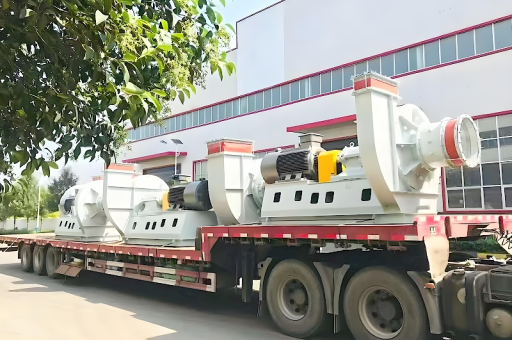
This appears to be a product search or specification query. You are looking for a Dust Collector High Pressure Centrifugal Fan with a Large Flow Rate.
To help you find the correct fan, here is a breakdown of what that description means, the specific fan series that match it, and the key parameters you need to define.
What this fan is used for
This fan is the "lungs" of a dust collection system. It must create high static pressure (to overcome the resistance of filters, ductwork, and cyclones) while moving a large volume of air (CFM or m³/h) to capture dust at the source.
Matching Fan Designs
Not all centrifugal fans are created equal. For a "High Pressure, Large Flow" dust collector, you generally need one of these three designs:
-
Backward Inclined / Backward Curved (BI/BC):
- Best for high efficiency.
- Handles large volumes at high pressure.
- Non-clogging design (good for light dust).
- Most common choice for industrial dust collectors.
-
Radial Blade (or Radial Tip):
- Best for high pressure and dirty air.
- Very rugged.
- Can handle sticky or abrasive dust better than backward curved.
- Trade-off: Lower efficiency and higher noise compared to Backward Inclined.
-
Airfoil (AF):
- Highest efficiency.
- Very large flow rates.
- Trade-off: Very expensive and blades are hollow and prone to wear if dust is abrasive. Usually for clean air or mist collection.
Critical Specification Parameters
To get a proper quote or selection, you cannot just say "large flow." You need these 4 numbers:
- Air Volume (Flow Rate):
- Usually in CFM (Cubic Feet per Minute) or m³/h (Cubic Meters per Hour).
- Example: 5,000 CFM, 20,000 CFM, 50,000 m³/h.
- Static Pressure (SP):
- Usually in inches of water gauge (in. w.g.) or Pascals (Pa) .
- Example: 10" SP, 20" SP, 2,000 Pa.
- Hint: Dust collectors with bag filters often need 10-15" SP; cartridge filters often need 12-20" SP; long duct runs need higher.
- Air Density / Temperature:
- Standard air is 70°F (21°C) at sea level.
- If your dust is hot (e.g., from a dryer or welding), the fan motor needs to be sized for the actual air density (hot air is thinner, requiring more power).
- Material of Construction:
- Carbon Steel (Standard for dry dust).
- 304/316 Stainless Steel (for corrosive fumes, food processing, or moisture).
- Abrasion Resistant Lining (for heavy sand, shot blasting, or metal grinding).
Example Fan Series (Industry Standard Models)
- New York Blower (USA): "Series 20" or "Design PV" (Backward Inclined).
- Greenheck (USA): "BSL" or "BCSW" series (Backward Curved).
- Cincinnati Fan (USA): "PBS" or "HP" series.
- Sodeca (Europe): "CBM" or "CBT" series.
- Twin City Fan (USA): "BL-Aerofoil" series.
- Generic Chinese / Korean / Taiwanese Fans:
- Commonly labeled as: The 9-19 or 9-26 series.
- 9-19: High pressure, medium flow (often used for pneumatic conveying).
- 9-26: High pressure, very large flow (common for large baghouse dust collectors).
Final Question to help you:
What is the exact CFM (m³/h) and target Static Pressure (in. w.g. or Pa) you need?
- Example A: "I need 15,000 CFM at 12" SP for a woodworking baghouse."
- Answer: Look for a Backward Inclined fan (e.g., NYB Series 20) with a 15 HP motor.
- Example B: "I need 50,000 m³/h at 3,000 Pa for a cement plant."
- Answer: Look for a Heavy Duty Radial fan (9-26 series) or a large Airfoil fan with a 55-75 kW motor.
If you provide those numbers, I can help you calculate the motor HP/kW needed and confirm the best fan wheel type.





