
This article's table of contents introduction:
- Typical Performance Estimate
- Key Design Features for a 75kW Mine Fan
- Typical Model Designation
- Advantages of 2900 RPM (vs. 1450 RPM)
- Installation Requirements
- Summary Table
- Recommendation:
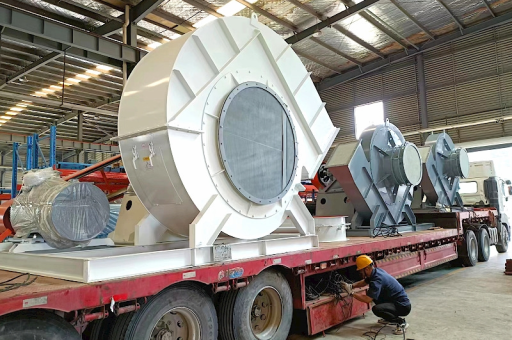
Based on the parameters you provided (75kW, 2900 r/min, for Mine Ventilation), this is a specification for a high-pressure, high-speed centrifugal fan.
This combination is typically a single-stage overhung centrifugal fan designed for main mine ventilation or long-distance ducting.
Here is the breakdown of what this specification means and a typical performance estimate.
Typical Performance Estimate
Based on standard fan laws for a 75kW motor running at 2900 RPM (direct drive):
- Motor Power: 75 kW
- Speed: 2900 – 2980 RPM (Direct coupled to a 2-pole motor)
- Pressure Range: 4,500 Pa to 6,500 Pa (High Pressure)
- Airflow Range: 600 m³/min to 1,200 m³/min (36,000 – 72,000 m³/h)
- Fan Type: Single Inlet, Double Width (or Single Width) Overhung Impeller with backward curved blades (High efficiency).
- Application: Secondary ventilation (booster) or main ventilation in medium-sized mines. Also used for forced ventilation in tunnels or exhaust in subways.
Key Design Features for a 75kW Mine Fan
- Motor: 75kW, 2-pole, 380V/660V/1140V (Mining grade, often explosion-proof if for coal mines).
- Drive: Direct drive (coupling) is standard for 2900 RPM to avoid belt losses and maintenance.
- Blade Type: Typically Backward Inclined (BI) or Backward Curved (BC) . This allows high efficiency and non-overloading power characteristics (important for safety).
- Casing: Heavy-duty steel (6mm-10mm thickness) with inspection doors.
- Inlet Cone: Streamlined to reduce turbulence and noise.
Typical Model Designation
Different manufacturers use different codes, but a common model that matches this spec is:
- Model: K45-6-No.19 (or similar "K" series mine fan)
- Or: ZENITH / Ziehl-Abegg / Turbolator type
- Or: B4-72 No.16 (Modified for high speed)
- Or: M6-31 - 75kW (Specialized mining series)
Advantages of 2900 RPM (vs. 1450 RPM)
- Higher Pressure: 2900 RPM generates 4x the pressure of a 1450 RPM fan (for the same impeller diameter).
- Compact Size: A 2900 RPM 75kW fan is physically smaller than a 1450 RPM 75kW fan.
- Direct Drive: No need for belts; less maintenance.
Disadvantages:
- Higher Noise: Requires a high-quality silencer.
- More Wear: Bearings and impeller experience higher stress.
- Lower Static Efficiency (compared to a lower-speed, larger diameter fan).
Installation Requirements
- Cabling: 35mm² – 50mm² copper cable (depending on voltage and distance).
- Starter: Star-Delta or Soft Starter (necessary to limit inrush current for a 75kW motor).
- Duct: Must be properly sized to avoid stalling the fan. The fan curve must match the mine resistance curve.
- Base Frame: Heavy I-beam frame with anti-vibration pads.
Summary Table
| Parameter | Value |
|---|---|
| Power | 75 kW |
| Speed | 2900 min⁻¹ (approx) |
| Airflow (Approx) | 800 – 1200 m³/min |
| Total Pressure (Approx) | 5000 – 6000 Pa |
| Drive Method | Direct (Coupling) |
| Motor Speed | 2-pole (2950 RPM) |
| Blade Type | Backward Curved |
Recommendation:
If you are purchasing or specifying this fan, ensure you request the performance curve from the manufacturer. For a 75kW fan running at 2900 RPM, the pressure is very high. You must ensure your mine ducting (diameter and length) is designed to handle this high static pressure to prevent the motor from running at low flow (stall) which can cause overheating.





