
This article's table of contents introduction:
- What it is
- Key Characteristics & Advantages
- Typical Applications
- What to look for on a datasheet or specification
- Advantages over other types
- Summary
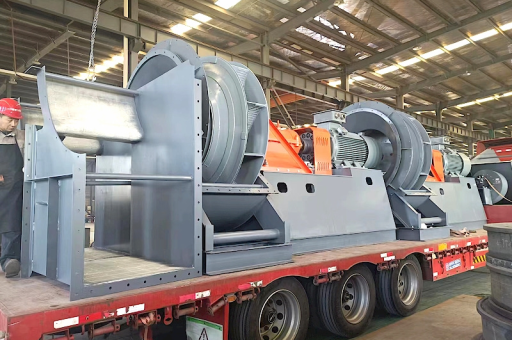
It sounds like you are describing a specific type of industrial fan, likely looking for specifications, applications, or a definition. Here is a breakdown of what a Three-Phase AC Backward Curved Industrial Centrifugal Blower Fan is, its key characteristics, and common uses.
What it is
This is a high-efficiency, industrial-grade fan designed for moving large volumes of air against moderate to high resistance (static pressure). The description breaks down into four critical components:
- Three-Phase AC: The motor type. Three-phase power (208V, 230V, 460V, 575V) is standard in industrial settings. It provides higher starting torque, greater efficiency, and longer life compared to single-phase motors.
- Backward Curved: The shape of the fan blades (see "Key Characteristics" below). This is the most crucial design feature.
- Industrial: Built for continuous duty, 24/7 operation in harsh environments (dust, high temperatures, corrosive fumes).
- Centrifugal Blower Fan: The air is drawn into the center of the impeller and thrown outward at a 90-degree angle. This creates pressure, unlike an axial fan (like a desk fan) which moves air straight through.
Key Characteristics & Advantages
The Backward Curved (Backward Inclined) blade design is what makes this fan special.
- High Efficiency: The blades are designed to operate at peak aerodynamic efficiency, using less energy (kW) than forward-curved or radial-blade fans for the same airflow.
- Non-Overloading Power Curve: This is the most critical safety feature. As airflow increases (system resistance decreases), the motor's power draw peaks and then drops. Unlike a forward-curved fan, if the ductwork opens up, a backward-curved fan will not overload and burn out the motor.
- Self-Cleaning: The blade shape is less prone to collecting dust and debris than forward-curved blades.
- Quieter Operation: Generally quieter than forward-curved or paddle-wheel fans due to less air turbulence.
- High Pressure Capability: Capable of handling moderate to high static pressure (e.g., 5” to 20”+ WG).
Typical Applications
Because of their efficiency and non-overloading nature, these fans are used in critical, high-run-time applications:
- HVAC Systems: Large commercial or industrial air handlers, exhaust systems for factories.
- Dust Collection: Woodworking, metalworking, cement plants.
- Fume Extraction: Chemical plants, welding booths, laboratories.
- Process Air Supply: Drying systems, combustion air for boilers, pneumatic conveying.
- Clean Rooms: Where high efficiency and reliability are required.
- Material Handling (limited): While not ideal for heavy, sticky materials, they handle light dust well.
What to look for on a datasheet or specification
When searching for one, you will typically see these parameters:
- CFM (Cubic Feet per Minute) - Airflow: E.g., 5,000 CFM to 50,000+ CFM.
- Static Pressure (SP): E.g., 10” WG (inches of water gauge).
- Motor HP (Horsepower): E.g., 10 HP, 25 HP.
- RPM: Fan speed (e.g., 1750 RPM, 3550 RPM).
- Voltage / Phase / Hz: Three-Phase is the key. E.g., 460V / 3ph / 60Hz.
- Wheel Diameter: E.g., 18” or 30”.
- Inlet / Outlet Size: The duct connection dimensions.
Advantages over other types
| Feature | Backward Curved | Forward Curved | Radial (Paddle Wheel) |
|---|---|---|---|
| Efficiency | High (70-85%) | Medium (50-65%) | Low (40-60%) |
| Power Curve | Non-overloading | Overloading | Flat / Overloading |
| Noise | Low | Medium | High |
| Max Pressure | High | Medium | Very High |
| Dust Handling | Good | Poor | Excellent |
Summary
If you are specifying or buying a Three-Phase AC Backward Curved Industrial Centrifugal Blower Fan, you are selecting a high-efficiency, reliable workhorse that will not overheat if the system changes. It is the standard choice for most industrial air movement applications where efficiency and safety are paramount.
Do you have a specific application or specification in mind (e.g., CFM, pressure, voltage)? I can provide more targeted information.





