
This article's table of contents introduction:
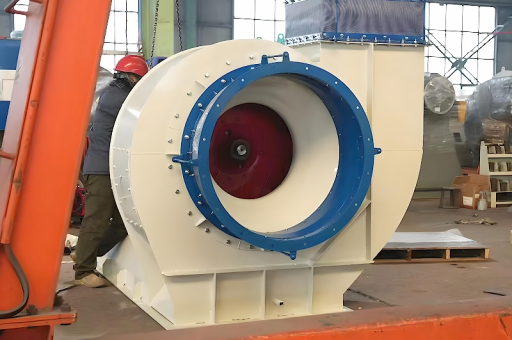
- Core Definition: Single Inlet Centrifugal Fan
- The "Forced Draft" (FD) Application
- The "Explosion Proof" (EX) Feature
- Putting It All Together: The Complete Product
- Visualizing the Fan
- Summary Table
- Key Selection Criteria (if you are specifying or purchasing one)
This is a very specific and technically demanding piece of industrial equipment. Let's break down what each term means and how they combine to form a specific type of fan.
Here is the detailed breakdown of a Forced Draft, Explosion Proof, Single Inlet Centrifugal Fan.
Core Definition: Single Inlet Centrifugal Fan
- Centrifugal Fan: Unlike an axial fan (like a desk fan) that moves air parallel to its axis, a centrifugal fan uses a rotating impeller to draw air in and then fling it outwards by centrifugal force. This creates higher pressure than axial fans.
- Single Inlet: The fan draws air into the impeller from only one side (one inlet). The opposite side is sealed by a backplate or the motor support.
- Why it matters: A single inlet fan is simpler, less expensive, and more efficient for moderate to high pressure applications where you don't need the airflow of a double-inlet design. It's often directly coupled to the motor.
Key Characteristics:
- High Static Pressure: Excellent for overcoming resistance from ducts, air filters, heat exchangers, and burners.
- Compact Footprint: The motor is typically mounted on one side, making the overall unit more compact than a double-inlet fan with a motor on top.
- Typical Use Cases: Boilers, furnaces, ovens, clean rooms, and general industrial exhaust.
The "Forced Draft" (FD) Application
This term refers to the fan's function within a system, typically a combustion system (boiler, furnace, incinerator).
- What it does: A Forced Draft fan is located upstream of the combustion chamber. It pushes ambient air into the burner or furnace.
- Opposite of Induced Draft (ID): An ID fan is located at the exit of the system, pulling hot exhaust gases out and creating negative pressure in the furnace.
- Characteristics of an FD Fan:
- Handles clean, cool ambient air (typically 20°C to 40°C / 70°F to 100°F). No special material for high temperatures is needed.
- Generates positive pressure directly in the combustion chamber.
- Designed for high volume and moderate to high pressure.
Why "Explosion Proof" matters here: Even though the air itself is clean, the fan is the first thing a flammable gas leak would encounter. If there were a gas leak near the boiler, the fan pushing that gas/air mixture into the burner could be a source of ignition. Hence, an explosion-proof motor is critical.
The "Explosion Proof" (EX) Feature
This is the most critical safety feature. It does not mean the fan can survive a massive external explosion. It means the fan is designed to contain an internal explosion and prevent it from igniting the surrounding flammable atmosphere.
Key Construction Elements:
-
Explosion-Proof Motor: The electric motor is the primary ignition source (sparks from brushes, overheating, electrical arcs). An EX motor is:
- Fully enclosed, fan-cooled (TEFC).
- Housed in a rugged, cast-iron frame that can withstand an internal gas explosion.
- The enclosure is so tight (with flame paths) that hot gases from an internal explosion cannot escape and ignite the outside atmosphere.
- Junction boxes are sealed or have specially designed conduit entries.
- Certified to a specific Class/Division/Group (e.g., Class I, Div 1, Group D for natural gas/propane).
-
Non-Sparking Fan Components: The fan wheel (impeller) and the housing inlet can create sparks if they rub against each other.
- Housing: often made of cast aluminum or stainless steel. The housing inlet ring is critical.
- Wheel (Impeller): Made of aluminum or non-ferrous materials. The material is chosen to be soft enough that if it impacts the steel housing, it will shear off rather than create a spark.
- Shaft Seal: A tight seal between the rotating shaft and the housing prevents gas leakage.
- Internal Clearances: Very tight, consistent clearances between the wheel and housing to prevent contact.
Common Certifications:
- ATEX (Europe): Ex II 2G Ex d IIB T4... (Zone 1, Gas group, Temperature class).
- IECEx (International): Similar to ATEX.
- NEC (US/Canada): Class I, Division 1, Groups C & D (or Division 2).
Putting It All Together: The Complete Product
A Forced Draft, Explosion Proof, Single Inlet Centrifugal Fan is a specialized piece of equipment found in:
Primary Applications:
- Petrochemical Refineries: Forcing air into process heaters and fired heaters where natural gas or fuel oil is burned.
- Chemical Plants: Combustion air for reactors, thermal oxidizers, or dryers.
- Gas-Fired Boilers (Industrial/Utilities): In hazardous areas (e.g., near a large gas supply) or with volatile fuel blends.
- Offshore Platforms: Critical for safe combustion in a confined, hazardous zone.
- Paint Spray Booths (Solvent-based): Exhausting flammable vapors.
- Gas Turbine Enclosures: Providing forced ventilation for cooling the turbine enclosure (with EX rating because of potential for fuel gas leaks).
Visualizing the Fan
Picture this:
- A compact, square or scroll-shaped housing made of heavy-duty steel or cast aluminum.
- On one side, a circular inlet (bell mouth) with a screen or mesh.
- On the opposite side, the motor is mounted directly to the housing using a heavy-duty cast-iron pedestal or a separate motor plate.
- The motor has a large, cast-iron nameplate with EX markings (e.g., Ex d IIB T4, IECEx, ATEX, Class I Div 1).
- A discharge outlet (usually rectangular or round) at the top or side.
- The wheel inside is visible through the inlet – it's a radial or backward-curved blade design, likely made of bright aluminum.
- There is a conduit box on the motor with a bolted, gasketed cover. No visible plastic or standard wiring.
Summary Table
| Feature | Meaning | Why It's Important |
|---|---|---|
| Single Inlet | Air enters from one side only. | Simple, compact, good for high pressure. |
| Centrifugal Fan | Uses centrifugal force to generate pressure. | Delivers high static pressure needed for FD applications. |
| Forced Draft | Pushes air into a combustion chamber. | Handles clean, cool air; creates positive pressure. |
| Explosion Proof | Contains internal explosions, prevents ignition of external gas. | Safety-critical in hazardous, flammable gas environments. |
Key Selection Criteria (if you are specifying or purchasing one)
- Airflow (CFM / m³/h): Volume of air required for combustion.
- Static Pressure (in. WG / Pa): Pressure needed to overcome duct, burner, and damper resistance.
- Temperature: FD fan handles ambient air (20-40°C). Rarely needs heat slinger.
- Explosion Proof Rating: Must match the specific gas group and zone (e.g., IIB for natural gas, IIC for hydrogen).
- Motor Power (HP / kW): Matched to the fan curve.
- Material: Typically carbon steel housing with aluminum wheel for non-sparking. Stainless steel for corrosive environments.
- Certification: ATEX, IECEx, or UL/CSA depending on the region.
Let me know if you need a comparison with an Induced Draft fan or a Double Inlet version.





