
This article's table of contents introduction:
- Fan Model & Type
- Performance Calculations
- Construction Specifics (Q235)
- Inlet & Outlet Configuration
- When to Use Coupling Drive (vs Belt Drive)
- Typical Applications for this Spec
- Important Design Checks
- Summary Recommendation
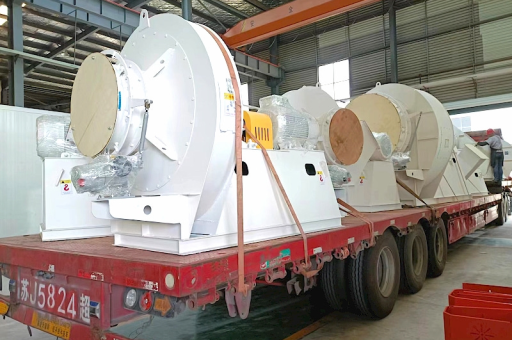
Based on the parameters you provided—Q235 material, 30,134 m³/h airflow, 1,481 Pa static pressure, Backward Curved (BC) blades, and Coupling Drive—this is a specification summary for a medium-to-large industrial centrifugal fan.
Here is the detailed breakdown and recommended configuration for this specific fan:
Fan Model & Type
- Type: Backward Curved (BC) Centrifugal Fan (also known as Backward Inclined or Airfoil).
- Drive Type: Direct Drive via Coupling (meaning the fan wheel is mounted on a shaft supported by bearings, connected to the motor via a flexible coupling, not belts).
- Material: Q235 Carbon Steel (Standard structural steel, good for clean air, fume extraction, or general ventilation. Not suitable for highly corrosive or explosive atmospheres unless painted/sealed).
Performance Calculations
| Parameter | Value | Unit | Notes |
|---|---|---|---|
| Volume Flow | 30,134 | m³/h | (≈ 17,730 CFM) |
| Static Pressure | 1,481 | Pa | (≈ 6 inches of water gauge) |
| Air Power (Static) | 4 | kW | (Theoretical power at fan inlet) |
| Estimated Shaft Power | 18–22 | kW | (Accounting for 70-80% fan efficiency typical for BC) |
| Recommended Motor | 22–30 | kW | (Motor power should be ~1.15x shaft power for safety factor) |
| Operating Speed (RPM) | ~1,100 – 1,450 | RPM | (Estimated range for a BC fan of this size at this pressure) |
- Fan Efficiency: Backward curved fans typically achieve 75–85% static efficiency. The shaft power is calculated as: ( P = \frac{Q \times P_s}{3600 \times \eta} ).
- ( \frac{(30,134 \times 1,481)}{(3600 \times 0.75)} \approx 16.5 \text{ kW (shaft)} ). A 22 kW motor is the minimum recommended; 30 kW provides a safer margin for startup and air density variations.
Construction Specifics (Q235)
- Housing: Heavy-gauge Q235 steel plate, continuous welded (or flanged bolted for access).
- Wheel: Backward curved blades, Q235, statically and dynamically balanced.
- Shaft: 45# steel (medium carbon) or Q235 treated shaft, sized for critical speed at least 30% above operating RPM.
- Bearing: Pillow block bearings with grease fittings. For coupling-driven fans, bearings are typically on a common baseplate with the motor.
- Coupling: Flexible jaw or tire-type coupling (to absorb vibration and allow minor misalignment).
Inlet & Outlet Configuration
- Inlet: Usually bell-mouth (conical) or spiroidal inlet cone to reduce turbulence.
- Outlet: Typically square or rectangular, with options for discharge direction (e.g., Top Horizontal, Bottom Horizontal, Upward, Downward).
When to Use Coupling Drive (vs Belt Drive)
- Advantages: High power transmission efficiency (98%), no belt slip, lower maintenance (no belt tensioning), cleaner operation, compact axial length.
- Disadvantages: Fixed speed (unless VFD is used). You cannot change fan speed by changing pulleys. Must have a motor speed matching the required fan RPM (or use a gearbox/gearmotor).
Typical Applications for this Spec
- Industrial ventilation (factories, warehouses, automotive paint booths).
- HVAC systems (large air handling units).
- Fume extraction (non-corrosive fumes).
- General exhaust/inlet systems where energy efficiency is important.
Important Design Checks
| Check Point | Requirement |
|---|---|
| Air Temperature | Standard is ≤ 80°C. If >80°C, Q235 loses strength. Consider expansion joints. |
| Air Cleanliness | BC blades are sensitive to dust buildup. Use only for relatively clean air <50 mg/m³. For dirty air, consider radial blade or dust-handling fan. |
| Vibration Limit | ISO 1940 G6.3 balance grade. Coupling must be aligned within 0.05mm. |
| Noise | BC fans are quieter than forward-curved. Expect ~75-85 dB(A) at 1m with a silencer. |
Summary Recommendation
Configure a direct-coupled, backward curved centrifugal fan:
- Model: BC-900 to BC-1200 size (inlet dia ~600-700 mm).
- Motor: 22 kW / 30 kW, 4-pole (1,450 RPM) or 6-pole (960 RPM) with a gearbox or a VFD.
- Base: Common heavy-duty steel baseplate with vibration isolators.
- Material: Q235 with a corrosion-resistant paint coating (epoxy or polyurethane).
Next Step: You need to define the operating speed (RPM) and outlet orientation. Please provide:
- Desired discharge angle (e.g., 0°, 90°, 180°).
- Motor RPM availability (e.g., 1,450 RPM or 2,900 RPM).
- Required noise level (if applicable).
Would you like me to calculate the exact inlet diameter, outlet area, or impeller size based on these parameters?





