
This article's table of contents introduction:
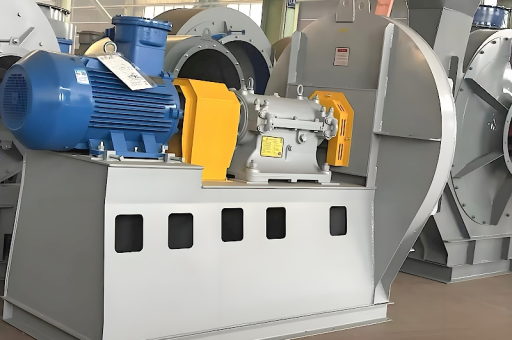
- What is it?
- Key Components & Working Principle
- Performance Characteristics
- Common Types (by Impeller Design)
- Advantages
- Disadvantages
- Primary Applications
- Selection & Design Considerations
- Summary Table
- Conclusion
Here is a comprehensive overview of the Single Inlet High Pressure Centrifugal Fan, covering its design, applications, advantages, and key selection criteria.
What is it?
A Single Inlet High Pressure Centrifugal Fan is a type of industrial fan designed to generate high static pressure (typically above 20-30 inches of water gauge (in. w.g.) or 5-7.5 kPa) at moderate to high flow rates. "Single Inlet" means the air enters the fan wheel from only one side (the inlet side of the fan housing), as opposed to a double inlet fan which draws air from both sides.
These fans are critical in applications where air must be forced through restrictive systems like long ductwork, dense filters, or material conveying lines.
Key Components & Working Principle
- Impeller (Wheel): The heart of the fan. For high pressure, the impeller is typically backward-curved (airfoil or flat blades) or radial (paddlewheel). Backward-curved blades are more efficient and quieter, while radial blades are more robust for handling dust and particulates.
- Housing (Volute): A spiral-shaped casing that collects the air from the impeller and converts its velocity energy into pressure energy.
- Inlet Cone (Venturi): A precisely shaped cone at the inlet that smoothly guides air into the eye of the impeller, minimizing turbulence and losses.
- Shaft & Bearings: Heavy-duty shafts and bearings (often grease-lubricated or oil-lubricated pillow blocks) are required to handle the high radial loads generated by high pressure.
- Drive System: Typically belt-driven (allows for speed changes to adjust performance) or direct-driven (for higher efficiency and reliability at fixed speeds). High-pressure fans require robust motors and drive components.
Workflow: Air is drawn axially into the fan through the single inlet. The rotating impeller accelerates the air radially outward. The volute housing collects this high-velocity air and, through its increasing cross-sectional area, slows it down, converting the high velocity into high static pressure.
Performance Characteristics
- Pressure: High static pressure (system resistance) capability. The pressure generated is directly related to the impeller tip speed (diameter × RPM).
- Flow: Moderate to high airflow, but generally lower than a similar-sized double-inlet fan due to the single intake path.
- Efficiency: Backward-curved airfoil designs can be very efficient (75-85+%). Radial designs are less efficient (60-70%) but more durable.
- Power: Requires significant horsepower due to the high pressure and flow.
Common Types (by Impeller Design)
| Impeller Type | Blade Shape | Typical Pressure Range | Efficiency | Key Characteristic | Common Use |
|---|---|---|---|---|---|
| Backward-Curved (FEG/AF) | Airfoil or flat plate | High (up to 30-40" w.g.) | High (75-85%) | Most efficient, quieter, non-overloading power curve | HVAC, process air, clean air systems |
| Radial (Paddlewheel) | Straight radial | Very High (40+ " w.g.) | Low (55-65%) | Extremely rugged, self-cleaning, handles particulates | Material handling, pneumatic conveying, dust collection |
| Forward-Curved | Numerous shallow cups | Medium-High | Lower (55-70%) | Compact, lower speed, smaller footprint (rare for true HP) | Residential/commercial HVAC (low pressure) |
Note: For true high pressure industrial applications, Backward-Curved Airfoil and Radial fans dominate.
Advantages
- High Pressure Capability: Can overcome significant system resistance.
- Compact Footprint: A single inlet fan is narrower than a double inlet fan for a given wheel diameter.
- Simpler Duct Connection: Single duct connection on one side simplifies layout in some systems.
- Efficient (Backward-Curved): Lower operating costs and energy consumption compared to radial fans for clean air.
- Durable (Radial): Ideal for dirty, abrasive, or high-temperature gas streams.
Disadvantages
- Potential for Imbalance: The single-sided inlet creates an asymmetric pressure profile on the impeller, which can cause higher axial thrust loads on bearings unless balanced properly.
- Higher Noise: Generally, any high-pressure fan is louder than a low-pressure fan due to higher tip speeds.
- Limited Flow: For the same wheel diameter, a single inlet fan cannot move as much air as a double inlet fan (which draws air from both sides).
- Cost: High-quality, high-pressure fans are more expensive than standard fans due to robust construction and precision balancing.
Primary Applications
- Pneumatic Conveying: Moving materials (cement, grain, plastic pellets, sawdust) through pipes.
- Industrial Dust Collection: High-pressure systems needed to pull dust from hoods and through long, small-diameter ductwork.
- Process Air Blowers: For combustion air, drying, cooling, or gas boosting in industrial furnaces, boilers, and ovens.
- Ventilation of Long Ducts: In tunnels, mines, or large warehouses where air must be pushed hundreds of feet.
- Clean Air Systems: Where high pressure is needed for specialized HVAC or filtration.
- Aeration (Wastewater): For diffused aeration systems in lagoons or tanks.
Selection & Design Considerations
- System Resistance (Static Pressure): Accurately calculate the total pressure drop the fan must overcome (ductwork, filters, elbows, conveying lines).
- Airflow (CFM or m³/hr): Determine the required volume of air.
- Air Temperature & Composition: High temperatures require special shaft seals, bearings, and metallurgy. Dust or corrosive gases require erosion-resistant coatings or materials.
- Efficiency & Energy Cost: A high-efficiency backward-curved fan (FEG/AF) is worth the investment if the air is clean and running 24/7.
- Size & Space: Single inlet fans save width compared to double inlet.
- Drive Type: Belt drive allows flexibility; direct drive is more reliable but fixed.
- Balance & Vibration: High-pressure fans must be dynamically balanced to a precision grade (e.g., G2.5 or G6.3) to avoid premature bearing failure.
- Construction Material: Carbon steel (standard), stainless steel (corrosion/clean applications), aluminum (lightweight/spark-resistant), or specialty alloys (high temp).
Summary Table
| Feature | Single Inlet HP Fan |
|---|---|
| Inlet | One side |
| Primary Purpose | High static pressure / overcoming system resistance |
| Typical Impeller | Backward-curved (efficient) or Radial (rugged) |
| Flow Rate | Moderate to High |
| Pressure Range | High (20-50+ in. w.g. typical) |
| Key Advantage | High pressure + simpler single duct connection |
| Key Disadvantage | Higher radial load on bearings than double inlet |
Conclusion
A Single Inlet High Pressure Centrifugal Fan is the workhorse of industrial processes that require forced air through restrictive paths. Its design is a compromise: it offers high pressure in a more space-efficient single-sided configuration, but it places higher loads on its bearings and is limited by a single intake. Choosing between a backward-curved (for efficiency and noise) or radial (for durability with dirty air) depends entirely on the specific application's requirements.
Would you like a deeper dive into how to calculate system resistance or compare specific fan curves?





