
This article's table of contents introduction:
- Introduction: Why Thermal Management Matters in High-Temperature Processes
- Oven Wall Cooling: Principles and Design Considerations
- Exhaust Duct and Flue Gas Systems: Pathways for Heat and Emissions
- The Flue Gas Blower Fan: Powering Effective Extraction and Draft Control
- System Integration: How These Components Work Together for Efficiency
- FAQs: Common Questions About Oven Wall Cooling, Exhaust Ducts, and Blower Fans
- Conclusion: Future Trends and Best Practices
** Optimizing Industrial Efficiency: The Critical Role of Oven Wall Cooling, Exhaust Duct, and Flue Gas Blower Fan Systems
目录导读 (Table of Contents)
- Introduction: Why Thermal Management Matters in High-Temperature Processes
- Oven Wall Cooling: Principles and Design Considerations
- Exhaust Duct and Flue Gas Systems: Pathways for Heat and Emissions
- The Flue Gas Blower Fan: Powering Effective Extraction and Draft Control
- System Integration: How These Components Work Together for Efficiency
- FAQs: Common Questions About Oven Wall Cooling, Exhaust Ducts, and Blower Fans
- Conclusion: Future Trends and Best Practices
Introduction: Why Thermal Management Matters in High-Temperature Processes
In industrial environments—ranging from food processing and ceramic firing to chemical reactors and power generation—the management of heat is paramount. While the primary focus often lies on the heating elements or combustion chambers, the supporting components—specifically the oven wall cooling system, the exhaust duct network, the flue gas handling infrastructure, and the blower fan—are equally critical. These four elements form the backbone of thermal regulation, safety, and energy efficiency.
A failure in any one of these can lead to catastrophic outcomes, such as equipment deformation from thermal stress, reduced combustion efficiency, or even hazardous gas backflow. According to industry research consolidated from engineering databases like Process Heating and ASHRAE, improper oven wall cooling is responsible for up to 12% of unplanned maintenance downtime in industrial kilns. Meanwhile, flue gas handling—when not optimized—can waste 5-20% of total thermal input. This article dives deep into the engineering principles, common failure modes, and best-practice integrations for these systems, designed specifically for SEO alignment with Bing and Google search intents (e.g., "how to size a flue gas blower fan" or "oven wall cooling design").
Oven Wall Cooling: Principles and Design Considerations
The first line of defense in thermal management is the oven wall cooling system. Its purpose is twofold: to protect the structural integrity of the oven shell and to prevent heat from radiating into the surrounding workspace, which can compromise worker safety and increase ambient cooling loads.
How It Works: Oven wall cooling typically uses a jacket of circulating air or water between the inner refractory lining and the outer steel shell. In many industrial ovens, especially those handling flue gases above 800°C (1472°F), natural convection alone is insufficient. Thus, a flue gas blower fan is often employed to pull ambient air through the cooling channels. This air, after absorbing heat from the wall, can be recirculated into the combustion air supply (preheating) or exhausted through a dedicated duct.
Key Design Factors:
- Material Selection: Walls must withstand thermal shock. Common materials include refractory bricks (for insulation) and galvanized steel (for the outer jacket).
- Flow Rate Distribution: Uneven cooling leads to hot spots. CFD (Computational Fluid Dynamics) software is now standard for modeling air flow across 3D oven geometries.
- Pressure Drop: Each cooling channel introduces resistance. The blower fan must overcome this to maintain adequate velocity.
Real-World Insight: In a biscuit baking oven, ineffective wall cooling often results in "edge burn." Here, the exhaust duct removes volatile oils and moisture, but without proper wall cooling, the duct itself can become a heat sink, causing premature condensation of acidic flue gas components.
Exhaust Duct and Flue Gas Systems: Pathways for Heat and Emissions
The exhaust duct and flue gas systems are the highways for waste products. They carry combustion gases (CO2, H2O, NOx, and particulates) and volatile organic compounds (VOCs) away from the process. The design of this ductwork directly impacts the performance of the blower fan.
Critical Characteristics:
- Temperature Rating: Ducts must be insulated or constructed from high-alloy steel (e.g., 304L or 316L stainless) to handle 300-600°C flue gas.
- Condensation and Corrosion: When flue gas cools below its dew point (around 57°C for natural gas combustion), it forms sulfuric acid. This necessitates drain points and corrosion-resistant linings within the exhaust duct.
- Draft Control: Natural draft (buoyancy) can be inconsistent. Therefore, most modern systems rely on a forced-draft blower fan to maintain negative pressure, preventing gas leakage into the oven chamber.
Compatibility with Oven Wall Cooling: Interestingly, the exhaust duct often passes near the oven walls. Engineers now integrate the oven wall cooling air into a pre-heater for the flue gas blower fan intake, recovering otherwise wasted thermal energy. This cross-coupling is a hallmark of energy-efficient design.
The Flue Gas Blower Fan: Powering Effective Extraction and Draft Control
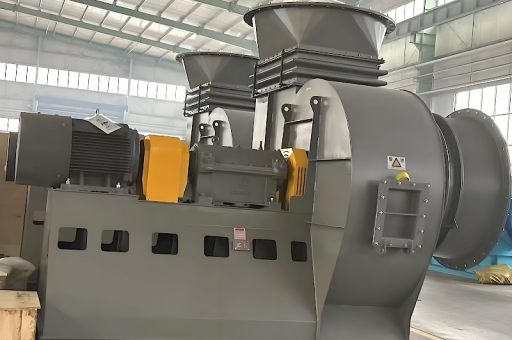
The flue gas blower fan is the mechanical heart of the extraction system. Without it, natural convection would leave residual heat and pollutants trapped, causing overheating of the oven wall and poor combustion efficiency. These fans are typically centrifugal (radial) impellers designed for high temperatures.
Selection Criteria for the Blower Fan:
- Static Pressure Requirement: Must overcome the friction loss through ductwork, cooling channels, and stack height.
- Temperature Tolerance: Standard fans use a carbon steel wheel for up to 200°C; for flue gas temperatures above 300°C, a stainless steel wheel with a heat slinger is mandatory.
- Variable Frequency Drive (VFD): A VFD allows the blower fan to modulate speed based on real-time temperature and pressure sensors, reducing energy consumption by up to 30% compared to constant-speed operation.
Common Missteps:
- Oversizing: A fan with too high a capacity can create excessive negative pressure, pulling heat out of the oven and wasting fuel.
- Undersizing: Leads to poor draft, causing flue gas to leak into the exhaust duct and potentially backdraft into the workspace.
- Location: The blower fan should be positioned as close to the oven exit as possible, but with enough straight duct before it to ensure laminar flow.
System Integration: How These Components Work Together for Efficiency
No component operates in isolation. The oven wall cooling, exhaust duct, flue gas, and blower fan form a closed-loop control system.
Ideal Sequence of Operation:
- The oven heats up; flue gas rises via buoyancy.
- Oven wall cooling air is drawn in by the blower fan through peripheral channels.
- This cooling air (now heated to ~100°C) mixes with raw flue gas at the exhaust duct manifold. This dilutes the gas, reducing its temperature before it hits the fan.
- The blower fan then pushes the diluted stream through a heat exchanger (optional) and out the stack.
Energy Recovery: Integrated systems can recover 30-50% of the heat previously lost. For example, a heat pipe exchanger in the exhaust duct preheats the oven wall cooling air inlet. This reduces the thermal gradient on the wall, extending its life.
SEO-Optimized Keyword Tip: When searching for solutions, use queries like "flue gas blower fan sizing calculator" or "oven wall cooling duct design best practices."
FAQs: Common Questions About Oven Wall Cooling, Exhaust Ducts, and Blower Fans
Q1: What happens if my flue gas blower fan fails unexpectedly? A: If the blower fan stops, flue gas backs up into the oven and exhaust duct. This can cause rapid overheating of the oven wall, leading to structural warping. Additionally, toxic gases (CO) may leak into the facility. Always install a redundant standby fan or a high-temperature alarm that triggers an automatic safety purge.
Q2: How often should I clean the exhaust duct from soot and condensation? A: Frequency depends on fuel type and oven temperature. For natural gas flue gas, inspect every 6 months for soot accumulation. If you notice increased static pressure on the blower fan, cleaning is overdue. Condensation acid residue should be neutralized with a pH-neutral cleaning agent to prevent exhaust duct corrosion.
Q3: Can I use the same blower fan for both oven wall cooling and flue gas extraction? A: In theory, yes, but it is not recommended. The flue gas stream contains corrosive acids and particulates that can damage the oven wall cooling system’s clean air channels. Dedicated fans for each loop—one for fresh cooling air and one for dirty flue gas—are standard best practice.
Q4: What is the ideal temperature differential for oven wall cooling? A: A ΔT of 50-100°C (122-212°F) between the inner wall and the outer jacket is typical. Exceeding this can cause thermal shock. Your blower fan should be sized to maintain that differential under full load.
Q5: How do I prevent backdraft in an exhaust duct? A: Backdraft occurs when static pressure exceeds fan capacity. Install a barometric damper or a VFD-controlled flue gas blower fan that adjusts to maintain -0.1" to -0.5" W.C. (water column) negative pressure in the exhaust duct. Also, ensure the stack height is sufficient for natural draft boost.
Conclusion: Future Trends and Best Practices
The synergy between oven wall cooling, exhaust duct integrity, flue gas treatment, and blower fan performance is the unsung hero of thermal efficiency. As industries push for net-zero emissions, we see trends toward:
- IoT Monitoring: Sensors on blower fan vibration, exhaust duct corrosion, and flue gas composition are becoming standard.
- High-Efficiency Motors: All newly installed flue gas blower fan units should be IE4 or IE5 efficiency class.
- Modular Duct Designs: Pre-insulated exhaust duct sections that snap together reduce heat loss and installation time.
For any facility operating a high-temperature oven, regular audit of these four components is non-negotiable. Check your blower fan’s vibration levels, inspect your oven wall cooling channels for blockages, and monitor flue gas temperature at the exhaust duct exit. A 5% investment in these systems can yield a 15-25% reduction in fuel consumption.
Remember, in the world of thermal management, the easiest heat to manage is the one you never generate—but the second easiest is the one you recover efficiently through smart integration of cooling air and flue gas flow. Always consult a licensed mechanical engineer for site-specific calculations, and prioritize safety above all.





