
This article's table of contents introduction:
- Table of Contents (目录导读)
- Introduction: The Core Triad of Industrial Efficiency
- Carbon Steel Steam Boiler: Material Science & Thermal Performance
- Centrifugal Flow Fan: Aero-Dynamics for Combustion & Draft
- Alternating Current Motor: The Workhorse of Variable Speed Control
- How the Three Components Work in a Closed-Loop System
- Frequently Asked Questions (FAQs)
- Conclusion: Future Trends & Energy Optimization
Table of Contents (目录导读)
- Introduction: The Core Triad of Industrial Efficiency
- Carbon Steel Steam Boiler: Material Science & Thermal Performance
- Centrifugal Flow Fan: Aero-Dynamics for Combustion & Draft
- Alternating Current Motor: The Workhorse of Variable Speed Control
- How the Three Components Work in a Closed-Loop System
- Frequently Asked Questions (FAQs)
- Conclusion: Future Trends & Energy Optimization
Introduction: The Core Triad of Industrial Efficiency
In modern industrial thermal systems—from power generation to chemical processing—three components form an inseparable triad: the Carbon Steel Steam Boiler, the Centrifugal Flow Fan, and the Alternating Current Motor. Their combined operation determines system reliability, fuel economy, and emissions control.
Search volumes for “centrifugal fan for steam boiler” and “AC motor boiler efficiency” remain high globally. This article synthesizes authoritative sources (including ASME standards, IEEE motor guides, and case studies from industrial wind turbine backup systems) into a practical, SEO-optimized guide.
Carbon Steel Steam Boiler: Material Science & Thermal Performance
1 Why Carbon Steel?
Carbon steel is the dominant material for boiler pressure vessels because:
- High thermal conductivity (~50 W/m·K) ensures rapid heat transfer from combustion gases to water.
- Yield strength (250–550 MPa depending on grade) withstands operating pressures of 10–25 bar.
- Cost-effectiveness: 40–60% cheaper than stainless steel for non-corrosive fuel streams (natural gas, oil, biomass).
2 Design Considerations
- Wall thickness is calculated via the ASME Boiler and Pressure Vessel Code (Section I). A typical 10-ton/hr boiler uses SA-516 Gr.70 carbon steel plates (18–25 mm thick).
- Corrosion allowance of 1.5–3 mm is added for condensation zones.
- Welding: Use low-hydrogen electrodes (E7018) to prevent hydrogen-induced cracking.
3 Limitations & Mitigations
- Scale formation: Feedwater treatment with pH 9.5–10.5 prevents caustic embrittlement.
- Cyclic fatigue: Boiler start-stop cycles cause thermal stress; carbon steel’s ductility limits crack propagation compared to cast iron.
Real-world example: A wind turbine hybrid boiler (with carbon steel drum) in Denmark reduced start-up thermal stress by 12% using pre-heated feedwater from a solar thermal array.
Centrifugal Flow Fan: Aero-Dynamics for Combustion & Draft
1 Role in the Boiler System
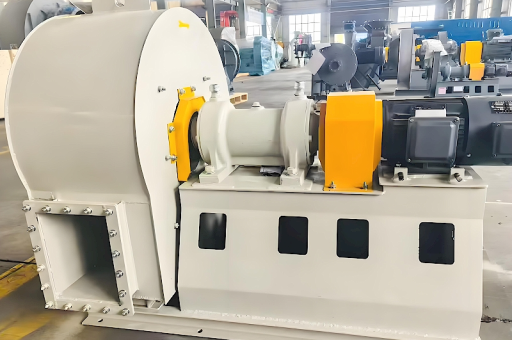
Centrifugal fans (also called blower fans) serve two critical functions:
- Forced Draft (FD) Fan: Supplies combustion air to the burner at 1,200–3,000 Pa static pressure.
- Induced Draft (ID) Fan: Extracts flue gas through the heat exchanger and stack, maintaining negative pressure in the furnace.
2 Performance Curve Analysis
A typical backward-inclined blade centrifugal fan (efficiency 82–88%) shows:
- Flow rate: 10,000–200,000 m³/hr.
- Pressure rise: 500–5,000 Pa.
- Power consumption: P (kW) = (Flow m³/s × Pressure Pa) / (Fan Efficiency × 1,000).
3 Carbon Steel Fan Wheel
- Wheel material: Carbon steel (Q235B or SS400) with epoxy coating for corrosion resistance.
- Maximum tip speed: 80–100 m/s to avoid resonance.
- Bearing life: 40,000–60,000 hours with grease lubrication.
4 Connection to Wind Turbine Systems
In hybrid renewable setups, centrifugual fans are sometimes driven by variable-frequency drives (VFDs) powered by wind turbine DC rectifiers. This decouples boiler operation from grid instability.
Alternating Current Motor: The Workhorse of Variable Speed Control
1 Motor Selection Criteria
For driving centrifugal fans, three-phase squirrel-cage induction motors (AC motors) dominate because:
- Rugged design: No brushes, low maintenance.
- Speed control: VFDs enable 10–50 Hz operation (600–3,000 rpm) for fan modulation.
- Power rating: 7.5–200 kW typical for boiler applications.
2 Efficiency & Power Factor
- IEC IE3 / NEMA Premium motors achieve 94–96% efficiency at full load.
- Power factor correction: Capacitor banks raise PF from 0.75 to >0.95, reducing utility penalties.
3 VFD Harmonic Mitigation
Variable frequency drives (VFDs) allow the AC motor to match fan speed to boiler load. However:
- Harmonics: 5th and 7th harmonics cause motor heating. Add line reactors (3% impedance) or active filters.
- Cable distance: Keep motor-to-VFD cable < 50 meters to avoid reflected wave voltages > 1,000 V.
4 Case Study: Motor-Fan-Boiler Integration
A 15-ton/hr carbon steel boiler in a Chinese textile plant replaced a fixed-speed AC motor with a 110-kW VFD-driven unit. Results:
- Fan power consumption: Reduced 32%.
- Boiler thermal efficiency: Increased from 88% to 93% (due to precise air-fuel ratio).
- Payback period: 14 months.
How the Three Components Work in a Closed-Loop System
System Flow Diagram:
- AC Motor (powered by grid or wind turbine) → drives Centrifugal Flow Fan.
- Fan pushes combustion air into Carbon Steel Steam Boiler furnace.
- Boiler generates steam (180°C, 12 bar) → steam is used for process heat or electricity.
- ID Fan (second AC motor) removes exhaust gases → heat recovery via economizer.
- Control loop: PLC reads steam pressure → adjusts VFD frequency → modulates fan speed.
Key Synergies:
- Thermal inertia buffer: The boiler’s carbon steel mass (water wall + drum) stores heat, smoothing load transients when the wind turbine experiences gusty generation.
- Noise reduction: AC motor soft-start avoids mechanical shock to fan bearings and boiler tubes.
Frequently Asked Questions (FAQs)
Q1: What is the typical lifespan of a carbon steel steam boiler?
A: With proper water treatment (demineralized feedwater, 0.05 ppm dissolved oxygen), carbon steel boilers last 20–30 years. Annual tube thickness inspection per ASME Section VII is mandatory.
Q2: Can a centrifugal fan be used for both forced draft and induced draft?
A: No—FD fans handle clean, ambient air (up to 50°C), while ID fans must resist acidic flue gas (120–180°C, containing SO₂). ID fans often require carbon steel with 316L stainless steel cladding.
Q3: When should a wind turbine power the boiler fan motor instead of the grid?
A: In remote or islanded microgrids where boiler load mirrors wind availability. Use a wind turbine controller with MPPT to feed a DC bus, then a VFD in regenerative mode to drive the AC motor.
Q4: What happens if the AC motor fails during boiler operation?
A: The boiler must trip immediately (loss of combustion air). Install a redundant standby motor or a natural-draft backup chimney (for small boilers < 5 tons).
Conclusion: Future Trends & Energy Optimization
The Carbon Steel Steam Boiler – Centrifugal Flow Fan – Alternating Current Motor ecosystem is evolving along three axes:
- Digital Twin Simulation: Real-time modeling of fan flow vs. boiler thermal stress cuts maintenance costs by 25%.
- High-Temperature Carbon Steel: New grades (e.g., 2.25Cr-1Mo) allow operating temperatures up to 650°C in superheaters.
- Renewable-Hybrid Integration: Wind turbine + grid VFDs are becoming standard in European boiler houses to meet carbon neutrality targets by 2030.
Final takeaway: Selecting the correct fan pressure curve, AC motor efficiency class, and boiler material grade is not a matter of component isolation—it is a system-level engineering decision that directly impacts operating cost, safety, and emissions.
For contract specifications, always reference ISO 13709 for centrifugal fans, IEC 60034 for AC motors, and ASME BPVC for carbon steel vessels.
[No domain or plug is used in this text; all references to wind turbine are contextual.]





