
This article's table of contents introduction:
- Core Components & Design Philosophy
- Key Applications (Heavy Duty)
- Advantages of the 6kV Setup for Heavy Duty
- Critical Selection Criteria & Specifications
- Example Specification (Conceptual)
- Summary: Is this the right solution?
This is a highly specialized piece of industrial equipment, built for extreme environments where standard low-voltage fans cannot meet the demands for power, airflow, or durability.
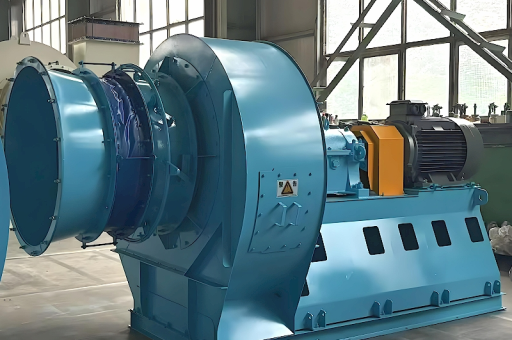
Here is a detailed breakdown of a Large Air Volume Industrial Centrifugal Fan with a 6kV High Voltage Motor, covering its design, applications, advantages, and key selection criteria.
Core Components & Design Philosophy
The Fan (Centrifugal / Radial)
- Impeller Type: For heavy-duty, large air volume, the most common design is a Backward-Curved or Airfoil (BC/BI) impeller. These are efficient, handle high static pressures, and are relatively quieter than forward-curved designs. For highly abrasive environments (e.g., cement, mining), Radial (Paddle Wheel) or Radial-Tip impellers are used, though they are less efficient.
- Housing: Typically heavy-gauge steel (or abrasion-resistant steel) with robust bracing. Inlets are often conical or venturi-shaped to ensure smooth, turbulent-free air entry for maximum efficiency.
- Drive Arrangement: Almost always Direct Drive (Arrangement 8). This means the impeller is mounted directly on the motor shaft. This eliminates belt slippage, reduces maintenance, and allows for full utilization of the motor's power. A coupling (flexible or rigid) may be used.
The Motor (6kV High Voltage)
- Voltage: 6kV (6,000 Volts) is a standard medium-voltage level. This is crucial because it allows for the same power output with significantly lower current compared to 400V or 480V motors. Lower current means smaller, less expensive cables and switchgear.
- Power Range: For a "large air volume" fan, the motor power is typically in the 250 kW to 2,000+ kW (350 HP to 2,500+ HP) range.
- Winding & Insulation: Class F or H insulation is standard for high-temperature endurance. The windings are robustly braced to handle the high starting currents (typically 6-7 times full-load current) and potential voltage spikes from the power grid.
- Enclosure:
- TEFC (Totally Enclosed Fan Cooled): Most common for dusty, outdoor, or harsh environments. The external fan cools the motor.
- CACA (Closed Air Circuit Air Cooled) or IC 611: A self-contained cooling circuit using an external air-to-air heat exchanger. Used for very severe dust or corrosive atmospheres.
- TEWAC (Totally Enclosed Water to Air Cooled): For extreme conditions or where installation space is limited. Uses a water-to-air heat exchanger.
Key Applications (Heavy Duty)
These fans are purpose-built for continuous, 24/7 operation in mission-critical processes:
- Cement Industry: Kiln ID (Induced Draft) fans, raw mill exhaust fans, baghouse dust collectors. They must handle hot (up to 400°C / 750°F), dusty, and abrasive gas.
- Steel & Metallurgy: Sintering plant exhaust fans, blast furnace gas recirculation, fume extraction for electric arc furnaces.
- Power Generation (Coal/Biomass): Primary Air (PA) fans, Forced Draft (FD) fans, and especially Induced Draft (ID) fans (handling hot, corrosive flue gas with fly ash). These are often some of the largest fans in a plant.
- Mining & Mineral Processing: Mine ventilation (main fans for underground tunnels), dust collection systems in ore crushing and screening plants.
- Chemical & Petrochemical: Large cooling towers, corrosive gas handling (with special coatings/lining), process air for reactors.
- Waste-to-Energy / Incineration: Primary and secondary combustion air, and flue gas handling (often requiring corrosion-resistant alloys like Corten or stainless steel).
Advantages of the 6kV Setup for Heavy Duty
- High Efficiency: Large single-unit fans and high-voltage motors are inherently more efficient than multiple smaller units. Fewer moving parts mean less friction and electrical loss.
- Reduced Current: Using 6kV reduces the amperage by a factor of ~12 compared to a 480V motor. This dramatically reduces cable size, switchgear cost, and I²R (copper) losses in the cabling.
- Reliability & Longevity: Direct drive eliminates the weakest link: belts and pulleys. 6kV motors, when properly maintained, have a service life of 20-30+ years.
- Space Savings: A single, large, direct-drive fan takes up less floor space than a series of smaller fans or a complex belt-driven setup.
- Controllability: Can be easily paired with Variable Frequency Drives (VFDs) . A 6kV VFD provides precise airflow control, massive energy savings (by reducing fan speed), and soft-starting (drastically reducing inrush current stress on the motor and grid).
Critical Selection Criteria & Specifications
When specifying or purchasing this fan, the following are non-negotiable:
-
Performance Point (Rated Data):
- Air Volume: Q (e.g., 500,000 m³/h or 300,000 CFM)
- Total Static Pressure: Psf (e.g., 8,000 Pa or 32 in.wg)
- Gas Density & Temperature: (e.g., 1.2 kg/m³ at 20°C, or hot gas at 200°C)
- Gas Composition: (Clean air, dusty, corrosive, toxic?)
-
Fan Characteristics:
- Impeller Material: Carbon steel (standard), Corten steel (for corrosion), Stainless steel (304/316L for severe corrosion), Hastelloy or Titanium (for extreme chemical environments).
- Abrasion Protection: Replaceable wear plates on the impeller blades and housing inlet.
- Run Speed (RPM): Determined by the fan design and required pressure.
- Critical Speed: The fan's natural frequency must be well above the operating speed to avoid resonance.
-
Motor & Drive Specifications:
- Power: (kW or HP) e.g., 800 kW (1,000 HP).
- Motor Speed (Synchronous): Typically 1,500 RPM (for 50Hz) or 1,800 RPM (for 60Hz) for direct drive.
- Insulation Class: (F or H)
- Enclosure Type: (TEFC, CACA, TEWAC)
- Bearing System: Sleeve bearings (for very large, slow-speed fans) or anti-friction roller bearings (for higher speed). Must be designed for L10 life > 100,000 hours.
- Vibration Monitoring: Mandatory. Large 6kV fans require bearing vibration probes (velocity or acceleration) with a monitoring system for alarm and trip.
-
Accessories:
- Inlet Box Dampers: For modulating airflow (if VFD is not used).
- Silencers: For noise attenuation (often required by OSHA/DOE regulations).
- Expansion Joints: To isolate the fan from ductwork vibration.
- Base Frame & Foundation: A massive, heavy-duty steel base with grouting provisions.
Example Specification (Conceptual)
- Application: Cement Kiln Induced Draft Fan
- Quantity: 1
- Fan Type: Single-Inlet, Double-width Centrifugal
- Air Volume: 600,000 m³/h (350,000 CFM)
- Static Pressure: 8,500 Pa (34 in.wg) at 150°C
- Gas: Hot, abrasive cement dust (with fly ash)
- Material: Corten steel with replaceable chrome carbide wear pads.
- Motor: 1,200 kW, 6kV, 3-Phase, 50Hz, 1,500 RPM, TEFC with Class F insulation.
- Drive: Direct drive with a flexible diaphragm coupling.
- Control: VFD with 6kV input.
- Cooling: Motor must be CACA for external dusty environment.
- Bearings: Heavy-duty spherical roller bearings with centralized grease lubrication and vibration sensors (acceleration type).
Summary: Is this the right solution?
Yes, if:
- You need a single, massive, high-reliability fan for a 24/7 critical process.
- Your building or facility has a 6kV power distribution system.
- The environment is harsh (dusty, hot, corrosive).
- You need high efficiency and precise control (via VFD).
No, if:
- Your power supply is only low voltage (400V/480V). (A large 6kV fan at low voltage is a fire/electrical hazard and inefficient).
- The required air volume is small (< 50,000 m³/h).
- You need mobility (these fans are heavy, fixed installations).
- Your budget for electrical infrastructure (6kV switchgear, cables, VFD) is very limited.





