
This article's table of contents introduction:
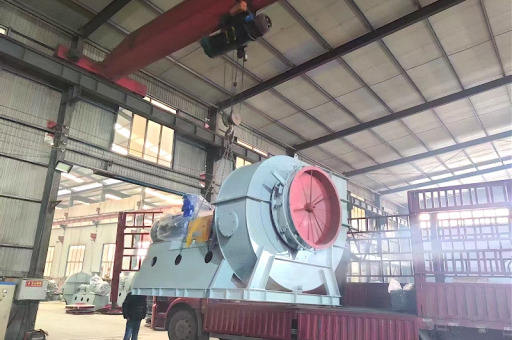
- What is it?
- Key Specifications (Typical for a 55kW Unit)
- Common Applications (Where you'd find this fan)
- Design Features for Dust Handling
- Selection & Sizing (How to Choose)
- Important Operational Considerations
- Cost & Availability
- Summary for Procurement
Here is a detailed breakdown of a 55 kW Dust Removal Centrifugal Induced Draft Fan, covering its specifications, applications, selection criteria, and key considerations.
What is it?
This is a high-power industrial fan designed to create negative pressure (suction) to pull dust-laden air through a dust collection system (e.g., baghouse, cyclone, cartridge filter). The 55 kW (approx. 74 HP) motor indicates a significant airflow capacity suitable for large-scale operations.
- "Centrifugal" : The fan uses a rotating impeller to accelerate air radially outward, increasing pressure.
- "Induced Draft" : The fan is located after the dust collector (on the "clean side"), pulling air through the system. This protects the fan from the heaviest dust and wear.
- "Dust Removal" : The fan is specifically designed or selected to handle particulate-laden air, often with wear-resistant features and a non-sparking design (depending on dust type).
Key Specifications (Typical for a 55kW Unit)
These are approximate values. A specific fan selection depends on the required Pressure (Static Pressure) and Flow (CFM or m³/h).
| Parameter | Typical Value | Notes |
|---|---|---|
| Motor Power | 55 kW (73.8 HP) | Standard IEC or NEMA frame motor. |
| Voltage | 380-480V (3-Phase) | Common industrial voltage. Can be 690V or 6.6kV. |
| Airflow (Flow Rate) | 50,000 - 80,000 m³/h | (~29,500 - 47,000 CFM). Varies with pressure. |
| Static Pressure | 2000 - 4000 Pa | (~8 - 16 inches w.g.). Higher pressure for larger systems. |
| Impeller Diameter | 1200 - 1800 mm | (~47 - 71 inches). |
| Speed | 800 - 1480 RPM | Lower speed for high dust load, higher for pressure. Often belt-driven. |
| Material | Mild Steel / Corten / SS304 | Coating or stainless steel for corrosive or explosive dusts. |
Common Applications (Where you'd find this fan)
- Cement Plants: Kiln baghouse, raw mill, finish mill, and crusher dedusting.
- Steel Mills: Sinter plant, blast furnace gas cleaning, electric arc furnace (EAF) fume extraction.
- Power Plants: Coal handling, biomass, ESP (Electrostatic Precipitator) induced draft (ID) fans.
- Wood Processing: MDF (Medium Density Fiberboard), particleboard, large sawmill extraction systems.
- Chemical & Pharmaceutical: Product conveying and dust collection for toxic or valuable powders.
- Mining & Quarrying: Primary crushers, screens, conveyors, and transfer points.
Design Features for Dust Handling
A standard fan will fail quickly in dusty environments. A 55kW dust removal fan must have:
-
Wear-Resistant Impeller:
- Backward-Curved Blades: Most common for high efficiency and lower dust accumulation.
- Replaceable Liners: Wear plates on the impeller blades and housing (especially the volute tongue).
- Hardfacing: Welding of tungsten carbide or stellite on high-wear areas.
- Thicker Material: e.g., 10-12mm steel instead of 6mm.
-
Non-Sparking Construction:
- Impeller: Aluminum or bronze (copper alloy).
- Housing: Lined with rubber or non-ferrous material.
- Shaft seal: to prevent dust ingress.
- Grounding: Essential to dissipate static charge.
-
Shaft & Bearing Protection:
- Shaft Seal: Labyrinth seal, carbon ring, or air purge to prevent dust from reaching bearings.
- Bearings: Heavy-duty spherical roller bearings in a split housing (easy maintenance).
- Temperature Monitoring: Bearing temperature sensors (PT100) to prevent overheating.
-
Variable Speed Drive (VFD) Ready:
- 55kW is a large motor, so a VFD is strongly recommended to control airflow precisely and save energy.
- VFDs also reduce inrush current (soft start).
-
Access Door / Inspection Port:
Large access doors for cleaning, inspection of impeller wear, and balancing.
Selection & Sizing (How to Choose)
You cannot buy a "55kW dust removal fan" without knowing the system. You select the fan to match the system curve.
Step 1: Determine System Parameters
- Required Airflow (m³/h or CFM): How much air needs to be moved (based on dust source capture hoods and ducting).
- Required Static Pressure (Pa or inches w.g.): The resistance of the entire system (ductwork, dust collector, dampers, inlet/outlet losses).
Step 2: Use Fan Curves
- The fan manufacturer provides a fan curve (Pressure vs. Flow).
- Find a fan model where its curve intersects your required airflow and pressure.
- The Efficiency at that point should be >80% for a 55kW fan.
Step 3: Calculate Motor Power
- Power (kW) = (Airflow (m³/s) × Pressure (Pa)) / (Fan Efficiency × Drive Efficiency × 1000)
- Example: If your fan needs to deliver 55,000 m³/h (15.28 m³/s) at 3000 Pa (12 in w.g.) with 85% fan efficiency and 95% belt drive efficiency:
- Power = (15.28 × 3000) / (0.85 × 0.95 × 1000) = ~57 kW
- You would select a 55kW motor as the closest standard size (but you might need 75kW if it's a borderline application or for safety factor).
Common Mistake: Buying a "55kW fan" that is designed for 2000 Pa but your system requires 4000 Pa. The motor will overload and burn out.
Important Operational Considerations
-
Balancing: Due to dust accumulation, the impeller can become unbalanced over time. Regularly check vibration levels (ISO 10816-3 for bracket-mounted fans, limit ~7.1 mm/s RMS for industrial fans). An out-of-balance fan can destroy bearings and the housing.
-
Speed Control:
- Belt Drive: Allows changing the fan speed easily by changing pulleys (most common for fixed-speed systems).
- Direct Drive (VFD): More efficient, but requires a VFD to vary speed.
-
Lubrication:
Grease or oil lubrication, depending on bearing type. Follow manufacturer's schedule (e.g., every 500-2000 hours).
-
Dampers:
- Inlet box damper: To control airflow (less efficient than VFD but cheaper).
- Outlet damper: For isolation during maintenance.
-
Standards & Certifications:
- ATEX / IECEx: Required for explosive dusts (e.g., wood, metals, food, coal).
- ISO 5801: Fan performance testing standard.
- AMCA 210: Air Movement and Control Association standard.
Cost & Availability
- Approximate Price Range (Fan + Motor + Base): $15,000 - $35,000 USD (depending on material, ATEX rating, and extras like dampers, silencers, VFD).
- Typical Lead Time: 4-8 weeks (custom-engineered).
- Major Manufacturers:
- Howden / TLT-Babcock (heavy industrial)
- Greenheck (general industrial)
- AirPro Fan & Blower (custom)
- New York Blower (general)
- Cincinnati Fan (medium duty)
- NI / ZI (China) - very common for 55kW in cement/steel.
Summary for Procurement
To order the correct 55kW Dust Removal Centrifugal Induced Draft Fan, provide this information to the manufacturer:
- Airflow: _ m³/h (or CFM)
- Static Pressure: _ Pa (or in w.g.)
- Temperature: _ °C
- Dust Type & Concentration: _ (e.g., cement dust, < 10 g/m³)
- Altitude: _ m (affects density)
- Material of Construction: (e.g., MS with hardfacing, SS304, Corten)
- Accessories: Inlet box damper, outlet damper, VFD, silencer, expansion joint.
- ATEX / Explosion Proof: Yes / No
- Belt Drive or Direct Drive? (Belt is more common for dust removal).
If you have the actual system airflow and pressure requirements, I can help you select a specific fan model or verify your current selection.





