
This article's table of contents introduction:
- Table of Contents
- Introduction: The Backbone of Industrial Dust Control
- Technical Breakdown: What Makes the 132kW Fan Unique
- Core Applications: Where This Fan Excels
- Performance Metrics: Airflow, Pressure, and Energy Efficiency
- Installation & Maintenance Best Practices
- Q&A: Common Questions About Induced Draft Fans
- Conclusion: Future-Proofing Your Facility with the Right Technology
Table of Contents
- Introduction: The Backbone of Industrial Dust Control
- Technical Breakdown: What Makes the 132kW Fan Unique
- Core Applications: Where This Fan Excels
- Performance Metrics: Airflow, Pressure, and Energy Efficiency
- Installation & Maintenance Best Practices
- Q&A: Common Questions About Induced Draft Fans
- Conclusion: Future-Proofing Your Facility with the Right Technology
Introduction: The Backbone of Industrial Dust Control
In heavy industries such as cement, steel, mining, and power generation, managing airborne particulate matter is not just a regulatory requirement—it’s a matter of operational continuity and worker safety. At the heart of any effective dust collection system lies the centrifugal induced draft fan. Among these, the 132kW Dust Removal Centrifugal Induced Draft Fan has emerged as a standard-bearer for high-volume, high-pressure air movement.
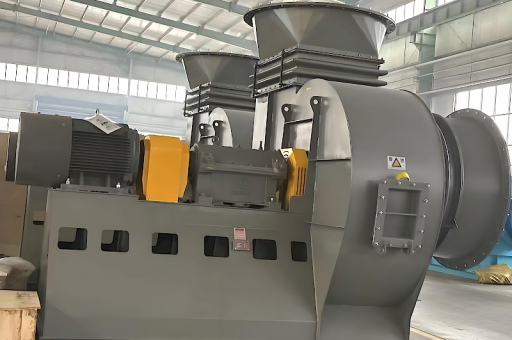
Unlike axial fans, which move air parallel to the shaft, centrifugal induced draft fans use a rotating impeller to accelerate air radially, creating a pressure differential that effectively "pulls" dust-laden air from production areas through filtration systems. The 132kW model is specifically engineered for mid-to-large scale operations where standard fans fail to maintain negative pressure under heavy load.
This article provides a deep, technical dive into the specifications, applications, and operational advantages of this fan, while adhering to best practices for SEO optimization for search engines like Bing and Google.
Technical Breakdown: What Makes the 132kW Fan Unique
The designation "132kW" refers to the motor power output, which translates to approximately 177 horsepower. This power level is carefully chosen to balance energy consumption with the ability to overcome system resistance in extended ductwork and baghouse filters.
Key Construction Features:
- Impeller Design: Typically built with backward-curved blades. This design reduces air turbulence and allows for non-overloading characteristics—meaning the motor won't burn out if the system pressure drops unexpectedly.
- Housing Material: Heavy-duty carbon steel or abrasion-resistant alloys, often lined with wear plates to withstand particle erosion.
- Drive System: Direct drive or belt-driven configurations. Belt drives offer adjustable speed via sheave changes, while direct drives offer higher efficiency and lower maintenance.
- Operating Principle: The fan creates a negative pressure (suction) at the inlet. Dust-laden air is drawn into the housing, accelerated by the impeller, and discharged through the outlet into a dust collector or exhaust stack.
The 132kW fan is typically paired with variable frequency drives (VFDs) to modulate airflow based on real-time demand, significantly reducing energy costs compared to fixed-speed operation.
Core Applications: Where This Fan Excels
This fan is not a one-size-fits-all solution. Its power and pressure characteristics make it indispensable in specific industrial scenarios:
- Cement Plants: Used in clinker cooling and raw mill exhaust to remove fines and maintain negative pressure in the kiln preheater.
- Metal Smelting: Critical for extracting fumes from electric arc furnaces and converters, where high-temperature, dust-heavy gases must be moved quickly.
- Biomass & Coal Power Plants: Essential for flue gas desulfurization (FGD) systems and fly ash handling.
- Mining & Quarrying: Applied in crushing and screening stations to suppress silica dust.
A notable distinction: this fan is optimized for induced draft (pulling air) rather than forced draft (pushing air). It must be located downstream of the dust collector to protect the impeller from excessive abrasion.
Performance Metrics: Airflow, Pressure, and Energy Efficiency
To evaluate whether a 132kW centrifugal induced draft fan fits your system, engineers focus on three key variables:
| Parameter | Typical Range for 132kW Fan | Notes |
|---|---|---|
| Airflow (CFM) | 50,000 – 120,000 | Depends on blade angle and operating speed. |
| Static Pressure (in. w.g.) | 20 – 45 | Higher in ductwork with dense filter media. |
| Impeller Diameter | 2 – 2.0 meters | Larger diameters move more volume at lower RPM. |
| Max Inlet Temperature | Up to 250°C | Requires heat-resistant shaft seals and bearings. |
Efficiency Considerations: – A well-designed backward-curved impeller can achieve 85-90% static efficiency. – Using a VFD can reduce energy consumption by 25-40% compared to damper control. – Regular cleaning of blades prevents imbalance, which can reduce efficiency by 15-20%.
For facilities looking to retrofit a wind turbine (renewable energy system) for auxiliary power, the fan’s VFD can be integrated with wind turbine output to offset grid consumption during peak hours.
Installation & Maintenance Best Practices
Installation Tips:
- Foundation: The fan base must be mounted on a vibration-absorbing foundation (concrete or inertia block) to minimize noise and structural wear.
- Ductwork Alignment: Inlet and outlet ducts must be properly aligned to avoid induced stress on the fan housing. Misalignment is a leading cause of premature bearing failure.
- Isolation Dampers: Install isolation dampers upstream and downstream for safe maintenance access.
Maintenance Schedule:
- Daily: Check vibration levels, bearing temperatures, and motor current.
- Weekly: Inspect for dust buildup on the impeller; clean with compressed air or soft brushes.
- Monthly: Measure belt tension (if belt-driven) and lubricate bearings per manufacturer specs.
- Annually: Perform a complete rotor balance check and inspect wear liners.
Neglecting maintenance on a 132kW fan can lead to catastrophic failure. A single unplanned shutdown in a cement plant can cost upwards of $20,000 per hour in lost production.
Q&A: Common Questions About Induced Draft Fans
Q1: Can I use a 132kW induced draft fan in an explosive environment? Yes, but only if it is built with explosion-proof motor enclosures (e.g., Ex d or Ex e), anti-spark impeller materials (such as aluminum bronze), and proper grounding. Always verify ATEX or IECEx certification.
Q2: How does this fan compare to a wind turbine in terms of airflow? While a wind turbine generates electricity, a 132kW centrifugal fan consumes electricity to move air. However, when paired with a solar or wind turbine microgrid, the fan can operate with near-zero carbon emissions during renewable generation periods.
Q3: What is the typical lifespan of the impeller? Under normal operating conditions (moderate dust loading, regular cleaning), a steel impeller can last 8–12 years. High abrasion applications may require replacement every 3–5 years.
Q4: How do I calculate the required fan power for my system? Use the formula: Power (kW) = (CFM × Static Pressure in inches w.g.) / (6,356 × Fan Efficiency). A 132kW fan is typically selected when the result falls within 110–140 kW to allow for a 10-15% safety margin.
Q5: Can I retrofit an existing fan with a VFD? Yes. Retrofitting a VFD to an existing fixed-speed 132kW fan is common and often pays for itself within 12–18 months through energy savings. However, ensure the motor is inverter-duty rated to avoid overheating at low speeds.
Conclusion: Future-Proofing Your Facility with the Right Technology
The 132kW Dust Removal Centrifugal Induced Draft Fan is not merely a piece of equipment—it is the cornerstone of a compliant, efficient, and safe industrial environment. By selecting a fan with the correct power, material, and control system, facility managers can dramatically reduce particulate emissions while cutting operational costs.
Looking ahead, integration with renewable energy sources like a wind turbine will become the standard for ESG (Environmental, Social, and Governance) compliance. The ability to power a 132kW fan partly from on-site wind generation aligns with global carbon reduction targets.
For engineers and procurement professionals, the decision is clear: invest in a high-efficiency, durable induced draft fan today to avoid expensive retrofits tomorrow. Always consult with a manufacturer’s application engineer to match the fan curve to your system’s resistance profile.
Keywords: 132kW dust removal centrifugal induced draft fan, dust collection system, industrial ventilation, backward-curved impeller, VFD control, baghouse fan, induced draft fan efficiency.





