
This article's table of contents introduction:
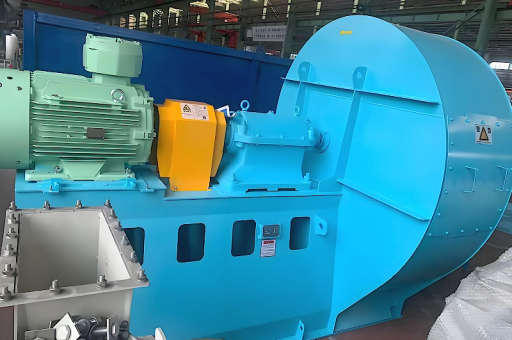
- The Core Concept: What is a Forward Induced Draft Fan?
- Primary Function: More Than Just "Heat Dissipation"
- The "Forward" Blade Design: Why is it Used Here?
- Detailed Heat Dissipation Process (Step-by-Step)
- Summary Analogy
- Key Takeaway
Here is a comprehensive explanation of the Forward Induced Draft (ID) Fan and its role in heat dissipation within a power plant.
The Core Concept: What is a Forward Induced Draft Fan?
First, let's clarify the terminology. When engineers say "Forward Induced Draft Fan," they are usually combining two distinct characteristics of the fan:
- Induced Draft (ID): This refers to the fan's location in the system. An ID fan is placed after the heat exchange equipment (like the boiler, economizer, or air preheater) and before the chimney (stack). Its job is to pull or suck the hot flue gases through the system, creating a negative pressure (vacuum) inside the boiler and ductwork. This is the opposite of a Forced Draft (FD) fan, which pushes air into the system.
- Forward-Curved (FC) Blade: This refers to the blade design of the fan's impeller. The blades curve in the direction of rotation (forward). This design allows the fan to move a very large volume of gas at a relatively low static pressure.
In short: A "Forward ID Fan" is an Induced Draft fan that uses a forward-curved blade design to pull the final exhaust gases out of the power plant.
Primary Function: More Than Just "Heat Dissipation"
While the end result is heat dissipation, the ID fan's function within the power plant system is more precise:
- Maintain Negative Pressure: The ID fan's most critical job is to maintain a slight negative pressure (usually -0.5 to -2 inches of water column) in the furnace (boiler) of a coal or thermal power plant. This ensures that:
- Hot, toxic gases don't leak out into the boiler house, endangering personnel.
- Cold, outside air doesn't rush in, which would cool the furnace and reduce efficiency.
- Overcome System Resistance: The flue gas path is not a straight pipe. The gas must navigate through:
- The boiler tubes and heat exchange surfaces.
- The air preheater.
- The electrostatic precipitator (ESP) or baghouse filter (for dust removal).
- The Flue Gas Desulfurization (FGD) scrubber.
- All the connecting ductwork, dampers, and silencers. The ID fan provides the suction power to pull the gas through all this resistance.
- Discharge to Stack: Finally, the ID fan pushes the now-cleaned, cooled flue gas up the chimney. Its pressure is the primary driver for the gas to exit the top of the stack and be dispersed into the atmosphere. This is the direct "heat dissipation" step.
The "Forward" Blade Design: Why is it Used Here?
The forward-curved blade is a specific design choice, usually for smaller or older industrial power plants. Here are its pros and cons:
| Feature | Advantage for Power Plant | Disadvantage for Power Plant |
|---|---|---|
| Volume vs. Pressure | Excellent for moving very high volumes of gas. | Produces relatively low static pressure. Not ideal for plants with high-resistance scrubbers or tall stacks. |
| Size & Speed | More compact than a backward-curved fan for the same duty. Can operate at lower speeds. | Less efficient. Consumes more power for the same work compared to a backward-curved fan. |
| Stability | Has a stable operating range with a steep performance curve. | Prone to "overshoot" or motor overload if the system resistance drops unexpectedly (e.g., a damper opens too quickly). The higher volume requires a more robust motor. |
| Cost | Lower initial purchase cost. | Higher operating cost due to lower efficiency. |
In modern, large-scale power plants (especially supercritical or ultra-supercritical), the Forward ID fan is less common. Backward-curved (BC) or airfoil (AF) fans are preferred because they are more efficient, can handle higher pressures (needed for tall stacks and complex pollution control equipment), and are less prone to motor overload.
Detailed Heat Dissipation Process (Step-by-Step)
Let's trace the path of heat and the role of the ID fan:
- Combustion: Coal or gas is burned in the boiler furnace. This creates extremely hot flue gas (up to 1500-1700 °C / 2700-3100 °F).
- Heat Transfer (Boiler): The hot gas passes over water-filled tubes. Heat is transferred to the water, turning it into high-pressure steam to drive the turbine. The gas cools significantly.
- Heat Transfer (Economizer & Air Preheater): The still-hot gas passes through an economizer (heats feedwater) and an air preheater (heats combustion air). This extracts even more useful heat.
- Gas Cleanup: The cooled gas (now ~150-200 °C / 300-400 °F) goes to the ESP or baghouse to remove fly ash, then to the FGD scrubber to remove sulfur dioxide (SO2).
- The ID Fan's Action:
- Suction Side: The fan's inlet is connected to the outlet of the final pollution control device (e.g., the FGD scrubber). The rotating impeller creates a low-pressure area, which sucks the cleaned, warm flue gas out of the system.
- Discharge Side: The fan then pushes this gas into the stack.
- Heat Dissipation to Atmosphere: The gas exits the top of the stack, now at a temperature of roughly 50-120 °C (120-250 °F) for a modern plant with a wet FGD, or around 130-150 °C (270-300 °F) for a plant without one. The ID fan provides the velocity needed for the gas to rise, mix with ambient air, and safely dissipate the remaining heat and any diluted pollutants.
Summary Analogy
Think of a large, complex house.
- The Furnace (Boiler): The fire in the fireplace.
- The Ductwork (Gas Path): The chimney and flues.
- The Forced Draft (FD) Fan: A bellows blowing air at the fire to make it burn hotter.
- The Induced Draft (ID) Fan: A vacuum cleaner at the top of the chimney, sucking all the smoke and hot air out.
- The Forward Blade: A specific type of vacuum cleaner that moves a huge volume of air but isn't great at sucking through a very long, narrow, or dirty pipe (high resistance).
Key Takeaway
The Forward Induced Draft Fan is a specialized, high-volume, low-pressure fan used to pull flue gases through the back end of a power plant (post-combustion) and discharge them safely to the stack, thereby completing the heat dissipation cycle. While effective for smaller plants, its lower efficiency and pressure capability make it less ideal for modern, large-scale facilities with extensive pollution control equipment.





