
This article's table of contents introduction:
- Key Fan Types in a Fluidized Bed Boiler (FBB)
- Why "High Pressure" is Crucial for Fluidized Bed Fans
- Unique Operating Challenges for FBB Fans
- Typical Fan Specifications for a 135 MW CFB Boiler
- Summary Table
- Conclusion
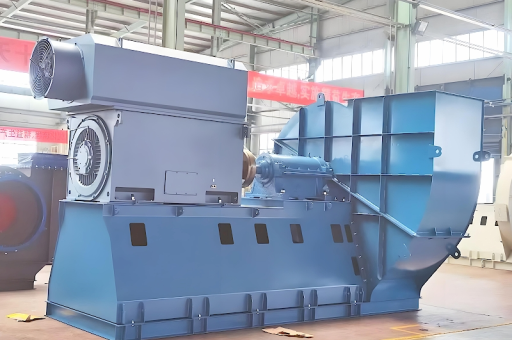
It appears you're looking for information about high-pressure power plant fans, specifically those used in Fluidized Bed Boilers (CFB or BFB) within a Thermal Power Plant.
These fans are critical for the combustion process and plant safety. Below is a detailed breakdown of the specific fan types, their roles, and the unique challenges they face in this application.
Key Fan Types in a Fluidized Bed Boiler (FBB)
Unlike a standard Pulverized Coal (PC) boiler, a Fluidized Bed Boiler relies on a bed of fuel and inert material (sand/ash) suspended by air. This requires specific high-pressure fans.
A. Primary Air (PA) Fan (The most critical)
- Function: Provides the fluidizing air.
- Pressure: Very High. Must overcome the weight of the bed material, the pressure drop across the air distributor plate (nozzles), and the resistance of the ash layer. Typical pressure: 15-25 kPa (60-100 inches w.g.) .
- Flow: High, dependent on boiler size.
- Type: High-pressure, single-stage or two-stage centrifugal fan. Often features backward-curved or radial blades for robustness.
- Why High Pressure? If the air pressure drops below the bed weight, the bed collapses (de-fluidization), leading to slagging and potential tube damage.
B. Secondary Air (SA) Fan
- Function: Provides over-fire air for complete combustion (staged combustion) and control of NOx formation.
- Pressure: Medium to High. It must penetrate the furnace cross-section. Pressure: 8-15 kPa (32-60 inches w.g.) .
- Location: Supplied through multiple ports in the furnace walls above the bed.
- Type: Centrifugal fan.
C. Induced Draft (ID) Fan
- Function: Creates negative pressure in the furnace and pulls the hot flue gases through the boiler, superheater, economizer, and pollution control equipment (ESP/Baghouse).
- Pressure: High (due to pressure drop across the entire gas path). Pressure: 6-10 kPa (24-40 inches w.g.) .
- Challenges: Handles hot, abrasive, and corrosive flue gases. In CFB boilers, the gas is heavily laden with fly ash.
- Type: Heavy-duty centrifugal fan often with radial or forward-curved blades. Sometimes axial flow for larger units.
D. Fluidizing Air Fan (For External Heat Exchangers / Ash Coolers)
- Function: Provides air to fluidize ash in external heat exchangers or bottom ash coolers.
- Pressure: Medium to High.
Why "High Pressure" is Crucial for Fluidized Bed Fans
The term "high pressure" is the defining characteristic here.
| Parameter | Pulverized Coal (PC) Boiler | Fluidized Bed (CFB/BFB) Boiler |
|---|---|---|
| PA Fan Pressure | 2-5 kPa (8-20 in w.g.) | 15-25 kPa (60-100 in w.g.) |
| Bed Material | None | Significant (sand/ash layer) |
| Pressure Requirement | To convey coal | To lift and suspend the entire bed weight |
The high pressure is necessary to overcome the hydrostatic head of the fluidized bed.
Unique Operating Challenges for FBB Fans
Fans in a Fluidized Bed Boiler face harsher conditions than those in a PC boiler:
- Erosion (Abrasion):
- Primary Air: Air entering the bed passes through nozzles, but if the windbox is not clean, fines can recirculate and erode the fan impeller.
- ID Fan: The biggest challenge. Flue gas contains high concentrations of fine, hard fly ash (silica, alumina). ID fan blades require hard-facing (tungsten carbide, ceramic tiles) to prevent rapid erosion.
- High Temperature (ID Fan):
Flue gas temperatures can reach 160-180°C (320-356°F). The fan must be designed with thermal expansion allowances and high-temperature bearings. In some cases, hot air recirculation ducts are used for starting.
- Variable Speed Operation:
- Due to the need for precise control of bed fluidization (primary air) and combustion staging (secondary air), Variable Frequency Drives (VFDs) or Hydraulic Couplings are almost mandatory for PA and SA fans. This allows the fan to match the exact airflow needed, rather than using inefficient dampers.
- Corrosion (Cold End):
- If flue gas temperature drops below the acid dew point, sulfuric acid can form, corroding the ID fan blades and housing. Materials like Corten steel or SS316L are used.
Typical Fan Specifications for a 135 MW CFB Boiler
To give context:
- Primary Air Fan:
- Type: Backward-curved centrifugal, double-inlet.
- Flow: ~250,000 - 400,000 m³/h (147,000 - 235,000 CFM)
- Pressure: 22 kPa (88 in w.g.)
- Motor: 2500 kW, 990 RPM
- Control: VFD
- Induced Draft Fan:
- Type: Radial or Paddle-wheel centrifugal (for high dust).
- Flow: ~500,000 m³/h (294,000 CFM)
- Pressure: 8 kPa (32 in w.g.)
- Motor: 1800 kW
- Control: Inlet guide vanes or VFD.
- Material: Hard-faced blades (16MnCr5 with hardfacing).
Summary Table
| Fan | Purpose | Pressure Requirement | Key Design Feature | Material Concern |
|---|---|---|---|---|
| Primary Air | Fluidizing the bed | Highest (15-25 kPa) | VFD control, robust casing | Erosion from fines |
| Secondary Air | Combustion staging | Medium (8-15 kPa) | Multiple outlet ducts | Standard steel |
| Induced Draft | Flue gas extraction | Medium-High (6-10 kPa) | Abrasion-resistant blades | Erosion & Corrosion |
Conclusion
In a Fluidized Bed Boiler, the Primary Air Fan is the "heart" of the system, requiring the highest pressure head to maintain the fluidized state. The Induced Draft Fan is often the most maintenance-intensive component due to severe ash erosion. Selecting the correct fan type (centrifugal radial/backward), material (hard-faced), and control system (VFD) is critical for the reliability and efficiency of the thermal power plant.





