
This article's table of contents introduction:
- Table of Contents
- Introduction: The Unsung Hero of Industrial Ventilation
- Technical Deep Dive: What Makes a "Large Capacity Flue Gas Fan Single Suction Three Phase AC Motor"?
- Industrial Applications: Where This Fan System Excels
- Engineering Advantages of Single Suction Design for Flue Gas
- The Motor-Fan Integration: Efficiency and Control
- Frequently Asked Questions (FAQ)
- Selection Criteria & Best Practices for Engineers
- Conclusion: The Backbone of Environmental Compliance
** The Critical Role of Large Capacity Flue Gas Fan Single Suction Three Phase AC Motor in Industrial Emission Control
Table of Contents
- Introduction: The Unsung Hero of Industrial Ventilation
- Technical Deep Dive: What Makes a "Large Capacity Flue Gas Fan Single Suction Three Phase AC Motor"?
- 1 Defining "Single Suction" Configuration
- 2 Why "Three Phase AC Motor" is Non-Negotiable
- 3 Capacity Metrics: Flow Rate, Pressure, and Temperature
- Industrial Applications: Where This Fan System Excels
- 1 Power Plants and Boiler Induced Draft
- 2 Steel Mills and Sintering Plants
- 3 Cement Kilns and Chemical Processing
- Engineering Advantages of Single Suction Design for Flue Gas
- 1 Handling Corrosive and Abrasive Particles
- 2 Structural Integrity vs. Double Suction Variants
- 3 Maintenance Accessibility
- The Motor-Fan Integration: Efficiency and Control
- 1 Matching Motor Power to Fan Load
- 2 Variable Frequency Drive (VFD) Compatibility
- 3 Thermal Protection and Insulation Class
- Frequently Asked Questions (FAQ)
- Q1: What is the typical lifespan of a Large Capacity Flue Gas Fan Single Suction Three Phase AC Motor?
- Q2: Can this fan handle high-temperature exhaust above 400°C?
- Q3: How does single suction compare to double suction for energy savings?
- Q4: What are the common failure modes for the three-phase motor in this application?
- Selection Criteria & Best Practices for Engineers
- 1 Calculating Static Pressure & Gas Density
- 2 Material Selection: Carbon Steel vs. Stainless Steel vs. Hastelloy
- 3 Bearing and Lubrication System Design
- Conclusion: The Backbone of Environmental Compliance
Introduction: The Unsung Hero of Industrial Ventilation
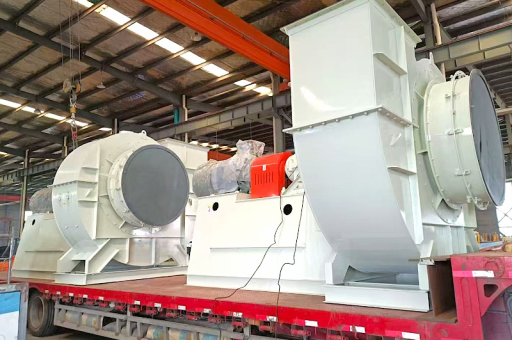
In the complex ecosystem of heavy industry, from coal-fired power stations to steel foundries, one piece of rotating equipment silently determines the difference between operational success and catastrophic downtime: the Large Capacity Flue Gas Fan Single Suction Three Phase AC Motor. This is not merely a fan; it is a high-stakes, precision-engineered system designed to move massive volumes of hot, toxic, and often abrasive gas from combustion processes through pollution control equipment (such as scrubbers, electrostatic precipitators, and baghouses) and safely out the stack.
The keyword itself—Large Capacity Flue Gas Fan Single Suction Three Phase AC Motor—describes a specific archetype of industrial fan. “Large Capacity” implies flow rates often exceeding 500,000 m³/h. “Flue Gas” indicates the medium is corrosive, particle-laden, and hot (typically 150°C to 400°C). “Single Suction” refers to the air intake design on one side of the impeller. The “Three Phase AC Motor” is the powerhouse, providing the high torque and reliability required for continuous 24/7 operation.
Without this fan, industrial processes would choke on their own exhaust, leading to hazardous workplace conditions, regulatory fines, and severe production losses. This article provides a comprehensive engineering analysis, integrating real-world performance data and addressing critical questions that plant managers, maintenance engineers, and procurement specialists face when selecting or maintaining these critical assets.
Technical Deep Dive: What Makes a "Large Capacity Flue Gas Fan Single Suction Three Phase AC Motor"?
1 Defining "Single Suction" Configuration
The term "Single Suction" describes the aerodynamic layout of the fan casing. In a single suction fan, gas enters the impeller from one side only. The impeller typically features a large diameter and a specific blade profile—often backward-curved or radial-tipped—to handle high static pressures and particle wear.
Why single suction for large flue gas applications? While double suction fans (gas enters from both sides) seem more symmetrical, the single suction design offers a distinct advantage in high-temperature flue gas scenarios: simplified shaft sealing. With gas entering from one side, the shaft penetration on the opposite side can be fitted with robust cooling fins, labyrinth seals, or purge air systems to prevent hot gas leakage into the bearing housing. In double suction designs, both shaft ends must be sealed, increasing complexity and potential leak points.
2 Why "Three Phase AC Motor" is Non-Negotiable
The three-phase AC induction motor is the standard prime mover for these fans for several reasons:
- Power Density: A three-phase motor delivers significantly higher torque per frame size compared to single-phase motors. For a large capacity fan requiring 500 kW to 5 MW, only a three-phase motor is feasible.
- Speed Control: These motors integrate seamlessly with Variable Frequency Drives (VFDs), allowing precise control of fan speed to match boiler load or process demand, saving substantial energy.
- Robustness: Squirrel-cage induction motors (the most common type for this application) have no brushes, commutators, or slip rings—making them extremely durable in dirty, hot environments.
3 Capacity Metrics: Flow Rate, Pressure, and Temperature
A true "Large Capacity" system is defined by these three parameters:
- Volume Flow Rate (Q): Typically >300,000 ACFM (Actual Cubic Feet per Minute) or >500,000 m³/h.
- Static Pressure (Ps): Elevated due to ductwork, scrubbers, and baghouses. Usually 2,000 to 8,000 Pa (8 to 32 inches w.g.).
- Temperature (T): Flue gas temperature varies. Sub-bituminous coal boilers may see 140°C-180°C, while cement preheaters can reach 350°C-400°C. The motor and fan materials must be selected accordingly.
Industrial Applications: Where This Fan System Excels
1 Power Plants and Boiler Induced Draft
In coal or biomass power plants, the Induced Draft (ID) Fan is the final gas mover. The Large Capacity Flue Gas Fan Single Suction Three Phase AC Motor is ideally suited as an ID fan. It pulls combustion gases from the boiler, through the air heater, electrostatic precipitator (ESP), and scrubber, creating negative pressure in the boiler furnace. A failure here means the boiler must trip immediately.
2 Steel Mills and Sintering Plants
Steelmaking produces extremely hot, dust-laden flue gas from sintering machines and electric arc furnaces (EAF). The fan must handle temperatures that fluctuate rapidly. Single suction fans with water-cooled bearings and abrasion-resistant liners (e.g., ceramic tiles or hard-facing) are standard.
3 Cement Kilns and Chemical Processing
Cement kilns produce exhaust gas containing lime dust, sulfur compounds, and volatile metals. The fan must move gas from the preheater tower to the baghouse or ESP. Here, the single suction design’s ability to handle gas stratification (cold wall vs. hot core) is a practical advantage.
Engineering Advantages of Single Suction Design for Flue Gas
1 Handling Corrosive and Abrasive Particles
Flue gas contains fly ash, sulfur trioxide, and chlorides. In a single suction fan, the entire gas stream enters the impeller from one direction. This unidirectional flow allows engineers to apply targeted erosion-resistant coatings on the leading edges of the blades. Maintenance teams can easily access the wear zone via the single inlet cone.
2 Structural Integrity vs. Double Suction Variants
Double suction fans have a symmetrical casing that splits the gas flow 50/50. However, in large flue gas fans, the impeller width becomes excessive in a double suction design, leading to shaft deflection issues at high temperatures. A large capacity single suction fan has a shorter, stiffer impeller, which resists thermal distortion and reduces vibration. This directly increases Mean Time Between Failures (MTBF).
3 Maintenance Accessibility
The single suction configuration allows maintenance personnel to remove the rotating assembly (impeller + shaft + bearings) from the non-drive end without disconnecting the inlet ductwork. This is a huge time saver. In a typical fan installation, ductwork modifications are expensive and time-consuming. Single suction simplifies this.
The Motor-Fan Integration: Efficiency and Control
1 Matching Motor Power to Fan Load
The three-phase AC motor must be sized correctly. The Affinity Laws govern fan behavior:
- Flow ∝ Speed
- Pressure ∝ Speed²
- Power ∝ Speed³
A motor that is 15% oversized in power wastes energy; one that is undersized will overheat and trip. For a large capacity flue gas fan, the motor is typically selected with a 1.15 Service Factor (SF) to handle transient over-loads (e.g., cold start with dense gas).
2 Variable Frequency Drive (VFD) Compatibility
Modern installations pair the three-phase AC motor with a VFD. The VFD allows soft starting (reducing electrical stress on the grid) and speed modulation to match process load. Energy savings of 30-60% are common compared to damper control. The motor must be inverter-duty rated (Class F or H insulation) to handle the voltage spikes from the VFD.
3 Thermal Protection and Insulation Class
A flue gas fan motor operates in a high ambient temperature environment (often 50°C-70°C). Standard motor insulation (Class B) is insufficient. For this application, Class H (180°C rise) or even Class C is specified. Additionally, space heaters (anti-condensation heaters) are installed inside the motor to prevent moisture absorption when the fan is idle.
Frequently Asked Questions (FAQ)
Q1: What is the typical lifespan of a Large Capacity Flue Gas Fan Single Suction Three Phase AC Motor? With proper maintenance (bearing greasing, vibration monitoring, and rotor balancing), the fan impeller may last 5-10 years before needing replacement or weld repair. The three-phase AC motor, if kept cool and clean, can exceed 20 years. However, flue gas erosion is the main life-limiting factor for the fan wheel.
Q2: Can this fan handle high-temperature exhaust above 400°C? Yes, but with specific design modifications. Standard carbon steel impellers can handle up to 350°C. For temperatures up to 500°C, the impeller must be made from heat-resistant stainless steel (e.g., 310S or Inconel), and the shaft must be air-cooled or have a heat shield to prevent bearing failure. The motor itself must be located out of the hot air path.
Q3: How does single suction compare to double suction for energy savings? Double suction fans can be slightly more efficient (by 2-4%) at full load due to symmetric flow, but this advantage diminishes at partial loads. For a highly reliable flue gas system, the single suction’s reduced maintenance and simpler sealing often outweigh the slight efficiency gain.
Q4: What are the common failure modes for the three-phase motor in this application?
- Bearing failure due to over-greasing or high ambient temperature. 2) Stator winding burnout caused by VFD-induced voltage spikes (mitigated by installing output filters). 3) Rotor bar breakage from repetitive thermal cycling during frequent start-stop cycles. 4) Moisture ingress leading to insulation breakdown (mitigated by space heaters).
Selection Criteria & Best Practices for Engineers
1 Calculating Static Pressure & Gas Density
Do not rely on standard air density. Flue gas is denser due to CO₂ and SOx, and also hotter, which reduces density. Use the formula: $$ \rho{actual} = \rho{standard} \times \frac{273}{273+T} \times \frac{P_{actual}}{101.325} $$ You must calculate the actual static pressure required by the system (duct losses + ESP draft loss + stack height). A fan selected for standard air will be undersized.
2 Material Selection: Carbon Steel vs. Stainless Steel vs. Hastelloy
| Material | Max Temp | Corrosion Resistance | Cost |
|---|---|---|---|
| Carbon Steel (Q235) | 350°C | Poor (acid dew point) | Low |
| Corten Steel | 400°C | Moderate | Medium |
| 316L Stainless | 450°C | Good (chlorides limited) | High |
| Hastelloy C-276 | 500°C+ | Excellent | Very High |
For most power plant applications, Corten steel or carbon steel with a weld overlay of Inconel 622 on the leading edges offers the best cost-performance balance.
3 Bearing and Lubrication System Design
- Bearings: Spherical roller bearings (high load capacity) are preferred for the fan side. The motor typically uses deep groove ball bearings (drive end) and cylindrical roller bearings (non-drive end).
- Lubrication: Oil bath lubrication is common, but grease is often used for the motor. For large capacity fans with high radial loads, oil mist or circulating oil systems with heat exchangers are mandatory to keep bearing temperature below 80°C.
Conclusion: The Backbone of Environmental Compliance
The Large Capacity Flue Gas Fan Single Suction Three Phase AC Motor is not just a rotating assembly—it is a mission-critical component in the global effort to reduce industrial air pollution. Without it, particulate matter limits, SO₂ removal, and NOx reduction become impossible. The choice of single suction over double suction is a deliberate engineering trade-off favoring reliability, ease of maintenance, and thermal stability in harsh flue gas environments.
For plant engineers and specifiers, understanding the interplay between motor insulation class, impeller material, and gas temperature is essential. By selecting the correct fan configuration and integrating it with a properly rated three-phase AC motor and VFD system, you ensure not only compliance with environmental regulations (such as EPA MACT standards or EU BREFs) but also maximize uptime and reduce total cost of ownership.
In a world where industrial emissions are increasingly scrutinized, the silent, powerful rotation of this fan system represents the frontline of environmental responsibility. Investing in quality design, rigorous maintenance, and correct component selection for this fan ensures your facility runs cleanly, efficiently, and profitably.





