
This article's table of contents introduction:
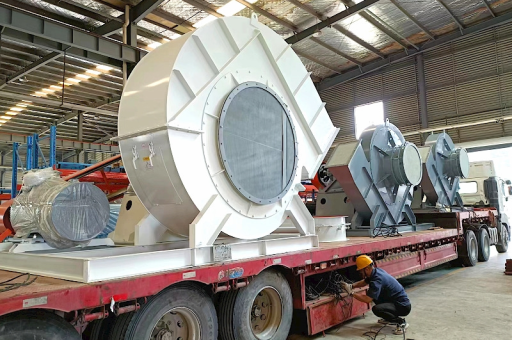
- The Core Application: The Clinker Cooler
- The Role of the Centrifugal Fan
- Why "Centrifugal"? Why "Boiler Fan"?
- Importance for Cement Cooling
- Common Issues with This Fan
- Summary Table
It appears you are referencing key components of a cement plant’s preheater and cooler system.
Here is a breakdown of the Centrifugal Boiler Fan in the context of Secondary Air and Cement Cooling.
The Core Application: The Clinker Cooler
In a cement plant, the clinker cooler (e.g., a grate cooler) is the central machine where this fan is used. Its primary job is to rapidly cool the hot clinker (coming out of the rotary kiln at ~1400°C) by blowing air through it.
- Secondary Air: This is the hot air that is recovered from the cooler and sent back into the rotary kiln for combustion. This is a critical heat recovery process.
- Tertiary Air: A portion of the hot air from the cooler is ducted to the calciner (preheater tower).
The Role of the Centrifugal Fan
While a "Boiler Fan" is a term borrowed from power plants, in a cement context, it usually refers to a heavy-duty, high-temperature centrifugal fan used for this process. The specific fan type you are describing is likely the Under-Grate Cooling Fan.
Here is how it functions in the cement cooling process:
- Function: Forces ambient air through the grates of the clinker cooler to quench the clinker.
- Path of Air:
- Ambient Air (Inlet)
- Centrifugal Fan (Pressure increase)
- Air distributed under the cooler grate
- Passes through the hot clinker bed
- Becomes Secondary Air (400°C - 800°C) or Tertiary Air.
- Cooling Effect: Rapidly reduces clinker temperature from 1400°C to 100°C - 200°C (depending on cooler design). This stops crystal growth and makes the clinker transportable and grindable.
Why "Centrifugal"? Why "Boiler Fan"?
- Centrifugal: This design is chosen because it can generate the high static pressure required to push air through the deep, dense bed of clinker on the cooler grates.
- Type: Often a Radial Blade (Paddle Wheel) or Backward Inclined design.
- Radial Blades: Very robust, tolerate dust, and are used when high pressure is needed.
- Backward Inclined: More efficient but slightly more sensitive to dust.
- Boiler Fan (Terminology): In a power plant, a "Boiler Fan" moves air for combustion (Forced Draft). Because the Secondary Air fan in a cement plant moves air that fuels the kiln burner, it is often functionally called a "Boiler Fan" or "Combustion Air Fan" in the cement industry.
Importance for Cement Cooling
- Heat Recovery: The fan ensures that as much heat as possible is recovered from the clinker. The hotter the Secondary Air, the less fuel the kiln burner needs.
- Clinker Quality: Rapid cooling (via high fan flow) locks in desirable crystal phases (e.g., C3S) and prevents the formation of large periclase crystals (MgO), which can cause concrete expansion.
- Durability: The fan must handle hot air (leakage or ducted air) and abrasive dust. Therefore, the impeller is often made of abrasion-resistant steel (e.g., Hardox) or has wear plates / hardfacing on the leading edges. Bearings are often water-cooled or have external cooling fans.
Common Issues with This Fan
- Erosion (Abrasion): The rotating blades are eroded by clinker dust in the airstream.
- Imbalance: Due to uneven dust accumulation on the blades (build-up) or erosion.
- High Temperature: If the cooler sealing fails, the fan can suck in hot air, damaging the shaft or bearings.
- Vibration: Caused by imbalance or mechanical looseness from years of heavy duty.
Summary Table
| Component | Role | Type | Key Feature |
|---|---|---|---|
| Centrifugal Fan | Provides airflow & pressure | Centrifugal (Radial / BI) | High pressure for bed penetration |
| Secondary Air | Hot air returned to kiln for combustion | Function of airflow | Heat recovery (reduces fuel use) |
| Cement Cooling | Cools clinker to ~100°C | Process on grate cooler | Affects grindability and quality |
Conclusion: This fan is a critical piece of equipment that directly impacts the thermal efficiency (fuel cost) and the final cement quality (grindability, soundness) by controlling the rate of clinker cooling.





