
This article's table of contents introduction:
- Table of Contents
- Introduction: Why Industrial Dust Collection Matters
- Understanding the Core Components
- Integrating V Belt Drive with Backward Centrifugal Design
- Performance Characteristics and Efficiency Analysis
- Key Selection Criteria for Your Dust Collection System
- Installation and Maintenance Best Practices
- Frequently Asked Questions (FAQ)
- Conclusion: Future-Proofing Your Air Quality System
Article Title:
Maximizing Industrial Air Quality: The Ultimate Guide to V Belt Driven Dust Collector Fan with Backward Centrifugal Fan and Three-Phase Motor
Table of Contents
- Introduction: Why Industrial Dust Collection Matters
- Understanding the Core Components
- What Is a V Belt Driven Fan?
- Backward Centrifugal Fan: How It Works
- Three-Phase Power: The Industrial Standard
- Integrating V Belt Drive with Backward Centrifugal Design
- Performance Characteristics and Efficiency Analysis
- Key Selection Criteria for Your Dust Collection System
- Installation and Maintenance Best Practices
- Frequently Asked Questions (FAQ)
- Conclusion: Future-Proofing Your Air Quality System
Introduction: Why Industrial Dust Collection Matters
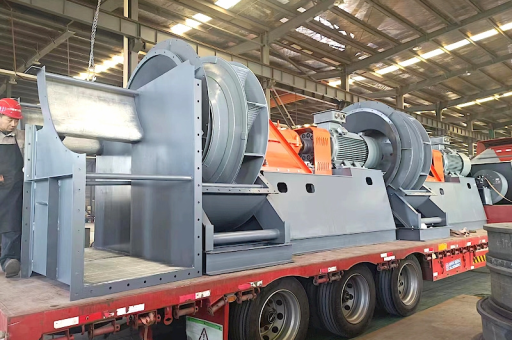
In modern manufacturing, woodworking, metal grinding, and chemical processing facilities, airborne dust and particulate matter pose serious health, safety, and compliance risks. A V Belt Driven Dust Collector Fan equipped with a Backward Centrifugal Fan and powered by a Three-Phase motor has emerged as a high-efficiency solution for these environments. This fan system moves large volumes of air at moderate static pressures while consuming less energy than traditional forward-curved alternatives.
The combination of V-belt drive flexibility, backward-curved impeller aerodynamics, and three-phase motor reliability creates a robust system that can handle continuous operation, varying load conditions, and stringent filtration requirements.
Understanding the Core Components
What Is a V Belt Driven Fan?
A V belt driven system transmits power from the motor to the fan impeller through a set of pulleys and a rubber-reinforced V-belt. This design offers several advantages over direct-drive configurations:
- Speed adjustability: By changing pulley ratios, operators can fine-tune fan RPM without replacing the motor.
- Motor protection: The belt absorbs shock loads and minor misalignments, reducing stress on motor bearings.
- Cost efficiency: Standard three-phase motors can be used across multiple fan sizes by simply swapping pulleys.
However, V-belt drives require periodic tension checks and belt replacement. For applications where continuous uptime is critical, a belt wear monitoring system is recommended.
Backward Centrifugal Fan: How It Works
The Backward Centrifugal Fan (also called backward-curved or backward-inclined) features blades that curve away from the direction of rotation. This design fundamentally changes airflow behavior:
- High efficiency: Air exits the impeller at higher velocities with less turbulence, achieving peak static efficiencies of 75–85%.
- Non-overloading power curve: Unlike forward-curved fans, power consumption peaks at the design point and decreases as system resistance increases. This prevents motor burnout in clogged duct systems.
- Lower noise levels: Smoother airflow reduces tonal noise, making these fans suitable for indoor installations.
- Self-cleaning tendency: The blade shape reduces dust build-up on the impeller surface, critical for dust collector applications.
Three-Phase Power: The Industrial Standard
Three-phase motors dominate industrial environments for good reason:
- Higher starting torque: Three-phase induction motors deliver smooth, high-torque starts without capacitor failures.
- Greater power density: For the same frame size, three-phase motors produce more horsepower than single-phase equivalents.
- Regenerative braking capability: In variable frequency drive (VFD) applications, three-phase motors can decelerate loads quickly.
- Lower operating cost: Power factor correction and higher efficiency (IE3 or IE4 class) reduce electricity bills over the long term.
For a typical dust collector fan, a 10 HP three-phase motor driving a backward centrifugal impeller can handle airflow between 5,000 and 15,000 CFM depending on duct design.
Integrating V Belt Drive with Backward Centrifugal Design
When these three elements converge, the system becomes highly adaptable. The V-belt drive allows the backward centrifugal fan to operate at its optimal efficiency point regardless of motor speed limitations. For example:
- A 1,750 RPM motor can drive a fan at 1,200 RPM for reduced noise, or at 2,200 RPM for higher pressure requirements—simply by changing pulley diameters.
- The backward centrifugal fan’s non-overloading characteristic pairs perfectly with V-belt drives because belt slippage at high torque is minimized when the power curve flattens after the design point.
- Three-phase motors easily integrate with VFDs, allowing variable-speed control via belt-driven pulley adjustments or direct electronic speed changes.
Industrial case studies show that properly matched V-belt-driven backward centrifugal fans achieve 15–25% energy savings compared to direct-drive forward-curved fans in dust collector duty cycles.
Performance Characteristics and Efficiency Analysis
To understand why this configuration excels, examine the key performance curves:
| Parameter | Backward Centrifugal Fan | Forward Curved Fan |
|---|---|---|
| Peak Efficiency | 75–85% | 55–70% |
| Power Curve Shape | Non-overloading | Overloading |
| Operating Speed | Medium to high | Low to medium |
| Noise Level | Moderate | Higher (due to turbulence) |
| Dust Handling | Good (self-cleaning) | Poor (blade buildup) |
For dust collector applications, the backward centrifugal fan’s ability to maintain high efficiency across a wide range of static pressures (6–20 inches water gauge) is critical. When paired with a three-phase motor and V-belt speed adjustment, operators can match the fan curve precisely to baghouse or cartridge filter pressure drop.
Real-world example: A woodworking facility replaced its direct-drive forward-curved fan (8 HP, 12,000 CFM @ 8" wg) with a V-belt-driven backward centrifugal fan (6 HP, 12,000 CFM @ 8" wg) and reduced energy consumption by 28% while improving filter cleaning intervals.
Key Selection Criteria for Your Dust Collection System
When choosing a V belt driven dust collector fan with backward centrifugal impeller and three-phase motor, evaluate these factors:
- Airflow requirements (CFM): Calculate based on machine pickup points and duct velocity (typically 3,500–4,500 FPM for wood dust).
- Static pressure (SP): Include duct friction, filter resistance, and cyclone losses. Most industrial systems require 6–15" wg.
- Motor horsepower: Use fan laws: CFM ∝ RPM, SP ∝ RPM², HP ∝ RPM³. Ensure the motor can handle the required speed.
- Pulley ratio: Select a V-belt drive that keeps the motor within its service factor (typically 1.15–1.25).
- Material construction: For abrasive dust (e.g., sanding), specify steel impellers with wear plates. For corrosive environments, use stainless steel or coated housings.
- VFD compatibility: If future speed control is needed, ensure the three-phase motor is inverter-duty rated.
Installation and Maintenance Best Practices
Proper installation extends fan life and maintains efficiency:
- Foundation: Mount the fan on a vibration-isolated base to reduce structure-borne noise.
- Belt tensioning: Use a belt tension gauge; deflection should be approximately 1/64 inch per inch of belt span length.
- Sheave alignment: Misalignment causes premature belt wear and bearing failure. Use a straightedge across both pulleys.
- Inlet duct: Maintain a straight duct length of at least 3–5 duct diameters before the fan inlet to avoid turbulence.
- Bearing lubrication: Grease motor and fan bearings every 3,000 operating hours with high-temperature lithium grease.
Common maintenance checklist:
- Monthly: Check belt tension, alignment, and wear.
- Quarterly: Inspect impeller for dust buildup or erosion.
- Annually: Measure vibration levels, replace belts, and verify motor winding insulation resistance.
- As needed: Replace worn sheaves after 3–5 belt replacements.
Frequently Asked Questions (FAQ)
Q1: Why use a V-belt drive instead of direct drive for a dust collector fan?
A: V-belt drives allow speed adjustments (both increase and decrease) without changing motors. They also protect the motor from shock loads and simplify replacement since the motor and fan are independent units. Direct-drive options are simpler but lack speed flexibility.
Q2: What is the main advantage of a backward centrifugal fan over a forward-curved fan?
A: The backward centrifugal fan offers higher efficiency (up to 85%), a non-overloading power curve (prevents motor burnout), and better self-cleaning characteristics for dusty environments. Forward-curved fans are cheaper but less efficient and more prone to blade clogging.
Q3: Can I run a three-phase motor on single-phase power?
A: Direct operation is not possible. However, you can use a phase converter (static or rotary) or a variable frequency drive (VFD) that inputs single-phase and outputs three-phase. For motors above 3 HP, a rotary phase converter or VFD is recommended.
Q4: What is the typical lifespan of a V-belt in a dust collector fan?
A: With proper alignment and tension, industrial V-belts last 2,000–6,000 hours depending on dust load, temperature, and starting frequency. Belt condition should be checked during every filter change.
Q5: How do I calculate the correct pulley size for my desired fan speed?
A: Use the formula: Motor RPM × Motor Pulley Diameter = Fan RPM × Fan Pulley Diameter. Rearrange to solve for unknown pulley diameter. Always stay within 95–105% of the fan’s rated speed.
Q6: Is noise reduction possible with this fan configuration?
A: Yes. Backward centrifugal fans are inherently quieter than forward-curved fans. Additional noise reduction can be achieved by installing an inlet sound attenuator, using a flexible duct connector, and ensuring balanced rotating assemblies.
Q7: What does "non-overloading" mean in the context of centrifugal fans?
A: It means the fan’s power consumption peaks at its design point (maximum efficiency) and then decreases as system resistance increases. This prevents the motor from drawing excessive current if filters clog or ducts get blocked, protecting both motor and electrical system.
Conclusion: Future-Proofing Your Air Quality System
The V Belt Driven Dust Collector Fan with Backward Centrifugal Fan and Three-Phase Motor represents the optimal balance of efficiency, reliability, and operational flexibility for industrial air filtration. By integrating speed adjustment via belt pulleys, the aerodynamic advantages of backward-curved blades, and the rugged power delivery of three-phase electricity, this configuration addresses real-world challenges such as variable duct conditions, energy costs, and maintenance downtime.
When specifying your next dust collection fan, prioritize systems that offer:
- Modular V-belt drive for easy speed tuning.
- Backward centrifugal impeller for self-cleaning and high efficiency.
- Three-phase motor for long service life and VFD compatibility.
Investing in this proven technology not only ensures compliance with OSHA and EPA air quality standards but also reduces total cost of ownership through lower energy bills and fewer unscheduled repairs. For mission-critical environments, consider pairing the fan with a high-efficiency filter system and a PLC-based control panel to maximize uptime.
For more technical specifications or to request a performance curve for your specific application, consult a qualified industrial ventilation engineer.





