
This article's table of contents introduction:
- The Core Definition
- Why "Medium Pressure Induced Draught" is Specific
- Typical Applications
- Key Technical Specifications for a "Medium Pressure" ID Fan
- Example of a Commercial Fan Model Matched to this Description
- Sizing & Selection Tips
- Summary Table: ID Fan vs. FD Fan for a Commercial Boiler
- Conclusion
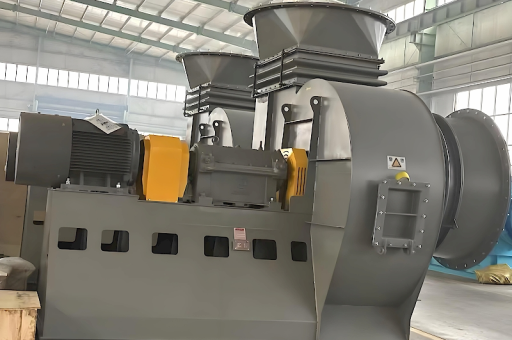
The term you've provided, "Induced Draught Boiler Fan Commercial Centrifugal Fans Medium Pressure," describes a highly specific piece of industrial equipment. Let's break down exactly what this means, where it is used, and the key specifications you should look for.
The Core Definition
This is a centrifugal fan designed for the medium-pressure application of creating induced draft (ID) in a commercial boiler system.
- Induced Draught (ID): This fan is located after the boiler (on the "outlet" or exhaust side). It pulls the hot flue gases out of the boiler and through the chimney/stack, creating a slight vacuum (negative pressure) inside the furnace. This is the safest and most common draft method for modern boilers.
- Boiler Fan: Designed to handle hot, corrosive, and particulate-laden flue gases.
- Commercial: Ranges typically from 500,000 BTU/hr to 10 million BTU/hr, found in hospitals, schools, apartment buildings, and light industrial facilities.
- Centrifugal Fan: Uses a rotating impeller (wheel) to increase the velocity of the air/gas, creating pressure. This type is ideal for handling dirty gases (compared to an axial fan).
- Medium Pressure: In fan engineering, this typically means a static pressure between 5” w.g. (125 Pa) and 12” w.g. (3000 Pa) . For ID boiler fans, "medium" usually covers 4” to 10” w.g.
Why "Medium Pressure Induced Draught" is Specific
- ID vs. FD: A Forced Draft (FD) fan pushes cold air into the burner. An ID fan handles hot, dirty exhaust gas. The ID fan is much more demanding on the fan's construction.
- Medium Pressure: High-pressure fans are for large power plants or high-friction systems. Low-pressure is for simple ventilation. Medium pressure hits the sweet spot for a commercial boiler with a moderate stack height and heat exchanger resistance.
Typical Applications
You will find this specific type of fan on:
- Fire-tube boilers (e.g., Cleaver-Brooks, Hurst, Johnston)
- Water-tube boilers (e.g., Babcock & Wilcox, Nebraska)
- Dual-fuel burners (e.g., Power Flame, Webster)
- Waste heat recovery units
- Process steam generators in hospitals and universities
Key Technical Specifications for a "Medium Pressure" ID Fan
When sourcing or specifying this fan, look for these critical parameters:
- Air Volume (CFM / m³/hr): Matched to the boiler's full-fire flue gas flow (typically 11-15 CFM per boiler horsepower, plus excess air).
- Static Pressure (SP): The "medium pressure" rating. Common values: 4” - 8” w.g. for a standard commercial boiler. This must overcome the resistance of the boiler tubes and breeching.
- Temperature: The most critical factor. ID fans handle hot gases. Commercial boilers often have exhaust temperatures of 350°F - 550°F (175°C - 290°C) . The fan must be designed for this (e.g., a heat slinger on the shaft, high-temperature bearings, and a cooling wheel if over 600°F).
- Wheel Type:
- Backward Inclined (BI): Most common for medium pressure ID. Non-overloading, high efficiency, handles moderate dust.
- Radial Tip (RT) / Paddle Wheel: Best for extremely dirty or sticky flue gases (e.g., heavy oil or solid fuel boilers). Very robust, but lower efficiency.
- Airsfoil: Highest efficiency for clean gas (natural gas).
- Construction: The housing and wheel must be robust. Heavy-gauge steel, with wear plates if burning coal or heavy oil.
Example of a Commercial Fan Model Matched to this Description
- New York Blower - "GI Fan" (General Industrial): A common choice. It can be configured for medium pressure and can be fitted with a high-temperature shaft seal for ID boiler service.
- Chicago Blower - "PLR" (Plug Fan with cooling disc): Often used for direct-drive, medium pressure ID applications.
- Greenheck - "BIDW" (Backward Inclined Double Width): Common for larger commercial boilers.
- Twin City - "AF" (Airsfoil) or "BL" (Backwardly Inclined): Standard for medium pressure clean gas boiler exhaust.
Sizing & Selection Tips
- Do Not Oversize: A medium pressure ID fan must be carefully matched to the boiler's draft requirement. Oversizing leads to high velocity, noise, and potential flame instability.
- Variable Speed Drive (VFD / Inverter): Highly recommended for ID fans. It allows for precise modulation of boiler pressure, saves energy, and reduces wear compared to inlet vanes or dampers.
- Choose the Right Fan Law: The fan's performance (CFM, SP, HP) is governed by the Fan Laws. A 10% increase in speed requires 33% more horsepower.
- Material of Construction: For natural gas (clean), standard steel is fine. For #6 oil or solid fuel, consider AR (Abrasion Resistant) steel or a gas-tight shaft seal.
Summary Table: ID Fan vs. FD Fan for a Commercial Boiler
| Feature | Induced Draft (ID) Fan | Forced Draft (FD) Fan |
|---|---|---|
| Location | After the boiler (exhaust side) | Before the boiler (air intake) |
| Gas Handled | Hot, dirty, corrosive flue gases | Clean, ambient air |
| Pressure | Negative (vacuum) | Positive |
| Main Challenge | High temperature, corrosion, dust | Noise, intake filter loss |
| Wheel Type | RT, BI, or Airsfoil (with abrasion resistance) | Airsfoil or BI (high efficiency) |
| Typical Motor | 5-50 HP, 1800 RPM | 3-30 HP, 1800 RPM |
Conclusion
You are looking for a rugged, backward-inclined or radial-tip centrifugal fan designed for 350°F - 550°F flue gas, with a static pressure of 4” - 10” w.g. and a VFD for speed control. It will be installed after the boiler's outlet and before the stack.
Next Step: If you provide the specific boiler model, its firing rate (HP or BTU/hr), and the stack height/temperature, a fan manufacturer can give you an exact model number. For a standard commercial natural gas boiler in the 200-600 HP range, the answer is almost always a Backward Inclined (BI) centrifugal fan with a variable frequency drive.





