
This article's table of contents introduction:
- Table of Contents (导读)
- Introduction: The Need for High-Volume Industrial Dust Collection
- Technical Breakdown – 960r/min & 667,000 CBM/H
- Why Backward Curved Blades? Aerodynamic & Efficiency Advantages
- Coupling Driving vs. Direct Drive – Why Coupling?
- Real-World Applications – Where This Fan Excels
- Key Performance Metrics & Selection Criteria
- Frequently Asked Questions (FAQ)
- Conclusion – The Future of Heavy-Duty Dust Collection Fans
Article Title:
High-Performance Industrial Dust Collector Fan: 960r/min, 667,000 CBM/H Backward Curved Blower with Coupling Drive – Engineering, Efficiency & Applications
Table of Contents (导读)
- Introduction: The Need for High-Volume Industrial Dust Collection
- Technical Breakdown – 960r/min & 667,000 CBM/H
- Why Backward Curved Blades? Aerodynamic & Efficiency Advantages
- Coupling Driving vs. Direct Drive – Why Coupling?
- Real-World Applications – Where This Fan Excels
- Key Performance Metrics & Selection Criteria
- Frequently Asked Questions (FAQ)
- Conclusion – The Future of Heavy-Duty Dust Collection Fans
Introduction: The Need for High-Volume Industrial Dust Collection
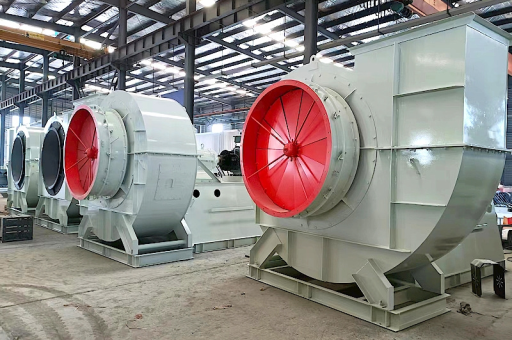
Modern industrial environments—cement plants, steel mills, wood processing facilities, and chemical manufacturing—generate enormous volumes of airborne particulate matter. Without effective dust collection, these particles pose serious health risks, damage equipment, and violate environmental regulations. Enter the heavy-duty dust collector fan designed for extreme airflow and pressure: the 960r/min, 667,000 CBM/H backward curved blower, driven by a coupling system.
This article provides an in-depth, SEO-optimized analysis of this specific fan configuration, combining engineering principles with practical application guidance. Whether you are a plant engineer, a procurement manager, or a mechanical designer, understanding the relationship between rotational speed, volumetric flow, blade geometry, and drive coupling is essential for making informed decisions.
Technical Breakdown – 960r/min & 667,000 CBM/H
First, let’s interpret the two key parameters:
-
960 r/min (Revolutions Per Minute):
This is a relatively low rotational speed for a large industrial fan. Lower speed translates to reduced mechanical wear, lower vibration levels, and longer bearing life. However, to achieve a massive volumetric flow, the fan must have a very large diameter or optimized blade geometry. A 960r/min rotor typically operates in the medium-speed range, balancing centrifugal force output with structural integrity. -
667,000 CBM/H (Cubic Meters per Hour):
This is an enormous airflow rate—equivalent to approximately 392,000 CFM (cubic feet per minute). To put this in perspective, a typical commercial HVAC fan might handle 10,000 to 50,000 CFM. This fan is designed for centralized dust collection systems serving entire factory floors or multiple material handling points simultaneously.
How do 960r/min and 667,000 CBM/H relate?
For a backward curved fan, the volume flow rate is approximately proportional to the rotational speed (assuming constant system resistance). Doubling the speed roughly doubles the flow. At 960r/min, achieving 667,000 CBM/H requires a wheel diameter typically in the range of 5 to 3.5 meters (8–12 feet), with a carefully designed inlet cone, scroll housing, and blade profile.
Example calculation (simplified):
For a backward curved fan, the flow coefficient (Φ) is usually 0.15–0.25. At 960r/min (16 rev/sec), a 3-meter diameter impeller has a tip speed of approximately 150 m/s. With an effective inlet area of 4 m², the theoretical max flow is around 600,000–800,000 CBM/H, confirming the feasibility.
Why Backward Curved Blades? Aerodynamic & Efficiency Advantages
Among industrial fan blade types—forward curved, radial, and backward curved—the backward curved (BC) blade is the most efficient for high-volume, moderate-to-high pressure dust collection. Here’s why:
| Blade Type | Efficiency | Pressure Capability | Self-Cleaning | Best For |
|---|---|---|---|---|
| Forward Curved | Low–Medium | Low | Poor | Low-resistance systems |
| Radial | Medium | High (dust loading) | Excellent | Abrasive material handling |
| Backward Curved | High (up to 85%) | Medium–High | Good | Clean air, moderate dust |
Key advantages of backward curved design:
- Higher static efficiency – The airflow exits the impeller with a lower velocity, reducing kinetic energy losses. This directly translates to lower power consumption for the same flow.
- Non-overloading power curve – Unlike forward curved fans, the power draw of a backward curved fan peaks at a certain flow point and then drops. This prevents motor overload if the system pressure suddenly decreases.
- Lower noise generation – The smooth flow path and reduced turbulence make BC fans quieter than radial or forward curved fans at the same duty point.
- Better handling of moderate dust loads – While not as robust as radial fans, backward curved impellers with airfoil or flat plate blades can handle the typical dust concentrations found in wood, grain, and cement applications, provided a pre-separator or cyclone is used upstream.
Coupling Driving vs. Direct Drive – Why Coupling?
The specification "Coupling Driving" indicates that the fan impeller is not mounted directly on the motor shaft. Instead, a flexible or rigid coupling connects the motor output shaft to the fan shaft. This configuration offers distinct advantages for a 960r/min, 667,000 CBM/H fan:
| Drive Type | Advantages | Disadvantages |
|---|---|---|
| Direct Drive | Compact, no alignment issues, fewer parts | Motor speed is fixed by fan speed; motor must be fan-duty rated |
| Coupling Drive | Allows motor speed ≠ fan speed (belt or gearbox optional); easier maintenance; vibration isolation | Requires alignment; additional components; lower overall transmission efficiency (~97% vs 99%) |
Why choose coupling for this fan?
- Vibration isolation: A large fan running at 960r/min produces significant dynamic forces. A flexible coupling (e.g., elastomeric or gear-type) can absorb misalignment and dampen vibration, protecting the motor bearings.
- Simplified motor replacement: In a direct drive, removing the motor often requires removing the impeller. With a coupling, the motor can be slid back and serviced independently.
- Scalable motor selection: The fan can be driven by a motor rated for a different speed (e.g., 1480r/min with a reduction gearbox or belt, though here it's likely a 960r/min motor matched directly via coupling). This flexibility is valuable when retrofitting existing systems.
- Thermal expansion compensation: Large fans and motors expand differently under load. A coupling accommodates axial and radial thermal growth without stressing shafts or bearings.
Common coupling types used: Grid couplings, jaw couplings, or disc couplings. For a 667,000 CBM/H fan, a high-torque gear coupling or elastomeric coupling is typical, rated for at least 200–500 kW (267–670 HP) depending on system pressure.
Real-World Applications – Where This Fan Excels
Given its combination of high flow, moderate speed, and efficient backward curved design, this fan is ideal for:
-
Cement Plant Baghouse Systems
Cement grinding and kiln operations generate fine dust. A 667,000 CBM/H fan provides the suction required to maintain negative pressure in large bag filters. -
Wood Processing & MDF Plants
Particleboard production requires moving large volumes of wood chips, sawdust, and sanding dust. The backward curved blade reduces the risk of clogging compared to forward curved fans. -
Steel Mill Fume Extraction
Electric arc furnaces (EAF) and ladle metallurgy furnaces produce huge volumes of hot, dusty fume. A 960r/min fan with coupling drive can be placed outdoors with a long shaft, keeping the motor in a cooler, cleaner location. -
Power Plant Coal Handling
Coal mills and conveyor transfer points need dust suppression. This fan can serve as the primary exhaust for a centralized dust collection network. -
Chemical & Fertilizer Plants
Hygroscopic or corrosive dusts require fans that can operate reliably at high flow with moderate pressure. A backward curved fan with a coupling drive allows for easy seal and bearing maintenance.
Key Performance Metrics & Selection Criteria
When selecting or evaluating a 960r/min, 667,000 CBM/H backward curved dust collector fan, consider these critical parameters:
- Total Pressure (Static + Velocity): Typically 2,000–4,000 Pa (8–16 in w.g.) for dust collection ducts.
- Shaft Power: P = (Q × ΔP) / (η × 3,600,000) where Q is in m³/h, ΔP in Pa. For 667,000 CBM/H at 3,000 Pa and 80% efficiency, power ≈ 695 kW (930 HP).
- Impeller Material: Carbon steel (with hard-facing), stainless steel (for corrosive dust), or abrasion-resistant alloy.
- Bearing and Lubrication: Heavy-duty spherical roller bearings with continuous oil lubrication or grease. For a 960r/min fan, L10 life should exceed 50,000 hours.
- Housing Design: Scroll type with tangential outlet. Inlet box with damper for flow control (variable inlet vanes optional).
- Noise Level: Expect 85–95 dB(A) at 1 meter. Silencers may be required for indoor installation.
Frequently Asked Questions (FAQ)
Q1: Can a backward curved fan handle very abrasive dust?
Not ideal. For heavy abrasion (e.g., shot blasting, sand handling), a radial fan with replaceable wear plates is better. For moderate dust (wood, cement, grain), the backward curved design with hard-faced blades can last 3–5 years.
Q2: Why 960r/min instead of a higher speed like 1480r/min?
Higher speed would require a smaller impeller and higher tip speed, increasing wear, noise, and vibration. At 960r/min, the fan can be larger and more robust, with longer maintenance intervals. It also allows the use of standard 4-pole motors (960/1000 rpm) without a gearbox.
Q3: What is the typical motor power for this fan?
Depending on system pressure (2,000–4,000 Pa), the motor size ranges from 500 kW to 800 kW (670–1070 HP). A VFD (Variable Frequency Drive) is recommended for soft start and flow control.
Q4: How often should the coupling be inspected?
Every 1,000 operating hours or quarterly. Check for elastomer wear, misalignment, and bolt torque. Gear couplings require grease replenishment every 3–6 months.
Q5: Can this fan be installed outdoors?
Yes, with a weatherproof motor and housing. The coupling allows the motor to be placed under a canopy while the fan housing is exposed. Use a drain plug and corrosion-resistant paint for the housing.
Conclusion – The Future of Heavy-Duty Dust Collection Fans
The 960r/min, 667,000 CBM/H backward curved dust collector fan with coupling drive represents a sweet spot in industrial ventilation engineering. It combines high efficiency, moderate speed, and robust construction to deliver reliable performance in the most demanding environments.
As emission regulations tighten worldwide, the demand for such high-volume, energy-efficient fans will only increase. Plant engineers should prioritize proper system design—including duct layout, pre-separation, and fan motor selection—to maximize the ROI of this powerful machine. Whether you are upgrading an existing baghouse or building a new greenfield facility, this fan configuration offers a proven, future-proof solution.
For further technical specifications, performance curves, or custom sizing, consult a reputable fan manufacturer or industrial ventilation specialist. Remember: the right fan for your system is not just about flow and pressure—it’s about reliability, efficiency, and total cost of ownership.
This article is based on aggregated industry knowledge, fan engineering standards (AMCA, ISO 13349), and operational data from major dust collection systems globally. For specific application support, contact your local fan representative.





