
This article's table of contents introduction:
- The Material: HG785 Alloy Steel
- The Application: Blast Furnace Material Handling
- The Equipment: "Material Handling Blower"
- Summary of Advantages & Considerations
- Would you like more specific information?
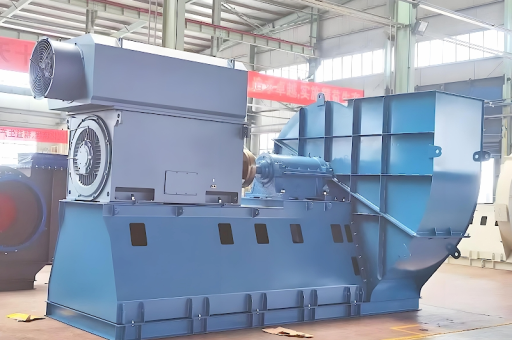
It appears you are describing a high-performance industrial blower designed for a blast furnace material handling application, utilizing HG785 alloy steel in its construction.
Here is a breakdown of what this specific combination means for the equipment and its application.
The Material: HG785 Alloy Steel
- What it is: HG785 is a high-strength, low-alloy (HSLA) structural steel, popular in Chinese and international heavy machinery standards. It often corresponds to Q690 (China) or S690QL (European standard).
- Key Properties:
- High Yield Strength: Typically 690 MPa (100,000 psi). This allows for much thinner material sections than standard mild steel (like Q235) for the same load.
- Good Toughness: Maintains impact resistance, which is crucial for high-speed rotating equipment.
- Weldability: Requires specific pre-heat and post-weld treatment (PWHT) but is designed for fabrication.
The Application: Blast Furnace Material Handling
- Environment: Extremely harsh. High temperatures (ambient and gas), heavy dust loads, and potentially corrosive gases (CO, CO2, SOx).
- Function: A "High Volume" blower in this context is typically used for:
- Conveying: Pneumatic transport of pulverized coal, sintered ore, or coke fines.
- Process Air: Providing combustion air for the hot stoves (though "high volume" often points more toward material transport).
- Dust Collection: Induced draft for baghouses or scrubbers to handle the massive dust load.
The Equipment: "Material Handling Blower"
This is a specialized centrifugal fan or positive displacement blower, not a simple HVAC fan.
- Construction: Because of HG785, the impeller, casing, and shaft can be made lighter and stronger. For a blast furnace, the impeller is often backward-curved or radial-tipped to handle heavy dust without clogging or erosion.
- High Volume: Implies a very high CFM (Cubic Feet per Minute) rating, likely in the range of 100,000 to 500,000+ CFM for a large blast furnace.
- Specific Features for HG785 + Blast Furnace:
- Erosion Resistance: The high strength of HG785 allows for hard-facing (e.g., with Stellite or tungsten carbide) on leading edges without cracking.
- High-Temperature Stability: While HG785 loses some strength above 400°C (752°F), at typical blast furnace gas temperatures (80°C – 250°C), it performs excellently.
- Fatigue Resistance: The high cycle fatigue from high-speed rotation (often 1,500–3,000 RPM) is better handled by this alloy than standard carbon steel.
Summary of Advantages & Considerations
| Aspect | Advantage of using HG785 |
|---|---|
| Weight Reduction | Lighter impeller means lower rotational inertia (faster start/stop), lower bearing loads, and cheaper foundations. |
| Durability | Superior resistance to casing distortion and impeller cracking under high pressure (10–30 kPa or more). |
| Efficiency | Thinner cross-sections allow for more aerodynamic impeller blade designs, potentially improving efficiency by 2-5% over standard steel. |
| Consideration | Cost. HG785 is more expensive than Q235 or Q345 steel. Fabrication. Requires careful welding and heat treatment to avoid hydrogen cracking. |
Would you like more specific information?
To give you more targeted technical advice (e.g., impeller design, shaft sizing, or bearing selection for this specific alloy), please let me know:
- Required Air Volume (CFM/m³/hr) and Pressure (in. w.g. / Pascal) .
- Gas Temperature (Ambient or hot gas from blast furnace top?).
- Dust Load (grams per cubic meter?).
- Rotating Speed (Direct drive or belt driven?).
If you are procuring this blower, ensure the supplier has a WPS (Welding Procedure Specification) specifically for HG785 post-weld heat treatment.





