
This article's table of contents introduction:
- Performance Profile (The Target)
- Key Design Features Required
- Why "Materials Drying"?
- The "Stainless Steel" (SS) Consideration
- Critical Questions for the Manufacturer
- Summary
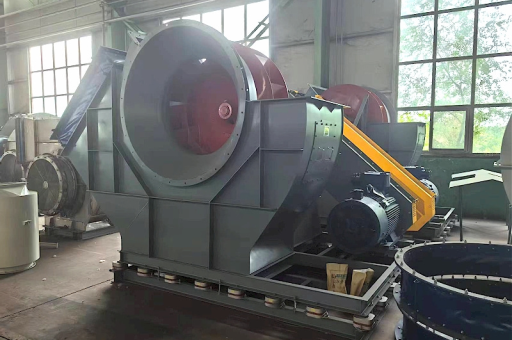
Based on the parameters you provided—10474 Pa (pressure), 10371 m³/h (airflow), and Stainless Steel construction—this appears to be a specification request for a high-pressure, medium-flow centrifugal blower fan designed for a materials drying system.
Here is a technical breakdown and what you need to know about this specific fan specification.
Performance Profile (The Target)
- Flow Rate: 10,371 m³/h (≈ 6,100 CFM)
- Static Pressure: 10,474 Pa (≈ 42 inches of water gauge or 1.52 PSI)
- Operating Condition: Single Inlet (SI)
Analysis:
- This is a very high pressure for this flow rate.
- In HVAC terms, this pressure is typically used for pneumatic conveying (moving particles like sawdust, plastic pellets, or grain) or forced draft industrial drying systems, not standard ventilation.
- The power requirement (Shaft Power) will be significant.
- Rough estimate: $Power (kW) = \frac{Flow (m³/s) \times Pressure (Pa)}{1000 \times Efficiency}$
- $10,371 m³/h = 2.88 m³/s$
- Assuming 75% static efficiency: $P = \frac{2.88 \times 10,474}{1000 \times 0.75} \approx 40.2 \text{ kW}$
Key Design Features Required
To achieve this pressure/flow ratio with stainless steel, the fan must be specific:
| Feature | Requirement for this spec |
|---|---|
| Fan Type | Centrifugal, Backward Curved (or Airfoil wheels are best for efficiency). Forward curved cannot handle this pressure. |
| Housing | Scroll (Volute) housing. Heavy gauge SS304 or SS316. |
| Impeller | Radial tip or Backward Inclined with heavy reinforcement. Must be dynamically balanced for high RPM. |
| Speed (RPM) | Very High. Est. 2,900 - 3,500 RPM (direct drive required, belt drive may slip). |
| Motor | 45 kW - 55 kW (60-75 HP), 2-pole (2900/3500 rpm). Must specify if explosion-proof (if drying combustible dust). |
| Inlet | Single Inlet (SI) with a conical inlet cone (venturi) to reduce turbulence. |
Why "Materials Drying"?
Drying systems (flash dryers, fluid bed dryers, spray dryers) use high-pressure fans to:
- Force hot air through a dense material bed.
- Convey the dried material through ductwork to a cyclone or baghouse.
- Overcome the pressure drop of heat exchangers, burners, and filter bags.
The "Stainless Steel" (SS) Consideration
You have specified SS construction. This is critical for:
- Corrosion: Drying acidic materials (e.g., wood, certain chemicals, food powders).
- Hygiene: Food or pharmaceutical drying where rust from mild steel would contaminate the product.
- Temperature: SS handles the elevated temperatures (80°C - 200°C+) common in drying better than carbon steel.
Typical SS grades:
- SS304: General use, good for food, light chemicals.
- SS316: Required if drying chlorides (e.g., salt, seafood, certain acids).
- SS310: Required if drying at very high temperatures (>400°C).
Critical Questions for the Manufacturer
When ordering this fan, you must specify:
| Question | Why it matters |
|---|---|
| Air Density? | The 10,474 Pa is likely static pressure. Fans are rated for standard air (1.2 kg/m³). If drying at 150°C, the air density is ~0.8 kg/m³, which drastically changes motor power and pressure capability. |
| Standard or Actual Flow? | Is the 10,371 m³/h at actual conditions (hot/wet) or standard conditions (compensated to 20°C)? |
| Spark Resistant? | If drying combustible dust (sugar, starch, wood), you need AMCA Type A or B spark-resistant construction (no aluminum in the air stream). |
| Drive Type? | At 10,474 Pa, Direct Drive is strongly preferred. Belt drives lose efficiency and require heavy maintenance at this load. |
| Discharge Position? | Where does the outlet need to face (Top Horizontal, Down Blast, etc.)? |
Summary
You are specifying a heavy-duty, high-speed, stainless steel centrifugal fan rated for approximately 40-55 kW (55-75 HP).
- If this is for a new system: Expect a large fan (approx. 500-600mm inlet diameter, 900-1000mm outlet width).
- If this is a replacement: Verify the existing motor frame size and shaft rotation direction. Ensure the existing ductwork is rated for 10,000+ Pa (they will implode if made of light gauge sheet metal).
Recommendation: Ask the supplier for a performance curve specifically for your air density (temperature). Without it, a standard fan may stall or the motor may overload.





