
This article's table of contents introduction:
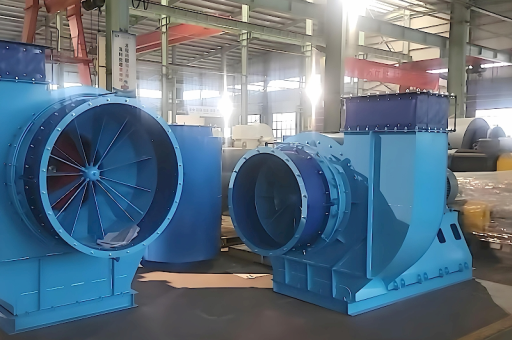
- The Most Likely Application: Induced Draft (ID) Fan
- Why Alloy Steel is Necessary at 1800 RPM & High Temp
- Key Fan Type: Centrifugal - Forward or Backward Curved
- Critical Design Considerations for Your Fan
- Summary Table for a Power Plant 1800 RPM Alloy Steel Fan
- Need More Specific Help?
Based on your query, it appears you are looking for a fan designed for a power plant application that operates at 1800 RPM, is made of alloy steel, and can withstand high temperatures inside a furnace.
Here is a breakdown of what this specification typically refers to, the challenges involved, and the most common type of fan that fits this description.
The Most Likely Application: Induced Draft (ID) Fan
In a power plant (coal, biomass, or waste-to-energy), the most critical fan that combines alloy steel, high temperature, and 1800 RPM is the Induced Draft (ID) Fan or a Primary Air (PA) Fan.
- Function: ID fans pull hot flue gas through the boiler, economizer, scrubbers, and stack.
- Temperature: Flue gas temperatures can range from 140°C (284°F) to over 400°C (752°F) depending on the location in the system.
- Material: Standard carbon steel cannot handle these temperatures and corrosive gases. Alloy steel (specifically Corten steel or stainless steel alloys like 310S or 316L) is required for strength and corrosion resistance.
- Speed: 1800 RPM is a standard speed for a 4-pole motor (1500 RPM in 50Hz regions / 1800 RPM in 60Hz regions). At this speed, the fan impeller experiences significant centrifugal stress, requiring high-strength alloy steel.
Why Alloy Steel is Necessary at 1800 RPM & High Temp
- Creep Resistance: At high temperatures, standard steel loses its strength and deforms over time (creep). Alloy steels (e.g., Chrome-Moly steels) maintain structural integrity.
- Stress: At 1800 RPM, a large-diameter impeller generates massive centrifugal forces. The alloy must have a high yield strength to prevent the blades from tearing off.
- Corrosion: High-sulfur coal or biomass creates acidic condensation. Alloy steel resists this.
- Erosion: Fly ash erodes blades. Hard-faced alloy steel extends life.
Key Fan Type: Centrifugal - Forward or Backward Curved
Given the speed (1800 RPM) and temperature, this is almost certainly a Centrifugal Fan, not an Axial Fan.
- If it is a Heavy-Duty Backward Curved (Airfoil or Radial Tip):
- Pros: High efficiency, stable performance curve, self-limiting power.
- Use: Cleaner flue gas, main boiler ID/FD fans.
- If it is a Forward Curved or Radial Blade:
- Pros: Handles dust and sticky particles better.
- Use: Dust collectors, pneumatic conveying.
Critical Design Considerations for Your Fan
If you are specifying or purchasing this fan, you must verify these parameters:
- Temperature Rating: What is the maximum continuous temperature? (e.g., 200°C vs 450°C changes the alloy required). You may need water-cooled bearings or a shaft cooling fan to protect the motor/bearings.
- Specific Alloy Grade: "Alloy Steel" is vague. Common grades:
- ASTM A387 (Gr 5, 9, 11, 22): Chromium-Molybdenum steel for high temp strength.
- SS 310 / 310S: High temperature stainless steel (up to 980°C).
- Corten A/B: Weathering steel for moderate temperatures (up to 400°C) with corrosion resistance.
- Dynamic Balancing: At 1800 RPM (approx. 30 Hz), the fan must be balanced to ISO G2.5 or G1.0 standard to avoid vibration and bearing failure.
- VFD Capability: Is the fan connected to a VFD? Operating away from the natural frequency (60 Hz / 1800 RPM base) can cause resonance.
Summary Table for a Power Plant 1800 RPM Alloy Steel Fan
| Parameter | Typical Specification |
|---|---|
| Type | Centrifugal (Radial or Backward Curved Airfoil) |
| Application | ID (Induced Draft) or PA (Primary Air) |
| Speed | 1800 RPM |
| Material | Alloy Steel (Corten / Chrome-Moly / SS316) |
| Drive | Direct drive or Coupling (V-Belt less common at this power) |
| Bearings | Spherical roller bearings with high-temp grease |
| Lubrication | Centralized or Oil bath with cooling |
| Standard | API 673 or ISO 13769 (for heavy duty) |
Need More Specific Help?
To give you a more accurate recommendation, please provide:
- Gas temperature (min / normal / max).
- Gas composition (Is it corrosive? Sulfur? Chlorine?).
- Static pressure required (e.g., 20 inches WC / 5000 Pa).
- Volume flow (CFM or m³/h).
- Fan size (Impeller diameter in mm or inches).
In short: What you are describing is a high-speed, heavy-duty centrifugal fan common in the boiler island of a power plant, specifically designed to survive harsh thermal and mechanical conditions.





