
This article's table of contents introduction:
- Specification Breakdown
- Critical Design Features Required
- Fan Laws & Performance Check
- Potential Issues & Recommendations
- Final Verdict
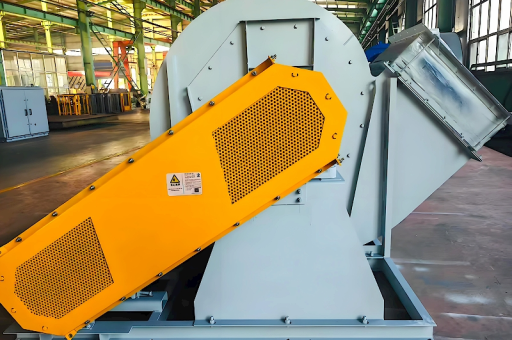
It appears you are describing the key specifications for a Centrifugal Induced Draft (ID) Fan intended for a Metallurgy Dust Collection system.
Here is a breakdown of what those specifications mean and how to interpret them for selection or application:
Specification Breakdown
- Application: Metallurgy Dust Collection
- Challenge: High dust load, abrasive particles (metal oxides, coke, flux), high temperatures.
- Fan Type: Centrifugal Induced Draft (ID) . This means the fan is located after the dust collector (baghouse, ESP, or scrubber) on the "clean" side, pulling air through the system.
- Speed: 1450 r/min (RPM)
- This typically indicates a 4-pole motor (standard for 50Hz mains, or high-slip for 60Hz with VFD).
- At this RPM for a dust collection fan, the impeller is likely large diameter and heavy. Balance (ISO 1940 G2.5 or G6.3) is critical to prevent vibration failure.
- Pressure: 7086 Pa
- This is a high static pressure (~708 mmWG / 28.3 inWG).
- Implication: The system has significant resistance, likely due to a very dense filter media (high efficiency baghouse), long duct runs, or restrictive process connections (e.g., furnace off-takes, ladle transfer stations).
- Volume: Not specified.
- You need the volumetric flow rate (m³/h or CFM). The power of the motor cannot be calculated without this.
- Typical range: For a metallurgy fan at this pressure, airflow could be 10,000 m³/h (small) to 150,000 m³/h (large furnace).
Critical Design Features Required
For a Metallurgy application with this pressure (7086 Pa), a standard industrial fan will fail quickly. You need a Heavy-Duty design:
| Feature | Requirement | Why? |
|---|---|---|
| Impeller Type | Backward Curved (BC) or Airfoil (AF) | High efficiency (70-85%) for high pressure. Backward curve is self-limiting on power. |
| Material | Corten Steel (S355J2W/N) or Abrasion-Resistant Steel (e.g., Hardox 400/500) | Particle erosion at 1450 RPM is aggressive. Standard mild steel will wear through in weeks. |
| Thickness | Heavy plate (8mm to 20mm+ depending on size) | Withstands the stress of 7086 Pa and vibration from dust imbalance. |
| Shaft Seals | Labyrinth / Carbon Ring / Purged | Prevents dust ingress into bearings (leading cause of failure in ID fans). |
| Wear Lining | Replaceable sacrificial plates at the inlet cone and impeller periphery (ceramic tile or hard-faced weld overlay). | Mandatory for longevity with abrasive dust. |
| Bearing Type | Heavy-duty spherical roller bearings (SKF/FAG/TIMKEN) rated for L10 life > 50,000 hours. | Must handle high radial loads from belt drive or direct drive at this pressure. |
Fan Laws & Performance Check
If you are testing this fan or looking at a curve, remember the fan laws for Speed (N) and Pressure (P) :
- P ∝ N² (Pressure changes with the square of speed)
- Flow ∝ N
- Power ∝ N³
Check: At 1450 RPM / 7086 Pa, this fan could potentially operate at a higher speed.
- If the fan is rated for 1480 RPM (50Hz typical), 1450 RPM might be a derated condition (e.g., for wear or noise control).
- If it is a 60Hz application, 1450 RPM is slow (4-pole motor slip). This suggests a large diameter impeller.
Potential Issues & Recommendations
- Vibration: At 1450 RPM and 7086 Pa, the impeller must be dynamically balanced to ISO 1940 G2.5 (1.2 kg-mm/kg at this speed). Use accelerometers on bearing housings for continuous monitoring.
- Temperature: If the gas being handled is hot (e.g., >80°C), you need a cooling wheel on the shaft or a heat-slinging disc to protect the bearings.
- Motor Power: Estimate required power:
Power (kW) = (Volume (m³/h) × Pressure (Pa)) / (3600 × Efficiency × 1.0)- Example: If Volume = 30,000 m³/h, Efficiency = 0.78:
Power = (30,000 × 7086) / (3600 × 0.78) = 75,700 W→ ~90 kW Motor (with safety factor).
- Do not guess. Oversizing the motor by 15-25% is standard for dust collection to handle filter blinding.
Final Verdict
You have a High-Pressure, Medium-Speed, Heavy-Duty ID Fan. This is not a standard ventilation fan. It is custom-built for high resistance systems.
To proceed:
- Get the design flow rate (m³/h). Without it, you cannot select a motor or verify the fan curve.
- Check the dust type. Is it coarse (cast iron) or fine (silica/fly ash)? This dictates wear protection.
- Check the temperature. >120°C requires special shaft cooling and bearing selection.
If you can provide the flow rate (m³/h) and the gas temperature (°C) , I can help you verify the motor size and confirm the fan selection.





