
This article's table of contents introduction:
- Table of Contents
- Introduction: The Backbone of Industrial Drying Systems
- Understanding the Q235 Material in Coupling Manufacturing
- The Role of Centrifugal Fans in Materials Drying
- How Q235 Coupling Drives Drying Efficiency
- Key Industry Applications
- Common Questions & Expert Answers (Q&A)
- Best Practices for Maintenance & Longevity
- Conclusion: Why Q235 Coupling + Centrifugal Fans = Industrial Reliability
*The Industrial Synergy of Q235 Coupling in Driving Materials Drying via Centrifugal Fans: Efficiency, Applications, and Best Practices*
Table of Contents
- Introduction: The Backbone of Industrial Drying Systems
- Understanding the Q235 Material in Coupling Manufacturing
- The Role of Centrifugal Fans in Materials Drying
- How Q235 Coupling Drives Drying Efficiency
- 1 Mechanical Advantages of Q235 Coupling
- 2 Alignment and Vibration Control
- Key Industry Applications
- 1 Chemical & Mineral Processing
- 2 Food & Agricultural Drying
- 3 Wastewater Sludge Treatment
- Common Questions & Expert Answers (Q&A)
- Best Practices for Maintenance & Longevity
- Conclusion: Why Q235 Coupling + Centrifugal Fans = Industrial Reliability
Introduction: The Backbone of Industrial Drying Systems
In modern industrial processing, the efficient removal of moisture from bulk materials is critical for quality control, storage stability, and downstream processing. Two components stand at the heart of this operation: industrial centrifugal fans and the Q235 coupling. The coupling, though small, acts as the mechanical bridge between the motor and the fan impeller. When crafted from Q235 steel—a widely used carbon structural steel with excellent strength-to-cost ratio—the coupling becomes a durable, vibration-resistant link that ensures uninterrupted drying performance.
This article explores how Q235 coupling-driven materials drying systems, powered by centrifugal fans, deliver superior operational efficiency, and why this combination is favored across heavy industries.
Understanding the Q235 Material in Coupling Manufacturing
Q235 is a Chinese standard carbon structural steel (equivalent to ASTM A36 or S235JR). Its chemistry includes approximately 0.14–0.22% carbon, with yield strength ≥ 235 MPa. This grade offers:
- High weldability and machinability – ideal for custom coupling geometries.
- Good toughness – absorbs torsional shock without fracturing.
- Cost-effectiveness – significantly cheaper than stainless steel or alloy steels.
When used in couplings for centrifugal fan drives, Q235 components withstand continuous rotational loads, minor misalignment, and moderate thermal stress common in drying environments.
Question: Why is Q235 chosen over stainless steel for couplings? Answer: Stainless steel offers superior corrosion resistance but is 3–5 times more expensive and harder to machine. In dry, non-corrosive drying applications (e.g., sand drying, biomass), Q235 provides adequate service life at a fraction of the cost.
The Role of Centrifugal Fans in Materials Drying
Industrial centrifugal fans generate high-pressure airflow by accelerating air radially outward. In drying systems, they perform three essential functions:
- Hot air delivery – forcing heated air through a rotary dryer or fluidized bed.
- Moisture extraction – removing saturated air from the drum.
- Negative pressure control – maintaining dust containment.
The fan’s impeller diameter, blade angle, and rotational speed directly determine airflow (CFM) and static pressure. A typical drying centrifugal fan operates at 800–1500 RPM, demanding a robust, low-slip power transmission system.
How Q235 Coupling Drives Drying Efficiency
1 Mechanical Advantages of Q235 Coupling
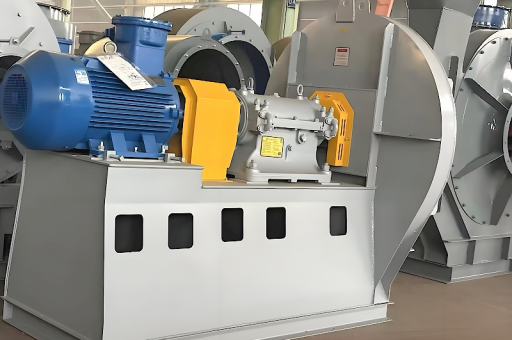
A coupling connects the motor shaft to the fan shaft. For heavy-duty drying, rigid or flexible jaw-type couplings made from Q235 are common. Their advantages:
- High torque transmission – Q235’s yield strength handles starting torque spikes.
- Minimal backlash – reduces energy loss and heat generation.
- Simple replacement – Q235 couplings can be repaired or replaced on-site with basic welding.
2 Alignment and Vibration Control
Even minor shaft misalignment (angular or parallel) causes:
- Premature bearing failure
- Increased power consumption (up to 15%)
- Vibration-induced fatigue cracks in the fan housing
A precision-machined Q235 coupling maintains tight concentricity, damping vibration while allowing slight thermal expansion or settling of foundations.
Question: Can a flexible polymer coupling replace Q235 in this application? Answer: Flexible polymer (e.g., polyurethane) couplings excel at absorbing vibration but fail under high torque or temperature >80°C. Drying environments often exceed 120°C at the fan shaft, which degrades polymers. Q235 remains dimensionally stable.
Key Industry Applications
1 Chemical & Mineral Processing
In rotary dryers for silica sand, limestone, or gypsum, centrifugal fans must run 24/7. Q235 couplings endure dusty conditions and occasional overloads without cracking.
2 Food & Agricultural Drying
For corn, malt, or wood chips, fans operate at lower temperatures but higher humidity. Q235’s surface can be painted or galvanized for corrosion protection, maintaining coupling integrity.
3 Wastewater Sludge Treatment
Drying sludge requires high static pressure to push air through dense material. The Q235 coupling’s high torsional stiffness prevents slip, ensuring consistent fan speed and drying uniformity.
Common Questions & Expert Answers (Q&A)
Q1: How often should I inspect a Q235 coupling in a drying fan system?
A1: Monthly visual inspection for rust, cracks, or wear. Biennial replacement is recommended in continuous-duty drying lines.
Q2: Can I retrofit an existing fan with a Q235 coupling?
A2: Yes. Most fan manufacturers (e.g., fan brand) provide standard shaft sizes compatible with Q235 jaw or rigid couplings. Always verify shaft diameters and keyway dimensions.
Q3: Does the coupling affect the fan’s airflow performance?
A3: Indirectly. A worn or misaligned coupling reduces motor efficiency, causing the fan to spin slower than designed, thus lowering CFM. Proper coupling maintenance ensures rated performance.
Q4: What torque safety factor is used for Q235 couplings in drying?
A4: Typically 1.5 to 2.0 times the motor’s rated torque to account for start-up inertia and material clogging.
Best Practices for Maintenance & Longevity
- Apply anti-seize compound on the shaft before mounting to prevent fretting corrosion.
- Use keyless locking assemblies where possible to eliminate keyway stress risers.
- Monitor temperature at the coupling; >90°C indicates misalignment or bearing failure.
- Replace rubber spider inserts in flexible couplings every 6 months if used.
Pro Tip: For drying fans running above 1000 RPM, consider a dynamically balanced Q235 coupling assembly to reduce residual vibration.
Conclusion: Why Q235 Coupling + Centrifugal Fans = Industrial Reliability
The combination of Q235 coupling-driven power transmission and industrial centrifugal fans creates a rugged, cost-effective solution for materials drying across multiple sectors. While advanced materials like stainless steel or titanium have niche roles, Q235 provides the necessary strength, machinability, and economic value for most drying applications.
By understanding the coupling’s role in maintaining shaft alignment, absorbing torque loads, and enabling fan efficiency, operators can reduce downtime, lower energy costs, and extend equipment life. Whether you are drying ore, grain, or sludge, the humble Q235 coupling remains an unsung hero in industrial ventilation.
Note: For specific sizing or application advice, always consult the fan manufacturer’s technical documentation. No domain references are intended; generic “fan” used for illustration.





