
This article's table of contents introduction:
- The Core Concept
- Detailed Breakdown
- Common Visual & Mechanical Characteristics
- Pros & Cons of this Configuration
- Is this the right fan for you?
- Summary
This appears to be a description of a specific industrial fan configuration used in dust collection systems for building ventilation. Let me break down exactly what this system is, the terminology, and its key characteristics.
The Core Concept
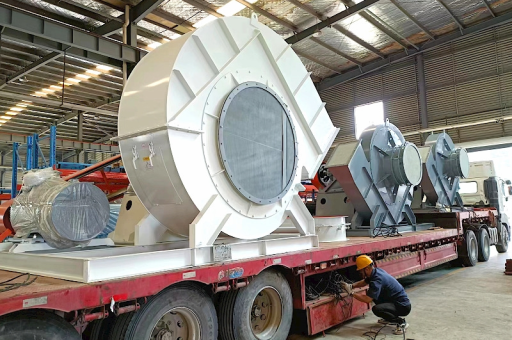
This is a Centrifugal Fan that is powered by an electric motor via V-belts, designed to move air (often laden with dust, fumes, or particles) through a Dust Collector (like a baghouse, cartridge collector, or cyclone) to clean the air before it is exhausted or recirculated inside a building.
Here is a breakdown of each component and why this configuration is so common.
Detailed Breakdown
The Fan: Centrifugal Fan
- How it works: Air enters the center of a rotating wheel (impeller), is accelerated outward by centrifugal force, and is discharged at a right angle (usually 90 degrees) to the inlet.
- Why for Dust Collection?
- High Static Pressure: Dust collectors (filters, ducts) create a lot of resistance (pressure drop). Centrifugal fans are excellent at generating the high pressure required to overcome this resistance.
- Sturdy Construction: They can be built with heavy-duty materials (steel, abrasion-resistant liners) to handle abrasive dust without failing.
- Non-Overloading Power Curve: A key safety feature. An impeller designed for dust collection (often "radial" or "paddle wheel" style) will not overload the motor if the duct gets clogged or the filter is dirty. The motor amperage drops when airflow is restricted.
The Drive Mechanism: V-Belt Driven
- How it works: An electric motor has a small pulley (sheave). The fan shaft has a large pulley. They are connected by one or more V-belts.
- Why not direct drive?
- Speed (RPM) Control: Dust collectors operate at specific airflows and pressures. A V-belt allows you to easily change the fan speed by swapping the pulleys. This is crucial for "system balancing."
- Torque Management: V-belts provide a smooth start and can absorb the shock load of starting a heavy fan wheel.
- Motor Protection: Belts can slip under extreme overload (e.g., a bearing failure), acting as a mechanical fuse to protect the expensive motor from burning out instantly.
- Motor Isolation: The motor sits on a pivoting base (a "belt tensioner base"). This isolates the motor bearings from the heat and vibration of the fan.
The Application: Building Ventilation & Dust Collection
- Building Ventilation: This refers to the system's purpose: to extract contaminated air from inside a workspace (factory, warehouse, woodshop) and replace it with fresh, make-up air.
- Dust Collector: The fan is the "engine" of the dust collection system. It pulls dusty air from the building through filters. The clean air is then either:
- Exhausted outside (most common for hazardous dust).
- Recirculated back into the building (saves heating/cooling energy, but requires high-efficiency HEPA filters).
Common Visual & Mechanical Characteristics
If you are looking at a fan described this way, it will typically have these features:
- "A" or "B" Section V-Belts: Most common sizes.
- Belt Guard: A mandatory metal mesh guard covering the belts and pulleys for safety.
- Bearing Pedestals: The fan shaft is supported by heavy-duty, pillow-block bearings on a steel base.
- Belt Tensioning Base: The motor is mounted on rails or a sliding base to adjust belt tension.
- Housing: Usually made of welded steel plate. The outlet can be positioned in different orientations (e.g., top horizontal, downblast, etc.).
- Access Door: A small door on the fan housing or inlet to allow cleaning out accumulated dust.
Pros & Cons of this Configuration
| Pros | Cons |
|---|---|
| Flexible Speed (change pulleys for different CFM) | Belt Wear (belts need periodic tensioning and replacement) |
| Motor Protection (belt slip prevents burnout) | Lower Efficiency (friction in belts is a power loss compared to direct drive) |
| Lower Motor Cost (can use a standard, high-speed motor) | More Maintenance (belts, pulleys, bearings) |
| Better for High Pressure (can handle dirty, stagnant start-up loads) | Space (takes up more physical space than a direct-drive fan) |
Is this the right fan for you?
Yes, if:
- Your building has a central dust collection system (e.g., for woodworking, metal grinding, powder coating).
- You need to move air against high static pressure (e.g., through long ducts and cartridge filters).
- You want the ability to adjust airflow later (fine-tuning) without changing the motor.
No, if:
- You need a variable-speed drive (VFD) for precise, automated speed control (a belt drive can still use a VFD on the motor, but it's less common).
- You have a clean, low-pressure application (like a simple exhaust fan).
- You want the absolute maximum energy efficiency.
Summary
A Building Ventilation Dust Collector Fan V Belt Driven Centrifugal Fan is the standard workhorse of industrial air cleaning. It is a rugged, reliable, and field-adjustable system designed to move dusty air through filters at high pressure, using a belt system for speed flexibility and motor protection.





