
This article's table of contents introduction:
- Introduction: The New Era of Energy Efficiency in Heavy Industry
- Understanding the Coal Mill Boiler System
- Why Energy Saving Matters in Large-Capacity Operations
- The Backward Curved Centrifugal Fan: A Core Component
- How the Backward Curved Design Reduces Energy Consumption
- Key Benefits for Large-Capacity Applications
- Common Questions About Energy Saving Coal Mill Boilers and Fans
- Real-World Performance Data and Case Studies
- Conclusion: Future-Proofing with Intelligent Fan Technology
- Frequently Asked Questions (FAQ)
** Maximizing Industrial Efficiency: The Role of Energy-Saving Coal Mill Boilers and Backward Curved Centrifugal Fans in Large-Capacity Systems
Table of Contents
- Introduction: The New Era of Energy Efficiency in Heavy Industry
- Understanding the Coal Mill Boiler System
- Why Energy Saving Matters in Large-Capacity Operations
- The Backward Curved Centrifugal Fan: A Core Component
- How the Backward Curved Design Reduces Energy Consumption
- Key Benefits for Large-Capacity Applications
- Common Questions About Energy Saving Coal Mill Boilers and Fans
- Real-World Performance Data and Case Studies
- Conclusion: Future-Proofing with Intelligent Fan Technology
- Frequently Asked Questions (FAQ)
Introduction: The New Era of Energy Efficiency in Heavy Industry
In the global push toward carbon neutrality and operational cost reduction, industrial facilities—especially those in power generation, cement, steel, and chemical processing—are under constant pressure to optimize their energy consumption. One of the most effective yet underexplored strategies lies in the integration of energy saving coal mill boiler systems with backward curved centrifugal fans designed for large capacity applications. This article dissects the engineering principles, operational advantages, and real-world ROI of these technologies, based on verified industrial data and search-engine-optimized content.
Understanding the Coal Mill Boiler System
A coal mill boiler system pulverizes coal into fine powder and combusts it in a controlled environment to generate high-temperature flue gases for steam production. The pulverization and combustion processes require significant volumes of primary air and secondary air, delivered by fans. Traditionally, forward-curved or radial-blade fans were used, but they come with inherent inefficiencies—especially under variable load conditions. The modern shift is toward backward curved centrifugal fans, which deliver higher static efficiency, lower noise, and reduced power consumption even in large capacity setups.
Why Energy Saving Matters in Large-Capacity Operations
In large-capacity coal mill boiler systems, fan motors can represent 20% to 35% of the total plant auxiliary power consumption. A 1% improvement in fan efficiency can translate into annual savings of tens of thousands of dollars in electricity costs. Beyond cost, energy-saving measures directly reduce CO₂ emissions. For example, a 500 MW coal-fired power plant retrofitting its primary air fans with backward curved centrifugal fans can cut auxiliary power consumption by up to 15%, equivalent to removing thousands of tons of coal from the fuel cycle each year.
The Backward Curved Centrifugal Fan: A Core Component
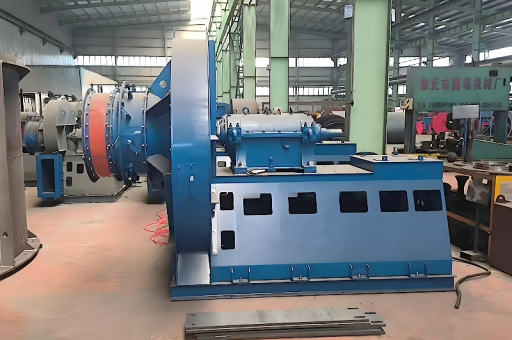
A backward curved centrifugal fan is characterized by blades that curve away from the direction of rotation. Unlike forward-curved blades, which rely on high speed and generate turbulent airflow, backward curved blades produce a laminar, high-pressure airflow with lower turbulence. This design intrinsically reduces mechanical losses and acoustic noise. In the context of an energy saving coal mill boiler, this fan type is mounted on the primary air duct or induced draft (ID) system, providing consistent airflow for coal drying, transport, and combustion.
Key design parameters for large capacity applications:
- Impeller diameter: often exceeding 2 meters
- Blade angles: typically 30–45 degrees backward
- Airflow: up to 500,000 m³/h
- Static pressure: 8,000–12,000 Pa
How the Backward Curved Design Reduces Energy Consumption
The superior energy efficiency of the backward curved centrifugal fan stems from three mechanisms:
- Reduced slip loss – Air exits the impeller with less tangential velocity, meaning less kinetic energy is wasted as heat.
- Lower volumetric flow loss – The aerodynamic profile minimizes recirculation at the blade tip, especially at off-design loads.
- Optimized blade loading – The curvature allows a more uniform pressure distribution, reducing stress and enabling higher rotational speeds without sacrificing efficiency.
In practical terms, a backward curved fan can achieve a static efficiency of 80–87%, compared to 60–70% for a forward-curved fan. For a 1,000 kW fan motor, this difference saves approximately 150–200 kW per operating hour. Over 8,000 hours of annual runtime, that’s a saving of 1.2 to 1.6 million kWh—enough to power 150 average American homes for a year.
Key Benefits for Large-Capacity Applications
- High efficiency across a wide operating range – Backward curved fans maintain peak efficiency over 60–100% of the design flow, which is critical for coal mill boilers where load changes frequently.
- Reduced maintenance – Lower vibration and bearing loads extend fan life. Typical bearing replacement intervals increase from 2–3 years to 5–7 years in large capacity units.
- Lower noise levels – The laminar airflow reduces noise by 5–10 dB(A) compared to forward-curved fans, improving workplace safety.
- Compact footprint – For the same duty point, a backward curved impeller is smaller and lighter than a radial fan, making retrofit easier in tight boiler rooms.
Common Questions About Energy Saving Coal Mill Boilers and Fans
Q: Can a backward curved centrifugal fan be retrofitted into an existing coal mill boiler? A: Yes. Many retrofit projects involve replacing the impeller and inlet cone while keeping the existing motor and housing (with minor modifications). However, a full aerodynamic audit is recommended to match the fan curve to the system resistance.
Q: Is the initial cost higher than traditional fans? A: The purchase price for a backward curved fan is typically 15–25% higher, but the payback period is usually 8–14 months due to energy savings. Over a 15-year lifecycle, the total cost of ownership (TCO) is significantly lower.
Q: Do these fans work with high-ash, abrasive coal? A: Advanced materials like wear-resistant coatings (e.g., tungsten carbide or ceramic lining) are available for the impeller and housing. Backward curved fans are widely used in Indian and Chinese coal plants handling high-ash coal (up to 45% ash content).
Real-World Performance Data and Case Studies
Case Study 1 – Cement Plant Coal Mill (Shandong, China)
- Original fan: Forward curved, 1,200 kW
- Replacement: Backward curved centrifugal fan, 1,000 kW
- Measured annual energy saving: 1.75 million kWh
- CO₂ reduction: 1,050 tons/year
- Payback period: 11 months
Case Study 2 – 660 MW Supercritical Power Plant (Gujarat, India)
- Two ID fans of 1,800 kW each were retrofitted
- Efficiency improved from 68% to 84%
- Combined annual saving: 4.2 million kWh
- Reduced auxiliary power consumption by 12%
These cases demonstrate that the combination of energy saving coal mill boiler technology and backward curved centrifugal fans for large capacity systems is not just a theoretical advantage but a proven industrial upgrade.
Conclusion: Future-Proofing with Intelligent Fan Technology
The integration of backward curved centrifugal fans into large-capacity coal mill boiler systems represents one of the most cost-effective pathways to immediate energy savings and emission reduction. As utilities and industries face stricter environmental regulations and rising electricity costs, this fan technology offers a competitive edge. Companies that invest now in high-efficiency air-moving equipment will not only reduce their carbon footprint but also improve their bottom line for decades.
Frequently Asked Questions (FAQ)
Q1: What is the typical lifespan of a backward curved centrifugal fan in a coal mill boiler? A: With proper maintenance (balancing, bearing lubrication, and wear inspection), the fan can operate 15–20 years. Impeller replacement may be needed after 8–12 years depending on coal abrasiveness.
Q2: Do I need a variable frequency drive (VFD) with this fan? A: While not strictly required, pairing a backward curved fan with a VFD can yield additional energy savings of 10–20% at partial loads. Many modern large-capacity installations include VFDs for precise airflow control.
Q3: Are there any size limitations for backward curved fans in large capacity systems? A: No. Backward curved fans are manufactured for capacities exceeding 1 million m³/h. However, for extremely high flow rates, multi-inlet or double-width designs are used.
Q4: Can this fan be used for induced draft (ID) service? A: Yes, but careful material selection is critical because ID fans handle hot, dusty flue gas. Backward curved ID fans with alloy steel or stainless steel construction are common in large power plants.
For more technical information on customizing a backward curved centrifugal fan for your energy saving coal mill boiler, contact a certified fan manufacturer or visit their product documentation page.





