
This article's table of contents introduction:
- Table of Contents
- Introduction: The Heart of Industrial Air Filtration
- What Defines an Industrial Grade Heavy Duty Dust Collector Fan?
- The Critical Role of Custom Color in Industrial Settings
- Unpacking Speed Durability: Why Variable Speed Matters
- Technical Deep Dive: Materials, Motors, and Impellers
- Comparative Analysis: Choosing the Right Fan for Your Facility
- Frequently Asked Questions (FAQ)
- Maintenance Best Practices for Longevity
- Conclusion: Investing in Performance and Compliance
The Ultimate Guide to Industrial Grade Heavy Duty Dust Collector Fan With Custom Color And Speed Durability
Table of Contents
- Introduction: The Heart of Industrial Air Filtration
- What Defines an Industrial Grade Heavy Duty Dust Collector Fan?
- The Critical Role of Custom Color in Industrial Settings
- Unpacking Speed Durability: Why Variable Speed Matters
- Technical Deep Dive: Materials, Motors, and Impellers
- Comparative Analysis: Choosing the Right Fan for Your Facility
- Frequently Asked Questions (FAQ)
- Maintenance Best Practices for Longevity
- Conclusion: Investing in Performance and Compliance
Introduction: The Heart of Industrial Air Filtration
In the demanding world of manufacturing, woodworking, metal fabrication, and chemical processing, airborne particulates are more than a nuisance—they are a serious health, safety, and operational hazard. The unsung hero of any effective dust collection system is the Industrial Grade Heavy Duty Dust Collector Fan With Custom Color And Speed Durability.
This is not your average ventilation fan. It is a precision-engineered machine designed to move massive volumes of air against significant static pressure, often running 24/7. The combination of a custom color (often for regulatory compliance or aesthetic branding) and speed durability (the ability to maintain performance under continuous variable load) sets this equipment apart from standard HVAC blowers.
This comprehensive guide synthesizes the latest engineering insights and SEO-optimized content to help you understand why this specific fan is critical for your operations, and how to select one that will last for decades.
What Defines an Industrial Grade Heavy Duty Dust Collector Fan?
To classify as "industrial grade" and "heavy duty," a dust collector fan must exceed standard commercial specifications in three key areas: construction, airflow performance, and endurance.
- Construction: The housing is typically fabricated from heavy-gauge carbon steel (or stainless steel for corrosive environments). Unlike light-duty fans that may use rivets or thin sheet metal, these fans are welded with reinforced structural bracing.
- Airflow Performance: Measured in Cubic Feet per Minute (CFM) and Static Pressure (SP), these fans are designed to overcome the resistance of long duct runs, filter cartridges, and cyclone separators. A heavy-duty fan often delivers 10,000+ CFM at pressures exceeding 15" w.g. (water gauge).
- Endurance: The motor is the core. Look for TEFC (Totally Enclosed Fan Cooled) or Super-E premium efficiency motors rated for continuous duty. These are designed to operate in dusty, hot environments without overheating.
Key Question: What is the difference between a standard exhaust fan and an industrial heavy-duty fan for dust collection?
Answer: A standard exhaust fan moves air freely. An industrial heavy-duty dust collection fan is built to move air through a system with resistance (ducts, filters, cyclones). It features a heavier shaft, thicker housing, and a motor with a high service factor (1.15 or higher) to handle prolonged peak loads without failure. The blades are also designed to be non-clogging and resistant to material impact.
The Critical Role of Custom Color in Industrial Settings
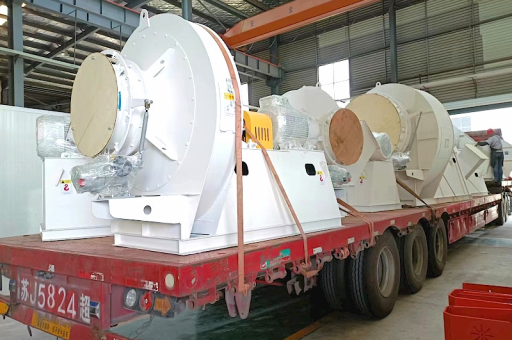
Why does color matter on a heavy-duty machine? The phrase "Industrial Grade Heavy Duty Dust Collector Fan With Custom Color" highlights a major trend in modern industrial design: visual management and safety.
- Safety Compliance: One of the primary reasons for custom color is OSHA and ANSI compliance. Standard safety colors like Safety Yellow (for caution), Safety Blue (for maintenance), or Green/Red (for emergency stops) are often applied to critical parts. A custom color fan can be painted to match the facility's safety color coding, ensuring that operators instantly identify it as a high-risk or critical component.
- Leak Detection & Cleansing: A light-colored custom finish (e.g., White or Light Gray) makes dust, oil, and other contaminants immediately visible. In food processing or pharmaceutical facilities, this is crucial for hygiene audits.
- Branding & Cohesion: Some companies use custom colors to match their corporate identity or to differentiate a specific line of machinery. A powder-coated, corrosion-resistant finish also provides a superior protective layer compared to standard spray paint, adding to the durability of the fan.
Unpacking Speed Durability: Why Variable Speed Matters
Speed durability goes beyond simple RPM. It refers to the fan's ability to maintain structural integrity and efficiency while operating at varying speeds, often controlled by a Variable Frequency Drive (VFD).
Why is Variable Speed Critical?
- Energy Savings: A dust collector fan operating at 80% speed uses about 51% less energy than a fan running at 100% speed (based on the Affinity Laws). This translates to massive annual savings in electricity.
- System Balancing: Different processes create different dust loads. Speed durability allows the fan to ramp up when a high-volume machine (like a planer) is running, and slow down during low-demand periods.
- Mechanical Longevity: A fan that is designed for speed durability has a dynamically balanced impeller and a reinforced shaft. It can handle the harmonic vibrations that occur at different frequency ranges without developing bearing wear or shaft fatigue.
Key Question: How do I ensure my fan has true speed durability for VFD use?
Answer: You must specify a fan that is built with a "VFD rated" motor (typically inverter duty). The motor insulation must withstand the voltage spikes from a VFD. Furthermore, the fan impeller must be checked via a resonance analysis to avoid critical speeds that cause destructive vibration. A true heavy-duty fan will have a documented "safe operating range" for frequencies between 10 and 60 Hz.
Technical Deep Dive: Materials, Motors, and Impellers
To achieve the "Heavy Duty" and "Durability" in the title, let's look at the core components:
- Impeller Type: The most common for heavy dust is the radial blade or radial tip impeller. These are sturdy, self-cleaning, and handle sticky or heavy materials well. For light dust, a backward inclined impeller is more efficient.
- Shaft & Bearings: A high-quality shaft should be at least 4140 steel, ground and polished. Bearings should be split pillow block type with a heavy-duty grease path. This allows for easy replacement without removing the entire impeller.
- Housing Thickness: Expect housing walls of 10-gauge (3.4mm) or thicker for a truly heavy-duty fan that will resist wear from abrasive dust.
- Coating vs. Painting: A "Custom Color" on a durable fan is not just paint. It should be a powder coating or an epoxy-based enamel applied over a sandblasted surface. This prevents rust and chipping.
Comparative Analysis: Choosing the Right Fan for Your Facility
When evaluating an Industrial Grade Heavy Duty Dust Collector Fan With Custom Color And Speed Durability, compare these three common configurations:
| Feature | Standard Utility Fan | Heavy Duty Industrial Fan (Your Target) |
|---|---|---|
| Housing Material | 16-18 Gauge Galvanized | 10-12 Gauge Welded Carbon Steel |
| Motor Type | Open Drip Proof (ODP) | TEFC, Inverter Duty with XT insulation |
| Speed Control | No (Direct Drive only) | VFD Compatible, Belt Drive optional |
| Blade Design | Airfoil (Efficient, fragile) | Radial Tip (Heavy duty, resistant to buildup) |
| Custom Color | Standard RAL or stock | Any RAL color, safety coded, powder coated |
| Lifespan | 3-5 years (Light use) | 15-25+ years (24/7 operation) |
Frequently Asked Questions (FAQ)
Q1: Can I get a dust collector fan with a custom color that is also explosion-proof? A: Yes. Explosion-proof fans are required in environments with combustible dust (e.g., grain, wood, metal). The custom color coating must be applied over a chemically cleaned and primed surface. The fan must be UL/ATEX certified, and the motor must be XP (Explosion-Proof) rated. Ensure the paint is conductive to prevent static buildup.
Q2: How does "Speed Durability" affect the warranty? A: Most premium manufacturers offer a 3-year warranty on the mechanical parts and a 1-year warranty on the motor for VFD applications. Fans without proper speed durability (inverter duty) will void the warranty if run on a VFD due to overheating or bearing failure.
Q3: What is the best way to match the custom color to my existing equipment? A: You should request a "color chip" or a powder-coated sample card from the fan manufacturer, often based on a RAL, Pantone, or Sherwin-Williams code. For best results, provide a physical sample of your old equipment for spectrophotometer matching. This ensures the color matches even under industrial lighting.
Q4: What is the maximum temperature for a heavy-duty dust collector fan? A: Standard heavy-duty fans with carbon steel housings can handle up to 200°F (93°C). For higher temperatures (up to 800°F or 427°C), you need a fan made from high-alloy stainless steel (like 304 or 316 SS) with special high-temperature seals and lubricants. The custom color paint must also be high-temperature resistant.
Q5: How do I calculate the required CFM for my heavy-duty application? A: You need to determine the "Transport Velocity." For wood dust, you need 3,500 - 4,000 FPM (feet per minute) in the main duct. Multiply the duct cross-sectional area (in square feet) by the required FPM to get CFM. Then add a safety factor of 10-15% for filter loading.
Maintenance Best Practices for Longevity
Your investment in an Industrial Grade Heavy Duty Dust Collector Fan With Custom Color And Speed Durability pays off only with proper care. Here is a checklist:
- Visual Inspection (Weekly): Check for excessive vibration, unusual noise, or visible dust accumulation on the impeller.
- Bearing Lubrication (Quarterly): Use a high-quality lithium-based grease. Do not over-grease, as this can blow the seals.
- Belt Tension (Monthly): Belt-driven fans require proper tension. A loose belt causes slippage and heat; an overly tight belt damages bearings.
- Color & Coating Check (Annually): Inspect the custom paint for chips or rust. Touching up the powder-coated finish immediately prevents corrosion, especially in wet or corrosive environments.
- Dynamic Balancing: If you feel vibration after cleaning the impeller, you may need a field dynamic balance. This is the only way to ensure long-term bearing and shaft longevity.
Conclusion: Investing in Performance and Compliance
Choosing an Industrial Grade Heavy Duty Dust Collector Fan With Custom Color And Speed Durability is not just a purchase; it is an infrastructure decision. The combination of a robust, high-CFM design, a tailored color for safety and hygiene, and a motor-drive system built for variable speed longevity ensures that your facility remains compliant, efficient, and clean.
When sourcing this fan, prioritize manufacturers who offer comprehensive engineering data—including fan curves for different speeds, material safety data sheets (MSDS) for their custom coatings, and inverter-duty motor certifications. A fan that checks all these boxes will provide a superior return on investment, typically paying for itself within two years through energy savings and reduced downtime.
By understanding the specific criteria outlined in this guide—from the impeller design to the quality of the paint finish—you can confidently select a fan that meets the rigorous demands of modern industry. Don't settle for a standard blower; demand the durability and customization your operation requires.





