
This article's table of contents introduction:
- Table of Contents
- Introduction: Understanding the Primary Air System
- Why Carbon Steel? Material Selection Rationale
- Design and Operational Mechanics of the Primary Air Fan
- Common Failure Modes and Maintenance Strategies
- Energy Efficiency and Performance Optimization
- Frequently Asked Questions (FAQ)
- Conclusion: Future Trends in Primary Air Fan Technology
*Optimizing Boiler Efficiency: The Critical Role of the Carbon Steel Primary Air Fan in Coal-Fired Power Plants*
Table of Contents
- Introduction: Understanding the Primary Air System
- Why Carbon Steel? Material Selection Rationale
- Design and Operational Mechanics of the Primary Air Fan
- Common Failure Modes and Maintenance Strategies
- Energy Efficiency and Performance Optimization
- Frequently Asked Questions (FAQ)
- Conclusion: Future Trends in Primary Air Fan Technology
Introduction: Understanding the Primary Air System
In a coal-fired boiler, the Carbon Steel Primary Air Fan is not merely a component—it is the respiratory system of the combustion process. Its primary function is to supply preheated air at sufficient pressure to transport pulverized coal from the mill to the burner nozzles, where it is ignited. Without this critical fan, the boiler cannot sustain stable combustion, leading to flame instability, incomplete fuel burn, and increased emissions.
The primary air system typically includes a forced draft fan that draws ambient air, passes it through an air preheater (to recover waste heat from flue gas), and delivers it to the coal mills. The fan must overcome system resistance—ductwork, dampers, pulverizer drag, and burner pressure drop. This is where the Carbon Steel Primary Air Fan excels due to its mechanical strength, erosion resistance, and cost-effectiveness.
In power plants, maintaining the correct air-to-fuel ratio is paramount. Too little primary air causes fuel settling in pipes (a serious safety hazard); too much air wastes energy and reduces boiler efficiency. Therefore, the design, material selection, and performance monitoring of the primary air fan directly impact plant profitability, safety, and regulatory compliance.
Why Carbon Steel? Material Selection Rationale
1 Mechanical Strength and Durability
Carbon steel, specifically grades such as ASTM A36, A516, or Q235 (depending on regional standards), is the preferred material for primary air fan impellers and housings. Unlike stainless steels or aluminum alloys, carbon steel offers a high yield strength-to-cost ratio. It can withstand the centrifugal forces exerted by large-diameter impellers rotating at speeds exceeding 1,000 RPM.
2 Erosion Resistance in Harsh Conditions
The air entering a primary air fan often contains particulate matter — fly ash, unburned carbon fines, and external dust. Although the air is pre-filtered, fine abrasive particles inevitably reach the fan blades. Carbon steel provides acceptable erosion resistance when surface-hardened or coated with wear-resistant overlays (e.g., tungsten carbide or ceramic epoxy). In severe cases, the leading edges of the blades are fitted with sacrificial wear plates.
3 Thermal and Economic Trade-offs
Carbon steel maintains its mechanical integrity up to operating temperatures around 400°C (752°F). Since the primary air is typically heated to 250–350°C after passing through the air preheater, carbon steel remains well within its safe range. Higher temperatures would require alloy steels, but at significantly higher cost. Therefore, Carbon Steel Primary Air Fan designs balance thermal performance, erosion life, and capital expenditure.
Design and Operational Mechanics of the Primary Air Fan
1 Fan Types: Centrifugal vs. Axial
The vast majority of primary air fans in utility boilers are centrifugal fans — specifically, backward-curved or radial-blade designs. Backward-curved blades are favored because they provide high efficiency (up to 85–88%) and a non-overloading power characteristic. This means that if the system resistance decreases unexpectedly, the motor does not overload.
Axial fans are sometimes used in smaller industrial boilers, but they are less common for high-pressure primary air applications.
2 Impeller and Housing Construction
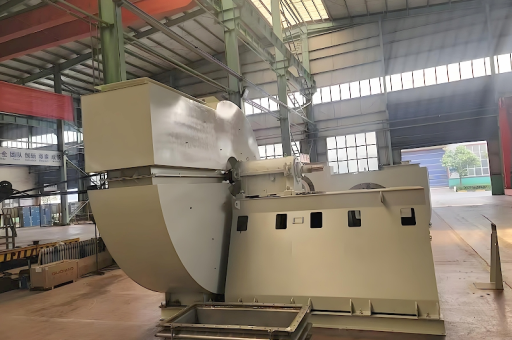
A typical Carbon Steel Primary Air Fan comprises:
- Impeller (Rotor): Fabricated from welded carbon steel plates. The blades are typically hollow-aerofoil shaped for aerodynamic efficiency, or flat radial for rugged duty.
- Volute (Casing): A spiral-shaped housing that collects air from the impeller and converts velocity energy into pressure energy. Carbon steel plates (6–12 mm thickness) are rolled and welded to form the volute.
- Inlet Cone: Directs air smoothly into the impeller eye, reducing turbulence.
- Shaft and Bearings: The impeller is mounted on a carbon steel or alloy steel shaft supported by heavy-duty spherical roller bearings.
3 Variable Speed Drive and Control
Modern primary air fans use variable frequency drives (VFDs) or hydraulic couplings to adjust speed and airflow. This is far more energy-efficient than throttling with inlet vanes or outlet dampers. In a typical coal-fired plant, the primary air fan consumes 3–5% of total station generation power; thus, even a 2% efficiency improvement yields significant annual savings.
Common Failure Modes and Maintenance Strategies
1 Blade Erosion (Leading Edge Wear)
Root Cause: Ash particles impact the blade surface at high relative velocities.
Solution: Apply erosion-resistant coatings; replace sacrificial wear plates; inspect blades every 6–12 months using ultrasonic thickness gauging.
2 Imbalance and Vibration
Root Cause: Uneven erosion deposits, or material buildup on blades caused by moisture condensation and fly ash adhesion.
Solution: Schedule periodic cleaning (shot blasting or water washing); balance the impeller in situ; monitor vibration via online condition monitoring systems.
3 Bearing Failures
Root Cause: Overheating due to inadequate lubrication or misalignment.
Solution: Use high-temperature grease with proper NLGI rating; verify shaft alignment; install temperature and vibration sensors for predictive maintenance.
4 Corrosion in Casing
Root Cause: Acid dew point corrosion when the fan handles air that has passed through a heat exchanger with sulfur-containing flue gas.
Solution: Maintain air preheater exit temperature above acid dew point; apply corrosion-resistant linings; inspect and weld repair pits.
Energy Efficiency and Performance Optimization
Optimizing a Carbon Steel Primary Air Fan begins with understanding its operating point on the fan curve. Many plants run fans with margins of 10–15% excess pressure capacity, which wastes power.
Key Optimization Steps:
- Measure actual system resistance: Use a pitot traverse to confirm duct pressure drops.
- Trim the impeller diameter: Reducing impeller diameter by even 2% can lower absorbed power by 6%.
- Convert from damper control to VFD control: This typically yields 20–30% energy savings at partial load.
- Upgrade to high-efficiency blade profiles: Modern aerofoil blades can improve static efficiency by 3–5%.
A case study from a 600 MW coal unit showed that replacing an aging constant-speed fan with a VFD-controlled Carbon Steel Primary Air Fan reduced annual power consumption by 1,200 MWh, reducing CO₂ emissions by 900 tons per year.
Frequently Asked Questions (FAQ)
Q1: Can a carbon steel primary air fan be used in corrosive environments like waste-to-energy plants?
For municipal solid waste plants, carbon steel may require additional protective coatings or cladding because the flue gas contains high concentrations of chlorides and sulfur compounds. In such cases, duplex stainless steels or alloys are often substituted, but at higher cost. For typical coal-fired boilers, carbon steel is adequate.
Q2: What is the typical lifespan of a carbon steel primary air fan impeller?
With proper maintenance, a carbon steel impeller typically lasts 5 to 8 years in continuous operation. High erosion environments may shorten life to 3–4 years. Regular coating renewal can extend life to 10 years.
Q3: How does the primary air fan differ from a forced draft (FD) fan?
- FD fan supplies combustion air to the furnace (often through the windbox).
- Primary air fan supplies high-pressure air specifically to the coal pulverizers and conveying lines. The primary air fan operates at higher pressure (typically 1,500–2,500 Pa) but at lower volume than the FD fan.
Q4: What safety alarms should be implemented for the primary air fan?
Critical alarms include:
- Bearing vibration high (ISO 10816-3 limits)
- Bearing temperature high (alarm at 85°C, trip at 100°C)
- Motor current imbalance
- Duct static pressure loss (indicating mill plugging or fan inlet blockage)
Q5: Can a primary air fan be retrofitted with a variable speed drive?
Yes. Retrofitting a VFD is a common upgrade for older plants. It requires installing a compatible motor, VFD cabinet, and re-tuning the control system. The payback period is typically 1.5 to 3 years based on energy savings.
Conclusion: Future Trends in Primary Air Fan Technology
The Carbon Steel Primary Air Fan remains the workhorse of coal-fired boilers worldwide, but the industry is evolving. Future trends include:
- Digital twin monitoring: Real-time simulation of fan performance using IoT sensors and machine learning to predict failures before they occur.
- Additive manufacturing of impellers: 3D-printed blade geometries that optimize airflow and minimize erosion.
- Hybrid materials: Carbon steel cores with composite or ceramic coatings for extended service life.
- Carbon capture integration: Fans designed to handle oxygen-enriched combustion environments in oxy-fuel boilers.
Ultimately, the success of a boiler’s primary air system depends on selecting the right fan material, maintaining operational discipline, and investing in intelligent control. The Carbon Steel Primary Air Fan— when properly specified, installed, and maintained—delivers decades of reliable service, supporting efficient combustion and lower lifecycle costs.
This article is provided for general informational purposes. For specific engineering design and procurement, consult a qualified mechanical engineer or fan manufacturer.





