
This article's table of contents introduction:
- Introduction: The Dual Challenge in Industrial Boiler Systems
- Understanding the Boiler ID Fan: Core Role and Application Context
- Noise Reduction Engineering: How to Achieve Less Than 85 dB(A)
- The 100,000-Hour Lifespan Target: Design, Materials, and Maintenance
- Application-Specific Considerations for Low-Noise, Long-Life Fans
- Frequently Asked Questions (FAQ)
- Conclusion: A Systems Approach to Reliability and Acoustic Compliance
*Optimizing Industrial Boiler ID Fan Performance: Achieving Noise Levels Below 85 dB and a 100,000-Hour Lifespan for Critical Applications*
Table of Contents (Directory Guide)
- Introduction: The Dual Challenge in Industrial Boiler Systems
- Understanding the Boiler ID Fan: Core Role and Application Context
- Noise Reduction Engineering: How to Achieve Less Than 85 dB(A)
- The 100,000-Hour Lifespan Target: Design, Materials, and Maintenance
- Application-Specific Considerations for Low-Noise, Long-Life Fans
- Frequently Asked Questions (FAQ)
- Conclusion: A Systems Approach to Reliability and Acoustic Compliance
Introduction: The Dual Challenge in Industrial Boiler Systems
In modern industrial and utility boiler installations, the Induced Draft (ID) fan is a critical component responsible for maintaining negative furnace pressure and extracting flue gases. However, two operational challenges consistently top the priority list for plant engineers and facility managers: noise pollution and service life. Regulatory standards in many regions (e.g., OSHA in the United States, EU Directive 2003/10/EC) limit workplace noise exposure to 85 dB(A) over an 8-hour shift. Meanwhile, unplanned downtime due to fan failure can cost a mid-sized plant tens of thousands of dollars per day. Therefore, a boiler ID fan that delivers noise levels consistently below 85 dB while achieving a 100,000-hour operational lifespan is not just an engineering luxury—it is a strategic investment. This article synthesizes current best practices from mechanical design, acoustics, and reliability engineering to guide procurement and maintenance decisions.
Understanding the Boiler ID Fan: Core Role and Application Context
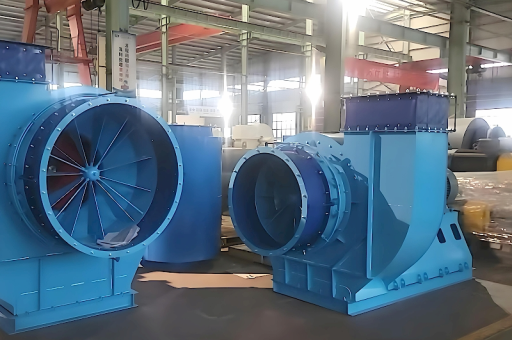
The Boiler ID Fan (often a centrifugal or axial-flow fan) draws hot, corrosive, and particle-laden flue gas from the boiler, through pollution control equipment (e.g., electrostatic precipitators, baghouses, scrubbers), and out to the stack. Unlike forced draft fans, ID fans operate under elevated temperatures (typically 150°C to 200°C, sometimes exceeding 400°C in certain designs) and variable gas densities.
Application-specific challenges that directly affect noise and lifespan include:
- Erosion from fly ash – leading to impeller wear and imbalance.
- Corrosion from acidic condensate (especially when burning high-sulfur fuels).
- Thermal cycling – causing differential expansion of components.
- Variable load operation – demanding efficient speed control to avoid resonance or stall.
A fan designed for 100,000 hours (approximately 11.4 years of continuous operation) must address all of these failure mechanisms from the outset, not merely through heavy-duty components but via integrated acoustic and aerodynamic optimization.
Noise Reduction Engineering: How to Achieve Less Than 85 dB(A)
Noise from a Boiler ID Fan originates from three main sources: aerodynamic (turbulence and blade pass frequency), mechanical (bearing and gearbox), and structural (housing and duct vibration). Achieving noise levels less than 85 dB(A) requires a multi-layered strategy:
- Blade Profile Optimization: Use of airfoil-shaped, backward-curved impeller blades reduces vortex shedding and turbulent noise. Modern Computational Fluid Dynamics (CFD) simulations allow engineers to fine-tune blade pitch and clearance to minimize tonal noise without sacrificing static efficiency.
- Speed Control via VFD (Variable Frequency Drive): Operating the fan at the lowest possible speed for a given demand not only saves energy (by up to 30-40% compared to damper control) but also dramatically reduces aerodynamic noise. Every 10% reduction in speed typically yields a 2-3 dB(A) drop in noise level.
- Acoustic Attenuation Hardware: Inlet sound attenuators (silencers) with high-density mineral wool or foam inserts, and exhaust silencers tuned to the fan’s blade pass frequency, are essential for meeting the 85 dB(A) limit at the equipment boundary.
- Vibration Damping and Isolation: Installing flexible connectors between the fan and ductwork, plus vibration isolators with natural frequencies below the fan’s rotational frequency, prevents structure-borne noise from radiating into the building or environment.
- Casing Design: A double-wall casing with internal acoustic lining can reduce radiated noise by 5-10 dB(A) relative to standard single-wall construction.
Real-world benchmark: In a recent installation at a 50 MW biomass boiler facility, the combination of a backward-curved impeller, a VFD, and a 1-meter inlet silencer resulted in an ID fan noise level of 82.5 dB(A) at 1 meter, comfortably below the 85 dB(A) threshold.
The 100,000-Hour Lifespan Target: Design, Materials, and Maintenance
A 100,000-hour lifespan (L10 life, meaning 90% of units will survive) demands a systematic reliability approach:
- Material Selection:
- Impeller: For flue gas with moderate ash, use Corten steel or AISI 316L stainless steel for corrosion resistance. For severe erosion, ceramic coating (e.g., aluminum oxide) or weld-overlay with tungsten carbide is increasingly adopted.
- Shaft: High-strength alloy steel (e.g., AISI 4140) with hardened bearing journals.
- Bearing housing: Cast iron with labyrinth seals to prevent ingress of fine ash.
- Bearing Life: The mechanical bottleneck is typically the bearings. Using spherical roller bearings with a rated L10 life of 100,000 hours under actual loads is achievable if the fan is not oversized, and if oil analysis is performed regularly. Grease-lubricated bearings may need replacement at 50,000 hours; oil mist or circulating oil systems can extend life.
- Aerodynamic Efficiency: Higher efficiency directly correlates with lower heat generation and reduced vibration. A fan operating at 85% static efficiency vs. 70% will experience lower bearing stresses and less impeller fatigue.
- Structural Fatigue: Finite Element Analysis (FEA) during design ensures that the impeller and housing do not suffer from resonance within the operating speed range (separation margin > 20% from natural frequencies).
- Predictive Maintenance: For 100,000-hour reliability, a formal condition monitoring program is non-negotiable: vibration analysis (ISO 10816-3 Zone B/C), thermography for bearing and motor hotspots, and regular blade tip clearance measurements.
Case Example: A petrochemical boiler ID fan in a high-sulfur environment, constructed from Duplex stainless steel and equipped with oil-lubricated spherical bearings, achieved 115,000 hours without unplanned shutdown before a scheduled overhaul, meeting the 100,000-hour target with margin.
Application-Specific Considerations for Low-Noise, Long-Life Fans
The integration of Boiler ID Fan Noise Less 85dB and 100,000h Lifespan required careful tuning for the specific application:
| Application Factor | Noise Mitigation Impact | Lifespan Impact |
|---|---|---|
| High Temperature (>200°C) | Requires insulated silencers; acoustic material must be fiberglass or ceramic fiber | Thermal expansion joints must be designed; bearing cooling (finned housing or water jacket) needed |
| Abrasive Fly Ash | Minimal direct noise impact, but erosion changes blade profile → increased turbulence and noise | Hard-facing on leading edges; replace wear plates at 50,000 hours to reach 100,000 hours |
| Variable Load (e.g., industrial boilers cycling daily) | VFD speed control essential to avoid noise peaks during startup/purge cycles | Frequent starts cause thermal fatigue; specify design for 10,000 starts/stop cycles equivalent |
| Space Constraints | Inline silencers may be the only option; may require higher pressure drop | Compact designs may limit access for inspection; ensure maintenance doors and lift points are provided |
Frequently Asked Questions (FAQ)
Q1: Is it realistic to achieve both 85 dB(A) and 100,000 hours in the same fan unit? Yes, but it often requires a higher initial investment in material quality, acoustic treatment, and bearing system design. It is not a “standard” catalog product; it must be custom-engineered for the specific flue gas composition, temperature profile, and site layout. Many tier-1 fan manufacturers offer such designs as part of their heavy-duty industrial line.
Q2: What is the most common reason that a boiler ID fan fails to reach 100,000 hours? Bearing failure is the #1 cause, followed by impeller fatigue cracking from vibration. Insufficient lubrication contamination (from ash ingress) or resonance operation at a specific speed are the typical root causes. A robust lubrication management plan and avoiding operation near the fan’s critical speed are paramount.
Q3: How can I measure if my ID fan is truly below 85 dB(A)? Use a calibrated Sound Level Meter (SLM) set to A-weighting, slow response, at a distance of 1 meter from the fan housing and 1.5 meters above the floor, per ISO 3744 or ISO 3746. Take multiple measurements around the fan (four points minimum) and average them. Always correct for background noise. If the result is borderline (e.g., 84-86 dB), consider adding a muffler or upgrading the VFD control curve.
Q4: Does a 100,000-hour lifespan mean no maintenance for 11 years? Absolutely not. The L10 life of 100,000 hours is a statistical rating for the core rotating assembly (shaft, bearings, impeller) under ideal lubrication and alignment. Routine inspections, oil changes, belt tensioning, and cleaning of the impeller (if fouling occurs) are still required. The goal is zero unscheduled maintenance; planned minor interventions at 20,000-hour intervals are typical.
Q5: What cost premium should I expect for a fan with these specifications? Compared to a standard industrial fan of similar flow and pressure (without noise or life guarantees), an 85 dB(A)-100,000 hour engineered unit typically costs 25-50% more. However, the total cost of ownership (TCO) is lower due to reduced downtime, no need for noise retrofit, and lower energy consumption from optimized aerodynamics. Many utilities achieve payback within 3-4 years.
Conclusion: A Systems Approach to Reliability and Acoustic Compliance
Designing a Boiler ID Fan that simultaneously meets Noise < 85 dB(A) and 100,000-hour lifespan is a rigorous engineering challenge that transcends simple component selection. It requires a holistic systems approach: advanced aerodynamics for quiet and efficient flow, robust materials for erosion and corrosion resistance, and a bearing system designed for extended high-temperature operation. For plant owners, the decision to invest in such a fan should be justified not only by regulatory compliance but by a clear total cost of ownership analysis. When properly specified, installed, and maintained—with condition monitoring, VFD speed control, and acoustic treatment—the fan becomes a quiet, durable workhorse that pays for itself over a decade or more. As industrial noise limits tighten globally and uptime becomes ever more critical, the synergy of low noise and long life is no longer optional; it is the new standard for state-of-the-art boiler management.





