
This article's table of contents introduction:
- What is it?
- Why "Large Air Volume & Wear Resistant" is Critical
- Key Design & Construction Features
- Performance Specifications (Typical for Power Plant Boiler)
- Where is it used in the Power Plant?
- Manufacturers & Models
- Procurement Considerations
- Summary
It sounds like you are looking for a heavy-duty, high-capacity centrifugal induced draft (ID) fan, specifically designed for a power plant boiler application. This is a critical piece of equipment. Here is a detailed breakdown of what this fan is, its key specifications, and why it meets your requirements.
What is it?
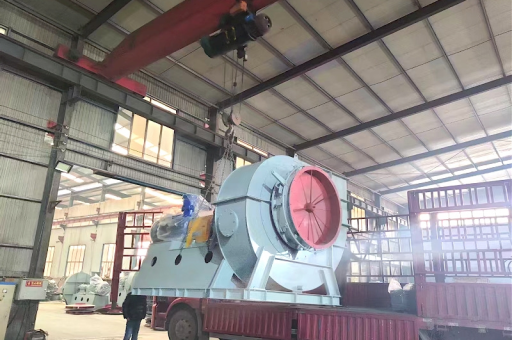
This is a Centrifugal Induced Draft Fan. Its job is to pull hot, ash-laden flue gas from the boiler, through pollution control equipment (like electrostatic precipitators or baghouses), and out the stack. The air volume is massive, and the gas is abrasive.
Why "Large Air Volume & Wear Resistant" is Critical
- Large Air Volume: Power plant boilers burn huge amounts of fuel. The fan must move hundreds of thousands to millions of cubic feet per minute (CFM) to maintain proper combustion and draft.
- Wear Resistant: Flue gas contains fly ash and unburned carbon particles. These are highly abrasive, and a standard fan would fail rapidly. Wear resistance is non-negotiable.
Key Design & Construction Features
For this specific application, the fan must have the following features:
Impeller (The Rotating Part)
- Material: Typically 16MnCr5, Hardox 450, or equivalent wear-resistant steel. Some high-end options use overlays of Stellite or ceramic tiles on the leading edges.
- Design:
- Backward-Curved or Airfoil Blades: This is the most efficient design for high-volume, medium-to-high pressure applications.
- Thick, Reinforced Base Plates: To withstand vibration and the weight of the ash load.
- Replaceable Wear Liners: The entire wear surface of the impeller is often clad with sacrificial wear plates that can be replaced without replacing the entire wheel.
- Hardfacing: Critical stress points (leading edge of blades, inlet cone) are hardfaced with tungsten carbide or chrome carbide.
Casing (Housing)
- Spiral or Volute Design: Standard for centrifugal fans.
- Thickness: Heavier gauge steel than normal (e.g., 10mm to 20mm plate).
- Wear Lining: The inside of the casing, particularly the "cut-off" (where the gas exits), is lined with ceramic tiles, cast basalt, or high-chrome steel plates. Some designs use a "double-skin" where the inner layer is sacrificial.
- Access Doors: Large, easily accessible doors for inspection and replacement of wear liners.
Shaft & Bearings
- Oversized Shaft: To handle high torque and prevent deflection.
- Spherical Roller Bearings: Designed for heavy radial and axial loads. They are often mounted in water-cooled or oil-lubricated bearing housings to cope with high temperatures (if the fan is before the air preheater).
- Vibration Monitoring: Standard for critical power plant fans. Transducers (accelerometers) are mounted on the bearing housings.
Inlet Box & Damper Control
- Inlet Box: A specially designed box to guide the gas smoothly into the impeller eye. Often lined for wear.
- Inlet Guide Vanes (IGVs): Adjustable vanes that control the airflow by pre-swirling the gas before it enters the impeller. This is far more energy-efficient than using a discharge damper. These are critical for wear resistance—they must be robust or expendable.
- Auxiliary Dampers: Guillotine or louver dampers for isolation during maintenance.
Performance Specifications (Typical for Power Plant Boiler)
| Parameter | Typical Value | Notes |
|---|---|---|
| Air Volume (Flow) | 500,000 – 1,500,000 CFM (850,000 – 2,500,000 m³/hr) | Huge volumes for a large boiler (300-600 MW). |
| Static Pressure | 20 – 40 in. WG (5000 – 10,000 Pa) | Must overcome boiler, duct, and ESP/Baghouse resistance. |
| Temperature | 150°C – 180°C (300°F – 350°F) | Temperature after Air Preheater (APH). If before APH, it can be 300-400°C. |
| Rotating Speed | 600 – 1000 RPM | Usually driven by a motor via a V-belt or direct coupling. High speeds maximize volume but increase wear. |
| Power | 2000 – 8000 kW (2700 – 10,000 HP) | Massive motors, often 6.6 kV or 11 kV. |
| Dust Load | 30 – 80 g/Nm³ | High ash content from coal. The exact value determines the wear resistance needed. |
Where is it used in the Power Plant?
- After Air Preheater (Cold End): The most common location. The gas is cooler but still contains fly ash. This is the "standard" ID fan location.
- Before Air Preheater (Hot End): Handles gas at 300-400°C. This is extremely harsh and requires exotic alloys or even water-cooled bearings. Very rare today.
- Boiler Draft System: It works in conjunction with the Forced Draft (FD) Fan (which pushes air in) and the Primary Air (PA) Fan (for the coal mill). The ID fan creates negative pressure in the furnace.
Manufacturers & Models
Several global manufacturers specialize in these. You would look for their "Power Plant" or "Heavy Duty" series:
- Howden (e.g., Howden VHX series)
- TLT-Turbo (e.g., TLT Centrifugal Fans)
- Zander & Ingeström (Z&I)
- Greenheck (Industrial fans, smaller units)
- New York Blower (Power Plant series)
- Dongfang Electric, Shanghai Electric, Harbin Electric (Major Chinese OEMs for power equipment supply)
Procurement Considerations
If you are sourcing this fan, you will need to provide:
- Design Conditions:
- Gas Volume (CFM / m³/h)
- Total Pressure (in. WG / Pa)
- Gas Temperature (°F / °C)
- Gas Density
- Dust Content (gr/ft³ or g/m³) - Critical for wear design
- Air Density at Fan Inlet (for horsepower calculation)
- Operational Requirements:
- Required Control Method (Inlet Guide Vanes, Variable Speed Drive, VFD)
- Noise Level Limits
- Desired Fan Efficiency (usually > 80% for these large units)
- Required Life of Wear Parts (e.g., "Minimum 24 month warranty on impeller with hardfacing")
- Environmental:
- Altitude
- Ambient Temperature
- Seismic Zone
Summary
A Large Air Volume Wear Resistant Induced Draft Fan for a power plant boiler is a custom-engineered, high-performance machine. It is not a "stock" item. It must be manufactured with heavy-duty materials, advanced wear protection (ceramic tiles, hardfacing, replaceable liners), and sophisticated control systems (IGVs) to survive years of continuous, abrasive operation.
Key takeaway: Prioritize wear life and efficiency. A 1% improvement in efficiency can save hundreds of thousands of dollars in electricity over the fan's lifetime. A 6-month increase in impeller life can save a week's worth of unscheduled downtime in a power plant.





