
This article's table of contents introduction:
- Table of Contents
- Introduction: The Need for Extreme Duty Ventilation
- Defining the 4500kW Beast: What Makes It Special?
- Key Engineering Challenges in High Temperature Dusty Environments
- Aerodynamic Design: Impellers, Housings, and Wear Protection
- Thermal Management: Cooling, Materials, and Expansion Control
- Drive Systems and Motor Selection for 4500kW Fans
- Performance Analysis: Pressure, Flow, and Efficiency Curves
- Installation and Integration in Process Plants
- Predictive Maintenance and Reliability Strategies
- Q&A: Common Questions About 4500kW Industrial Fans
- Conclusion and Future Trends
*The Ultimate Guide to High Temperature High Dust Industrial Centrifugal Fans 4500kW: Engineering, Performance, and Maintenance*
Table of Contents
- Introduction: The Need for Extreme Duty Ventilation
- Defining the 4500kW Beast: What Makes It Special?
- Key Engineering Challenges in High Temperature Dusty Environments
- Aerodynamic Design: Impellers, Housings, and Wear Protection
- Thermal Management: Cooling, Materials, and Expansion Control
- Drive Systems and Motor Selection for 4500kW Fans
- Performance Analysis: Pressure, Flow, and Efficiency Curves
- Installation and Integration in Process Plants
- Predictive Maintenance and Reliability Strategies
- Q&A: Common Questions About 4500kW Industrial Fans
- Conclusion and Future Trends
Introduction: The Need for Extreme Duty Ventilation
Industrial processes such as steel manufacturing, cement clinker production, non-ferrous smelting, and power generation generate two of the most hostile operational conditions known to mechanical engineers: extreme heat (often exceeding 400 °C) and heavy particulate-laden air streams. In these environments, standard ventilation fans fail within hours due to thermal creep, abrasive wear, and rotor imbalance.
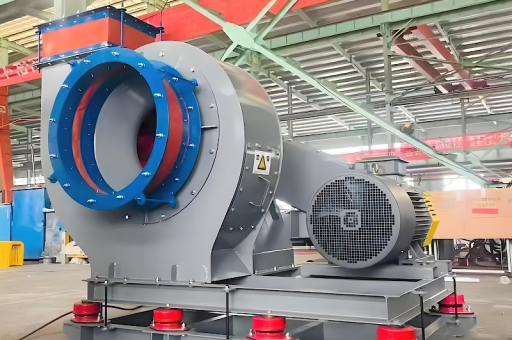
Enter the High Temperature High Dust Industrial Centrifugal Fan rated at 4500 kW—a class of equipment designed not merely to survive, but to deliver reliable, continuous airflow under the most punishing physical stress. These fans are the unsung workhorses behind forced draft in waste heat recovery boilers, induced draft in sintering plants, and dust extraction in ore dryers. Understanding their construction, selection, and maintenance is critical for plant managers and engineering teams aiming to minimize unplanned downtime and total cost of ownership.
This article synthesizes technical best practices from heavy industry, original equipment manufacturer literature, and field case studies to provide a comprehensive reference for anyone specifying or operating a 4500kW centrifugal fan in high-temperature, high-dust applications.
Defining the 4500kW Beast: What Makes It Special?
A 4500kW fan is not simply a scaled-up version of a smaller fan. At this power level, the rotating assembly can weigh several tons, and the tip speed of the impeller often exceeds 120 m/s. To put this into perspective, a 4500kW unit can move over 600,000 m³/h of gas against a static pressure of 10–15 kPa while operating at gas temperatures of 350–500 °C.
Key differentiators from standard industrial fans include:
- Massive moment of inertia – requiring specialized soft-starting or variable frequency drive (VFD) systems to avoid grid disturbances.
- Custom alloy construction – using materials like HARDOX® for wear plates and Inconel® or 310S stainless steel for high-temperature sections.
- Complex rotor dynamics – necessitating finite element analysis (FEA) for critical speed avoidance and damping.
- Integrated cooling systems – such as finned bearing housings or forced-air cooling jackets for the shaft seals.
Key Engineering Challenges in High Temperature Dusty Environments
Challenge 1: Erosive Wear Abrasive particles (silica, clinker dust, fly ash) impinge upon the impeller blades and volute casing. Standard carbon steel can erode at 5–10 mm per year. For a 4500kW fan operating 8,000 hours annually, this leads to catastrophic failure within 2–3 seasons if unmitigated.
Challenge 2: Thermal Fatigue and Creep Continuous operation at >350 °C causes metal expansion. The rotor can grow radially by several millimeters, altering the clearance between the blade tips and the inlet cone. If not accounted for in design, tip rubs can generate sparks and cause rotor seizure.
Challenge 3: Dust Accumulation and Imbalance Sticky or hygroscopic dust cakes onto the impeller blades unevenly. A 1 kg imbalance at the blade tip at 1500 RPM can generate centrifugal forces exceeding 2.5 kN, rapidly destroying bearings and seals.
Challenge 4: Bearing Thermal Management Bearings in hot zones must cope with conducted heat from the shaft. A standard grease-packed bearing will fail within days at 150 °C surface temperature.
Aerodynamic Design: Impellers, Housings, and Wear Protection
Impeller Geometry: Backward-Curved vs. Radial-Tipped
For high-dust applications, backward-curved (BC) impellers with higher blade counts (16–24 blades) offer superior efficiency (up to 85%) but are more prone to dust deposition. Radial-tipped (RT) impellers, while slightly less efficient, provide better self-cleaning characteristics and are the preferred choice for dust concentrations above 10 g/Nm³.
Wear Protection Techniques
- Ceramic tile lining on leading blade edges and cut-off plate.
- Hardfacing with chrome carbide overlays (60–64 HRC).
- HARDOX® 500 replaceable wear plates bolted to the volute inner wall.
- Air-inlet cone with replaceable throat ring to protect the most erosion-prone area.
Housing Design: Scroll Width and Clearance
The housing must allow for thermal growth without jamming. The volute width is typically increased by 3–5% over standard cold-spec dimensions. A wear-back clearance of 8–15 mm is maintained between the impeller shroud and the inlet cone.
Thermal Management: Cooling, Materials, and Expansion Control
At 4500kW, thermal management is not optional—it is the primary design constraint.
- Shaft Cooling: Hollow shafts with forced air flow through the bore to draw heat away from the bearings.
- Bearing Cooling: Water-cooled bearing housings or oil lubrication systems with external heat exchangers. For extreme temperatures (>400 °C grease is replaced by synthetic oil mist).
- Expansion Joints: Bellow-type expansion joints on inlet and outlet ducts to absorb axial and radial growth of up to 25 mm.
- Material Selection Grid:
| Zone | Temperature | Recommended Material |
|---|---|---|
| Impeller | < 200 °C | Corten® steel or 304L |
| Impeller | 200–400 °C | 310S stainless steel |
| Impeller | > 400 °C | Inconel® 625 or Hastelloy® X |
| Shaft | All | 42CrMo4 (quenched & tempered) |
| Bearings | < 100 °C | Standard deep groove ball (grease) |
| Bearings | 100–250 °C | High-temperature roller (oil mist) |
Drive Systems and Motor Selection for 4500kW Fans
A 4500kW fan motor is a substantial electrical machine – typically a 6 kV or 11 kV induction motor with cast copper rotors for improved thermal conductivity.
Starting Methods:
- VFD (Variable Frequency Drive): Allows soft start, speed trimming for process optimization, and energy savings. Essential for fans with large inertia (GD² > 50,000 kg·m²).
- Liquid Resistance Starter (LRS): Lower capital cost but zero speed control. Suitable for constant-speed induced draft fans.
- Clutch or Hydrodynamic Coupling: Protects against thermal shock by decelerating the fan during start.
Coupling Considerations
Gear couplings are preferred over grid couplings because they accommodate higher misalignment and are less sensitive to thermal shaft elongation. Cardan shafts with torque-limiting devices are used in some heavy-duty installations.
Performance Analysis: Pressure, Flow, and Efficiency Curves
The fan law affinity formulas remain valid for 4500kW fans, but the fans must be tested under hot running conditions. Cold performance tests (ambient air) do not predict hot performance reliably due to density change.
Key performance indicators:
| Parameter | Typical Value (4500kW Hot Fan) |
|---|---|
| Airflow (Q) | 300,000 – 650,000 m³/h |
| Static pressure (SP) | 8,000 – 15,000 Pa |
| Operating temperature | 350 – 500 °C |
| Efficiency (peak) | 80% – 85% |
| Noise level (LwA) | 115 – 130 dB(A) – requires silencers |
System resistance curves must account for dust loading, as a loaded duct system imposes 15–30% higher backpressure due to settled material.
Installation and Integration in Process Plants
Installing a 4500kW fan requires:
- Foundation design: Reinforced concrete block with mass >2.5× total rotating weight to damp vibration.
- Thermal alignment checks: Shaft-to-motor alignment should be performed hot (after 2 hours of operation) to correct thermal growth offset.
- Duct transition: Long-radius elbows with turning vanes prevent separation and accumulate dust.
- Pressure relief doors to protect the fan in case of gas explosion or sudden blockage.
Implementation should follow ISO 1940-1 balancing grade G2.5 or better.
Predictive Maintenance and Reliability Strategies
Condition Monitoring Parameters:
- Vibration sensors: Dual accelerometers on bearing housings (radial + axial); alert at >4.5 mm/s RMS; shutdown at >7.1 mm/s RMS.
- Thermography: Weekly scans of housing, bearings, and motor terminal boxes.
- Bearing temperature trending: Any rise >10% over baseline in 24 hours triggers inspection.
- Wear thickness measurement: Eddy current probes installed behind wear liners to detect remaining thickness without shutdown.
Recommended Maintenance Schedule:
| Interval | Action |
|---|---|
| Weekly | Visual check for dust build-up on rotor |
| Monthly | Vibration data recording & bearing temperature log |
| Quarterly | Balance check in-situ using strain gauges |
| Semi-annually | Borescope inspection of internal surfaces |
| Annually | Full rotor rebuild: replace wear liners, balance, measure clearances |
Q&A: Common Questions About 4500kW Industrial Fans
Q1: Can I use a standard steel fan for 450°C dust-laden gas? No. At 450°C carbon steel loses 70% of its tensile strength and will creep-fatigue within 500 hours. Use 310S or Inconel® for the impeller.
Q2: How do I prevent dust from caking on the blades? Install a leading-edge air knife or spray system (if wet application is allowed). Alternatively, specify radial-tipped or straight-bladed impellers with high tip speed (>120 m/s) to encourage shear stripping.
Q3: What is the expected lifespan of a 4500kW fan in cement kiln service? With proper wear protection and maintenance: 8–10 years. Without: 18 months.
Q4: Is a VFD mandatory for a fan of this size? Not mandatory, but highly recommended to reduce electrical inrush currents (which can exceed 6× full load current), and to achieve energy savings of 20–35% when operating at partial load.
Q5: How do I select a fan for 4500kW when there is no space for a large foundation? Consider an overhung rotor design or in-line arrangement where the fan is supported on a dedicated steel skid isolated with elastomeric pads. Consult the manufacturer for a dynamics analysis.
Conclusion and Future Trends
The High Temperature High Dust Industrial Centrifugal Fan 4500kW represents the pinnacle of mechanical fan engineering. It must balance extreme thermal expansion, severe abrasive wear, and enormous rotational forces while operating 24/7 for years.
Looking forward, three trends will shape the next generation of these fans:
- Digital Twin integration – real-time simulation of blade erosion and thermal stress using IoT sensor data to predict remaining useful life.
- Advanced ceramic composites – full ceramic impeller rings or hybrid metal-ceramic blades that outlast steel by a factor of 5 in dust-laden flows.
- Active balancing systems – using piezoelectric actuators on the rotor to automatically compensate for dust build-up, eliminating unscheduled shutdowns.
Choosing the right 4500kW fan is not a purchase; it is an investment in industrial uptime. Always validate selection through full-scale CFD thermal-fluid analysis and partner with manufacturers who offer comprehensive field support for large rotating equipment. For dedicated technical consultation, visit fan.





