
This article's table of contents introduction:
- Engineering Analysis of Your Specifications
- Common Industrial Applications
- Recommended Blower Configuration
- Example Performance Data (Approximation)
- Key Engineering Considerations
- Summary Recommendation
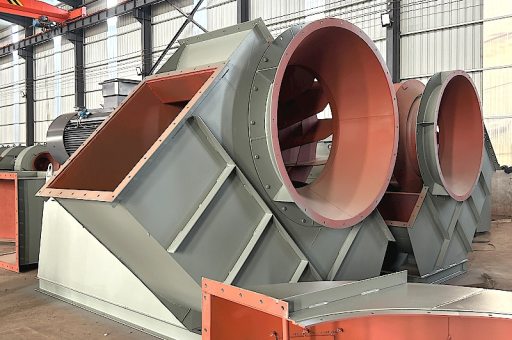
Based on the parameters you provided (Speed: 1400–2900 RPM, Efficiency: ≥70%), here is a professional specification overview and analysis for an Industrial Centrifugal Blower.
This combination of specifications is typical for Medium-Pressure or High-Volume Backward-Curved (BC) or Airfoil (AF) blowers.
Engineering Analysis of Your Specifications
-
Speed Range (1400–2900 RPM):
- Direct Drive (2900 RPM): Likely a 4-pole motor (1450 RPM) direct coupled, or a 2-pole motor (2900 RPM) for higher pressure/flow.
- Belt Drive (1400-2900 RPM): Allows for tuning the fan curve. You can run it at 1400 RPM for quiet, energy-efficient operation, or crank it to 2900 RPM for maximum pressure/flow.
- Implication: The wheel diameter is likely moderate-sized (300mm - 700mm / 12" - 28"). A very large fan would not spin at 2900 RPM (tip speed would be too high, causing vibration/noise), and a very small fan is inefficient at 1400 RPM.
-
Efficiency (≥70%):
- Standard: This is a high-efficiency standard. Many industrial backward-inclined fans achieve 75-85%.
- Achievable at this Speed: At 1400-2900 RPM, a well-designed Backward Curved (BC) or Airfoil (AF) impeller easily achieves ≥70% efficiency across a wide operating range.
- Power Savings: Compared to a standard forward-curved fan (often 50-60% efficient), this blower will save significant energy (typically 15-30%).
Common Industrial Applications
Given the speed and efficiency, this blower is ideal for general ventilation, process air, and pneumatic conveying. Typical applications include:
- Dust Collection: Moving air through baghouses or cyclones.
- Fume Extraction: Welding fumes, chemical vapors, or lab exhaust.
- Material Handling: Conveying light materials (chips, dust, granules).
- HVAC: Large building pressurization, exhaust, or make-up air.
- Oven/Dryer Air Supply: For industrial ovens or drying tunnels.
Recommended Blower Configuration
| Feature | Specification |
|---|---|
| Impeller Type | Backward Curved (BC) or Airfoil (AF) (Required for ≥70% efficiency) |
| Drive Arrangement | Direct Drive (D) or Belt Drive (V) depending on desired flow control. |
| Motor | IEC Standard (e.g., IE3 / NEMA Premium Efficiency) to match fan efficiency. |
| Material | Mild Steel (MS) with Epoxy Paint (Standard), Stainless Steel (SS304/316) for corrosive air. |
| Housing | Scroll type, SWSI (Single Width Single Inlet) or DWDI (Double Width Double Inlet). |
Example Performance Data (Approximation)
Assuming a standard Backward Curved blower with a 400mm (16") wheel.
| Speed (RPM) | Airflow (CFM) | Static Pressure (in.WG) | Motor Power (kW) | Efficiency |
|---|---|---|---|---|
| 1400 | 1,500 – 3,500 | 2 – 6 | 5 – 3 | 72% |
| 1750 | 2,000 – 4,800 | 4 – 8 | 3 – 5.5 | 75% |
| 2900 | 3,500 – 8,000 | 8 – 16 | 5 – 15 | 70% |
(Note: These are estimates. Actual performance depends on impeller diameter, blade angle, and housing design.)
Key Engineering Considerations
To ensure your blower achieves ≥70% efficiency and operates reliably, you should verify the following with the manufacturer:
- Air Density: The efficiency is typically tested at standard air density (20°C, 0.075 lb/ft³). If operating at high altitude or high temperature, the actual motor power required will change (increase for hot air, decrease for altitude).
- Tip Speed: At 2900 RPM, ensure the wheel is dynamically balanced (ISO 1940 Grade G6.3 or better) to prevent vibration.
- Inlet Condition: Ensure the inlet is clean and unobstructed. For high efficiency, use an Inlet Cone / Venturi to prevent turbulence at the impeller eye.
- Motor Selection: A standard TEFC motor is fine. For VFD operation (variable speed from 1400 to 2900 RPM), use an Inverter Duty Motor and ensure the fan is not run below 20% speed (shaft whipping risk).
Summary Recommendation
- Best Use: Medium to high pressure drop systems requiring reliable, efficient air movement.
- Action: Request a Performance Curve from the supplier showing efficiency lines. You want the "Best Efficiency Point" (BEP) to match your design flow and pressure.
Would you like me to calculate the approximate Brake Horsepower (BHP) or Motor Power (kW) needed for a specific CFM and Static Pressure?





