
This article's table of contents introduction:
- Key Characteristics of an 11,000 Pa Centrifugal Fan
- Common Applications (Where a 11 kPa fan is used)
- Important Questions to Ask When Selecting One
- Where to Find One
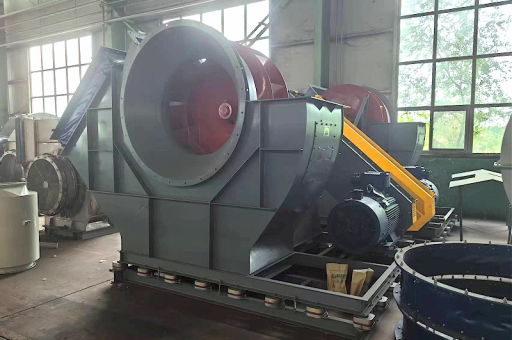
It sounds like you're asking about a centrifugal fan rated for 11,000 Pascals (Pa) of static pressure.
This is a very high-pressure rating. To put it in perspective:
- A standard box fan produces about 20–50 Pa.
- A typical household HVAC blower produces ~250–500 Pa.
- A high-pressure industrial blower might produce 2,000–5,000 Pa.
- 11,000 Pa (11 kPa) is in the range of industrial process fans, vacuum cleaners, pneumatic conveying systems, or specialized ventilation in demanding environments.
Here’s a breakdown of what that rating implies for the fan and its applications:
Key Characteristics of an 11,000 Pa Centrifugal Fan
- Design Type: To achieve this pressure, the fan will almost certainly be a Backward Curved (BC) or Airfoil blade design. It cannot be a simple forward-curved "squirrel cage" blower (which maxes out around 2,000 Pa).
- High Speed / Power:
- It will run at a high RPM (e.g., 3,000–5,000+ RPM).
- Power draw will be significant. Even a small flow rate at 11 kPa requires substantial motor power (often 5 kW, 10 kW, or more).
- Rugged Construction:
- The housing and impeller must be very strong to withstand the internal pressure without deforming.
- Bearings will be heavy-duty, often with external grease lines or cooling.
- The shaft will be thick and supported on both sides.
- Noise: It will be very loud without significant sound attenuation (silencers / mufflers).
Common Applications (Where a 11 kPa fan is used)
- Pneumatic Conveying: Moving powders, pellets, or granules through pipes (e.g., in plastic manufacturing, grain handling, cement).
- Industrial Vacuum Systems: Central vacuum systems for industrial cleaning.
- High-Pressure Aeration: Deep tank aeration in wastewater treatment where high backpressure is needed.
- Process Air Supply: Supplying combustion air in boilers or furnaces.
- Ventilation in High-Resistance Systems: Exhausting from long duct runs with heavy-duty filters (e.g., in pharmaceutical fume hoods or laser cutting tables). Note: An 11kPa fan would be overkill for most standard supply / exhaust ventilation.
Important Questions to Ask When Selecting One
Before you buy or specify a "11000 Pa centrifugal fan," you must know the airflow (CFM / m³/hr). You cannot select a fan on pressure alone.
A fan's performance is defined by the intersection of Airflow (Q) and Static Pressure (SP) on its curve.
- The Paradox: A fan that produces 11,000 Pa at zero airflow (shut-off) might be different from one that produces 11,000 Pa at 1,000 m³/hr.
- The Curve: For a given impeller, as airflow increases, the available static pressure decreases.
Therefore, you need to ask:
- "What is the airflow requirement at that pressure (e.g., 2,000 m³/hr at 11,000 Pa)?"
- "What is the material being moved? (Clean air? Dusty? Corrosive?)"
- "What is the temperature of the air? (High temp requires different materials and seals)"
- "What is the power supply? (Voltage, frequency, 3-phase required?)"
Where to Find One
Big manufacturers that make fans in this pressure range include:
- Greenheck (Industrial Process & Heavy Duty)
- New York Blower (Series 20, 30, or Pressure Blowers)
- Chicago Blower (High Pressure / HP Series)
- Cincinnati Fan (HP Series High Pressure Blowers)
- Howden (Heavy industrial)
- AirPro Fan & Blower (Custom high-pressure)
You will not find a simple 11 kPa fan at a home improvement store. It will be a specialized, industrial piece of equipment.
Summary for a User Searching "11000Pa centrifugal fan": You are looking at a heavy-duty industrial machine. Ensure you have the required Air Flow (m³/hr or CFM) before calling a supplier, or you will get a fan that is either too small or dangerously oversized for your system.





