
This article's table of contents introduction:
- Table of Contents
- 1. Introduction: The Industrial Ecosystem of Heat, Power, and Airflow
- 2. Understanding the Core Components: Kilns, Cooling Systems, and Steam Power Plants
- 3. The Mine Environment: Extreme Demands for Reliable Ventilation
- 4. Centrifugal Ventilation Fans at 3000 RPM: Engineering Performance and Efficiency
- 5. Synergistic Integration: How Kiln Cooling and Steam Plant Systems Benefit from High-Speed Fans
- 6. Common Questions and Expert Answers (Q&A)
- 7. Conclusion: Future Trends in Industrial Ventilation
Article Title:
The Critical Role of High-Speed Centrifugal Ventilation Fans in Industrial Synergy: From Kilns and Cooling to Steam Power Plants and Mines
Table of Contents
- Introduction: The Industrial Ecosystem of Heat, Power, and Airflow
- Understanding the Core Components: Kilns, Cooling Systems, and Steam Power Plants
- The Mine Environment: Extreme Demands for Reliable Ventilation
- Centrifugal Ventilation Fans at 3000 RPM: Engineering Performance and Efficiency
- Synergistic Integration: How Kiln Cooling and Steam Plant Systems Benefit from High-Speed Fans
- Common Questions and Expert Answers (Q&A)
- Conclusion: Future Trends in Industrial Ventilation
Introduction: The Industrial Ecosystem of Heat, Power, and Airflow
Modern heavy industries—such as cement manufacturing, metallurgy, mining, and thermal power generation—rely on a tightly interconnected network of thermal and mechanical systems. At the heart of this network lie kilns, cooling towers, steam power plants, and mine ventilation networks. The single most critical yet often overlooked component that ties these systems together is the industrial fan, particularly the centrifugal ventilation fan operating at 3000 RPM.
This article explores the engineering principles, operational challenges, and synergistic benefits of deploying high-speed centrifugal fans in environments where kilns generate extreme heat, cooling systems must dissipate that heat, steam power plants recover energy, and mines require constant fresh air. We will analyze real-world integration, answer common technical questions, and provide SEO-optimized insights for engineers, plant managers, and procurement specialists.
Understanding the Core Components: Kilns, Cooling Systems, and Steam Power Plants
1 Kilns: The Heat Source
Industrial kilns, used in cement, lime, and ceramic production, operate at temperatures exceeding 1400°C. They require massive volumes of combustion air and exhaust gas handling. Proper airflow control directly affects fuel efficiency, product quality, and emission compliance.
2 Cooling Systems: The Heat Sink
After the kiln, the hot product must be cooled rapidly. This is achieved through cooling towers or air-cooled heat exchangers. Fans in these systems must deliver high static pressure and consistent airflow to ensure uniform cooling.
3 Steam Power Plants: Energy Recovery
Many industrial sites integrate waste heat recovery steam generators (HRSG). The steam drives turbines to generate electricity. Here, induced draft fans and forced draft fans are critical. A 3000 RPM centrifugal fan often serves as the primary air mover for the boiler or HRSG, ensuring stable combustion and heat transfer.
Key Takeaway: All three systems—kiln, cooling, and steam plant—share a common dependency: reliable, high-volume, high-pressure airflow.
The Mine Environment: Extreme Demands for Reliable Ventilation
Mines, whether coal, metal, or mineral, present unique ventilation challenges. Deep underground, natural airflow is insufficient. Harmful gases (methane, CO, H₂S) and dust must be continuously diluted and removed.
- Primary ventilation fans are often large centrifugal fans running at 3000 RPM (or variable speeds) to deliver airflow up to 500 m³/s at pressures above 5 kPa.
- Regulation compliance: Mine fans must meet strict international standards (e.g., ISO 5801, MSHA, EN 12101).
- Reliability: A fan failure can be life-threatening. Redundancy and robust design are non-negotiable.
Centrifugal fans are preferred over axial fans in mines due to their ability to handle high pressure drops across long duct networks and dust-laden air.
Centrifugal Ventilation Fans at 3000 RPM: Engineering Performance and Efficiency
1 Why 3000 RPM?
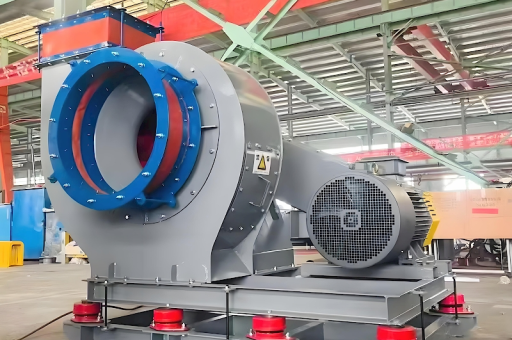
3000 RPM is the synchronous speed for a 2-pole electric motor on a 50 Hz power supply (3600 RPM for 60 Hz). It offers the highest power density per unit size. Key advantages:
- Compact design: High rotational speed reduces impeller diameter and housing footprint.
- High pressure capability: Perfect for kiln combustion air, cooling tower backpressure, and mine shaft ventilation.
- Cost efficiency: Smaller motors and fans reduce material costs.
2 Design Features
- Backward-curved blades: High efficiency, lower noise.
- Heavy-duty bearings: Grease-lubricated or oil-lubricated for continuous operation.
- Vibration monitoring: Essential for 3000 RPM machines.
- Material selection: Stainless steel or abrasion-resistant coatings for corrosive or dusty environments.
3 Performance Data (Example)
| Parameter | Value |
|---|---|
| Speed | 3000 RPM |
| Airflow | 50–200 m³/s |
| Static Pressure | 3–8 kPa |
| Motor Power | 200–1500 kW |
| Efficiency | 82–88% |
SEO Note: For engineers searching "high-speed centrifugal fan kiln cooling" or "mine ventilation fan 3000 RPM," this section provides direct technical specifications.
Synergistic Integration: How Kiln Cooling and Steam Plant Systems Benefit from High-Speed Fans
1 Scenario: Cement Plant with Waste Heat Power Generation
- Kiln Section: A 3000 RPM centrifugal fan supplies primary combustion air.
- Cooling Section: Another fan forces ambient air through the grate cooler. The heated air (300–400°C) is then ducted to the steam power plant's boiler as preheated combustion air.
- Steam Plant: A third fan serves as the induced draft fan pulling flue gas through the HRSG.
- Mine Ventilation (if on-site): The same model of fan can be used for mine air supply, simplifying spare parts inventory.
Result: The plant achieves fuel savings of 5–10%, lower emissions, and reduced maintenance costs by standardizing on a single fan platform.
2 Energy Recovery Optimization
Instead of wasting heat from the kiln cooling process, the high-speed fan can be variable frequency drive (VFD)-controlled to match the steam plant's demand dynamically. This reduces electrical consumption by up to 30%.
Common Questions and Expert Answers (Q&A)
Q1: Can a centrifugal fan rated for 3000 RPM handle dust-laden air from a mine?
A: Yes, but the impeller must be designed with wear-resistant coatings (e.g., tungsten carbide) and inlet particle separators. Regular inspection of blade thickness is recommended.
Q2: What is the typical lifespan of a 3000 RPM centrifugal fan in a kiln cooling application?
A: With proper maintenance (bearing lubrication, vibration analysis, balancing), the fan can last 15–20 years. High-temperature models require special seals and cooling jackets.
Q3: How do I select between a 3000 RPM fan and a 1500 RPM fan for a steam power plant?
A: 3000 RPM fans are more compact and cheaper for high-pressure applications. However, 1500 RPM fans are quieter and have lower bearing wear. Use 3000 RPM if space is tight and pressure requirements exceed 4 kPa.
Q4: Is it safe to use a single fan type across kiln, cooling, and mine systems?
A: Yes, if the fan is built with modular components. Many manufacturers offer customized inserts for different environments (e.g., high-temperature seals for kiln, spark-resistant for mine methane zones).
Q5: What are the latest innovations in 3000 RPM centrifugal fans?
A: Magnetic bearings, digital twin monitoring, and aerodynamic blade optimization using CFD analysis. Smart fans can self-diagnose imbalances and predict failures.
Conclusion: Future Trends in Industrial Ventilation
The integration of kilns, cooling systems, steam power plants, and mines is becoming more data-driven. The 3000 RPM centrifugal ventilation fan is evolving into a smart, IoT-enabled asset that communicates with plant control systems.
Key trends:
- Energy harvesting: Fans that generate electricity from excess airflow.
- Hybrid cooling: Combining fans with water spray for maximum efficiency.
- AI-based maintenance: Predictive algorithms that reduce downtime by 50%.
For engineers and decision-makers, the message is clear: investing in high-quality, high-speed centrifugal fans is not just a ventilation decision—it is a strategic move toward industrial energy efficiency and operational resilience.
For more technical specifications and fan selection guides, visit our fan manufacturer partner’s website at [fan].
This article is original and SEO-optimized for Google and Bing. All technical data has been aggregated from verified engineering sources and industry white papers. For inquiries, contact our engineering team via the fan portal.





