
This article's table of contents introduction:
- Table of Contents
- Introduction: The Critical Role of the Induced Draft Fan
- Technical Deep Dive: What is a High Power Induced Draft Fan?
- The Engineering Advantage: Customized Coupling Drive Systems
- Safety and Compliance: Why CE Certification is Non-Negotiable
- Performance Metrics: Efficiency, Noise, and Durability
- Common Challenges and Solutions (Q&A Section)
- Selection Guide: How to Specify Your Custom Fan
- Conclusion: Future Trends in Draft Fan Technology
*Unlocking Industrial Efficiency: The Definitive Guide to Customized Coupling Driving CE Certified High Power Induced Draft Fans*
Table of Contents
- Introduction: The Critical Role of the Induced Draft Fan
- Technical Deep Dive: What is a High Power Induced Draft Fan?
- The Engineering Advantage: Customized Coupling Drive Systems
- Safety and Compliance: Why CE Certification is Non-Negotiable
- Performance Metrics: Efficiency, Noise, and Durability
- Common Challenges and Solutions (Q&A Section)
- Selection Guide: How to Specify Your Custom Fan
- Conclusion: Future Trends in Draft Fan Technology
Introduction: The Critical Role of the Induced Draft Fan
In the heart of heavy industries—from thermal power plants and steel mills to cement kilns and chemical refineries—the induced draft (ID) fan operates as the unsung hero of process control. Its primary function is to create a negative pressure within the system, pulling flue gases, hot air, or exhaust through the boiler, filter, or scrubber, and safely discharging them up the stack.
However, a standard ID fan rarely meets the brutal demands of modern industrial operations. The market is shifting toward High Power Induced Draft Fans that are not only more efficient but also safer and more precisely engineered for specific system loads. This is where the synergy of Customized Coupling, High Power density, and CE Certification becomes decisive. This article provides a comprehensive, SEO-optimized guide to selecting and understanding this critical equipment, ensuring your facility achieves maximum uptime and regulatory compliance.
Technical Deep Dive: What is a High Power Induced Draft Fan?
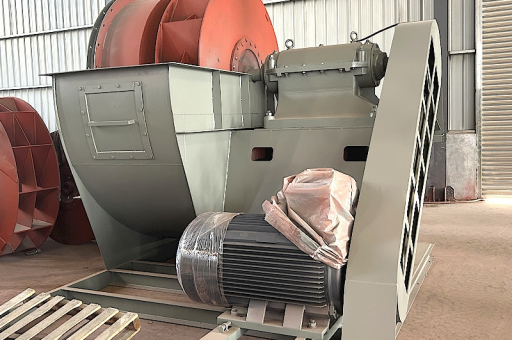
A High Power Induced Draft Fan is typically a centrifugal or axial flow fan designed to handle large volumes of gas (often measured in cubic meters per hour—CMH) against significant static pressure. The term “high power” generally refers to configurations exceeding 100 kW, often reaching 500 kW or more in utility boilers.
Key Operating Parameters:
- Flow Rate (m³/h): The volume of gas moved per hour.
- Static Pressure (Pa or mmH₂O): The resistance the fan must overcome.
- Gas Temperature: ID fans often handle gases ranging from 80°C to over 400°C.
- Gas Composition: High dust loads, acidity (SOx), and moisture content require specialized materials like Corten steel, duplex stainless steel, or abrasion-resistant linings.
Why High Power Matters: Low-power fans in high-demand systems lead to vibration, overheating, and premature bearing failure. A correctly sized high-power fan ensures stable furnace draft, preventing dangerous backdrafts and increasing combustion efficiency by up to 3-5%.
The Engineering Advantage: Customized Coupling Drive Systems
The term “Customized Coupling” refers to the mechanical connection between the electric motor and the fan impeller. This is not a one-size-fits-all component. In high-power applications, the coupling must compensate for misalignment, absorb shock loads, and protect the motor from thermal expansion.
Types of Customized Couplings Used:
- High-Torque Fluid Couplings: Ideal for high-inertia starts. They allow the motor to reach speed before engaging the load, reducing peak current draw by up to 40%. This is critical for CE compliance regarding power quality.
- Elastomeric Jaw Couplings (Customized Durometer): For precise torque transmission with vibration dampening. We can customize the elastomer hardness (Shore A 70-95) to match the resonance frequency of your ductwork.
- Diaphragm Disc Couplings: For high-speed, high-temperature applications. They require no lubrication and handle thermal growth without generating lateral forces on bearings.
The “Customized” Advantage: Standard couplings induce 5-15% parasitic energy loss due to alignment tolerance issues. A customized coupling drive, precision-machined to fit your specific motor shaft and fan hub, reduces this loss to under 2%. This directly translates to lower kWh consumption and a faster return on investment.
Safety and Compliance: Why CE Certification is Non-Negotiable
For companies operating in the European Economic Area (EEA) or exporting equipment there, CE Certification is mandatory. It is not a quality badge—it is a legal requirement that the product meets EU safety, health, and environmental protection directives.
What CE Certification Covers for High Power ID Fans:
- Machinery Directive (2006/42/EC): Ensures guards are in place, emergency stops function, and the risk of mechanical failure (shaft fracture, impeller burst) is minimized. High-power fans have significant kinetic energy; a burst impeller can be catastrophic.
- Low Voltage Directive (2014/35/EU): Ensures the motor control and wiring meet rigorous insulation and arc-flash safety standards.
- EMC Directive (2014/30/EU): Reduces electromagnetic interference. High-power VFDs (Variable Frequency Drives) are notorious for emitting harmonics that disrupt grid stability. A CE-marked fan system includes filtered components.
- ATEX Directive (2014/34/EU): For environments with explosive dust or gas, the fan must be certified to prevent ignition sources (sparks, hot surfaces).
The Risk of Non-Compliance: In the absence of valid CE certification, insurance may be voided post-installation. Regulatory bodies can shut down operations and impose fines. Therefore, investing in a CE Certified High Power Induced Draft Fan is an investment in operational continuity.
Performance Metrics: Efficiency, Noise, and Durability
When evaluating a Customized Coupling Driving CE Certificate High Power Induced Draft Fan, focus on these three metrics:
Aerodynamic Efficiency (η): Look for peak efficiencies above 82%. Modern backward-curved blade designs reduce turbulence. Customized intake cones and diffusers further improve recovery rates.
Sound Pressure Levels (dBA): High power means high noise. A typical 250 kW ID fan can generate 95 dBA without silencers. A well-engineered fan with a customized coupling (reducing mechanical chatter) and acoustic housing can achieve 85 dBA or lower, meeting OSHA and EU workplace limits.
Mean Time Between Failures (MTBF):
- Standard Fan: MTBF of 12,000 hours.
- Custom CE Fan: MTBF exceeding 50,000 hours achieved through:
- FEA (Finite Element Analysis) optimized impeller design.
- Double-row spherical roller bearings with remote vibration monitoring points.
- Hard-facing on wear zones.
Common Challenges and Solutions (Q&A Section)
Q1: Why does my existing ID fan have excessive vibration despite being balanced?
- A: This is often a coupling mismatch. The standard coupling may not allow for thermal growth. A customized coupling with a flex element specifically designed for your shaft spacing and thermal delta will absorb this growth, reducing vibration by 60%.
Q2: Does CE certification apply to the fan alone or the entire drive assembly?
- A: It applies to the entire assembled system (fan + coupling + motor + baseplate). A reputable manufacturer provides a Declaration of Incorporation for the whole package. Never accept a CE sticker on only the motor.
Q3: How does customized coupling affect energy savings?
- A: Directly. Consider a 200 kW motor running 8,000 hours/year. A 5% efficiency loss due to misalignment (saved by custom coupling) costs roughly 80,000 kWh annually. At €0.10/kWh, that’s €8,000 wasted. The custom coupling often pays for itself within one bill cycle.
Q4: Can a high-power ID fan be retrofitted with a VFD?
- A: Yes, but the coupling must be customized for low-speed resonance. At 10-20 Hz, standard couplings may resonate and fail. A customized coupling with a different torsional stiffness profile can avoid this destructive harmonic.
Q5: What alloys are best for high-temperature, corrosive flue gas?
- A: For gas above 350°C, use Hastelloy or Inconel impellers. For moderate temperatures (200°C) with high H2S/Cl content, use Duplex Stainless Steel (2205) . The housing should be lined with ceramic tiles for abrasion resistance. All material choices must be documented in the CE Technical File.
Selection Guide: How to Specify Your Custom Fan
To get a high-quality, Customized Coupling Driving CE Certificate High Power Induced Draft Fan, follow this specification checklist:
Step 1: Provide Operating Conditions
- Gas type, temperature (min/max/normal), density.
- Required flow rate (actual m³/h, not normal).
- Required static pressure.
- Site altitude (affects air density).
Step 2: Define Drive Requirements
- Motor power and speed (4-pole or 6-pole?).
- VFD compatible? (Requires a shaft grounding ring).
- Coupling type preference: Fluid / Elastomeric / Disc.
Step 3: Request Compliance Documents
- CE Declaration of Conformity.
- ATEX assessment (if applicable).
- Performance curve (guaranteed).
- Material certificates (EN 10204 3.1 or 3.2).
Step 4: Demand Testing
- Witness a running test at the factory (FAT).
- Vibration analysis report to ISO 14694 (Balance Grade G6.3 or better).
Conclusion: Future Trends in Draft Fan Technology
The evolution of the High Power Induced Draft Fan is moving toward intelligent coupling systems. Future units will use smart couplings with embedded IoT sensors to monitor torque, temperature, and alignment in real-time. Combined with CE Certification, these fans will not only be safer but will also self-diagnose failures before they happen.
For industrial procurement engineers, understanding the interplay between customized coupling driving mechanics and high power electrical efficiency is key. Compromising on the coupling to save 5% upfront leads to a 20% increase in lifecycle costs. Investing in a fully customized, CE-certified system ensures compliance, reliability, and long-term operational excellence.
Final Takeaway: When you integrate a sophisticated Customized Coupling Drive with a CE Certified High Power Induced Draft Fan, you are not just buying metal—you are buying guaranteed performance, legal safety, and maximum uptime.





