
This article's table of contents introduction:
- What is it?
- Key Features & Design
- Common Applications (Where it is used)
- Advantages
- How to Choose the Right One? (Typical Selection Criteria)
- Summary Table for Selection
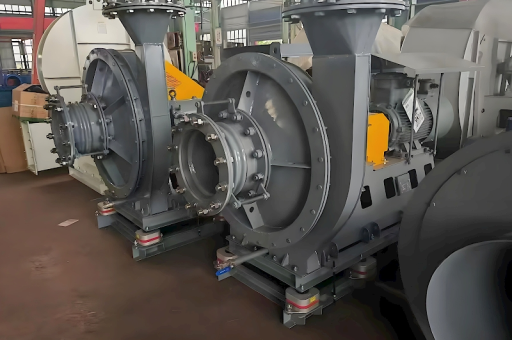
It seems you are looking for information on a Single Suction Medium Pressure Dust Collector Fan (also commonly referred to as an Air Purification Blower Fan).
This is a specific type of industrial fan designed to move air and dust particles through a filtration system. Here is a breakdown of what this product is, its key features, and typical applications.
What is it?
This fan is a centrifugal blower with a single air inlet (single suction). It operates in the medium pressure range, meaning it can generate enough static pressure to overcome the resistance of ductwork, filters, and dust collectors (like baghouses or cartridge collectors) without being as powerful (or energy-intensive) as a high-pressure blower.
Key Features & Design
- Single Suction: Air enters the fan from only one side of the impeller. This is the most common design for dust collection. The impeller pulls air axially and then accelerates it radially (centrifugal force) to generate pressure.
- Medium Pressure: Typically ranges from about 700 Pa to 3,000 Pa (7 to 12 inches of water gauge). This is the "sweet spot" for most general industrial dust collection systems.
- Impeller Design:
- Radial Blades (Paddle Wheel): The most rugged design. Handles heavy dust loads well but is less efficient. Ideal for sticky or fibrous materials.
- Backward Inclined Blades (BC/BI): More energy-efficient (non-overloading). The preferred choice for general dust collection, woodworking, and lighter dust loads.
- Airfoil (AF): The most efficient but also the most expensive. Best for clean air applications.
- Construction: Usually made of heavy-gauge steel (often with a wear-resistant coating or liner) to withstand abrasion from dust particles. The housing is typically spiral (volute) shaped.
- Air Purification Blower: This term emphasizes the fan's specific role: it creates the vacuum or negative pressure needed to pull contaminated air into the filter, not to push dirty air around.
Common Applications (Where it is used)
- Woodworking Shops: Collecting sawdust, wood chips, and sanding dust from table saws, planers, and CNC routers.
- Industrial Manufacturing: Capturing metal grinding dust, plastic regrind, and powder coating overspray.
- Chemical & Pharmaceutical: Ventilation and dust control for powders, granules, and hazardous materials.
- Welding & Fume Extraction: Pulling welding smoke and fumes through filtration units.
- Grain & Agricultural: Handling grain dust, chaff, and husks.
- General Air Purification: Used as the main motor for large room air scrubbers or central vacuum systems.
Advantages
- High Reliability: Simple, robust design.
- Abrasion Resistance: Can be built to handle harsh, abrasive dust.
- Good Efficiency: More efficient than forward-curved fans for pressure applications.
- Non-Overloading Power Curve (Backward Inclined): The motor will not burn out if the duct is accidentally blocked (unlike a forward-curved fan).
How to Choose the Right One? (Typical Selection Criteria)
To select the correct fan, you need to know:
- Air Volume (CFM or m³/h): How much air needs to be moved.
- Static Pressure (SP - inches of water or Pa): The total resistance in the system (ductwork + filter + equipment).
- Material Type: Is it clean air, wood dust, metal grinding dust, or explosive dust? (This dictates material, spark resistance, and impeller type).
- Temperature: Is the air hot or cold? (Standard fans are for air up to 80°C / 176°F; high-temp versions exist).
Summary Table for Selection
| Feature | Recommendation |
|---|---|
| Application | General dust collection, air purification |
| Pressure Range | Medium (700-3000 Pa) |
| Impeller Type | Backward Inclined (for efficiency) or Radial (for heavy dust) |
| Key Component | Motor (often VFD-ready) + Inlet/Outlet Flanges |
Disclaimer: For specific safety and engineering requirements (e.g., explosion-proof rating for combustible dust like wood or metal), you must consult a local engineer or fan manufacturer to ensure the fan meets your local codes.
If you have a specific question about this fan (e.g., "How to calculate the required static pressure?" or "What is the difference between single and double suction?"), feel free to ask





