
This article's table of contents introduction:
- Product Breakdown: Key Requirements
- The Correct Fan Type: Backward-Curved Centrifugal Fan
- Key Specifications to Look For
- Potential Alternative (Louder but More Rugged)
- Summary for Your Supplier
- Example Product from a Major Chinese Manufacturer
This is a highly specific technical product request that combines several key performance criteria. Let's break down what you are looking for and identify the type of fan that fits this description.
Product Breakdown: Key Requirements
- Environmental Protection / Dust Removal: The fan is intended for industrial air pollution control, likely as part of a baghouse, cartridge collector, or wet scrubber system. This implies it needs to handle air with some particulate loading, though typically a "clean side" fan is placed after the filter.
- High Flow: This indicates a large volumetric flow rate (e.g., 10,000 to over 100,000 CFM). This is the primary requirement for moving massive volumes of dusty air.
- Low Noise: A critical constraint. Traditional industrial fans can be very loud. This requirement points to specific design features like backward-curved blades, optimized housings, and potentially lower tip speeds for the given flow.
- Medium Pressure: This is the defining characteristic. In fan engineering, "medium pressure" usually refers to static pressure in the range of 15 to 40 inches of water gauge (in. w.g.), or roughly 3,700 to 10,000 Pa. This is higher than a simple ventilation fan but lower than a high-pressure compressor or a specialized high-pressure radial fan (e.g., for pneumatic conveying).
The Correct Fan Type: Backward-Curved Centrifugal Fan
The most suitable design for these specific parameters is a Backward-Curved (BC) or Airfoil (AF) Centrifugal Fan.
Here is why this is the ideal choice:
- High Flow & Medium Pressure: The BC/AF fan design is the industry standard for this exact operating range. Its performance curve is steep and stable, meaning it can handle pressure changes well without surging, which is crucial for filter systems that load up with dust.
- Low Noise: This is the biggest advantage of BC/AF fans over other types.
- Backward-Curved (BC): The blades curve away from the direction of rotation. This reduces gas velocity exiting the wheel, leading to lower turbulence and significantly lower noise levels than forward-curved or radial fans.
- Airfoil (AF): A subtype of BC where the blades have a wing-like shape. These are the most efficient and quietest of all centrifugal fans. They are the top choice for low-noise, high-efficiency critical applications.
- Environmental Protection (Durability):
- For clean-side air (after the filter), a standard steel construction with a good paint system is fine.
- For dirty-side or abrasive dust, you can spec abrasion-resistant liners on the housing or use a Radial Tip fan design (as a compromise, though this is louder) or a specialized Exhauster Fan with wear plates.
Key Specifications to Look For
When procuring this fan, you should request a fan selection based on these parameters from a reputable manufacturer (like New York Blower, Howden, Greenheck, Cincinnati Fan, or a major Chinese OEM like Yilong or Zibo Jingye).
Critical Selection Criteria:
- Fan Wheel Design: Airfoil (preferred) or high-efficiency Backward-Curved.
- Speed (RPM): To achieve "low noise," you want a larger diameter wheel running at a slower RPM. A smaller wheel spinning very fast is LOUD.
- Tip Speed: A key factor in noise. Keep this as low as possible for the required pressure. Typically, under 15,000 FPM (75 m/s) for quiet operation.
- Housing Width: A wider housing allows for higher flow at a given diameter, keeping the RPM lower.
- Sound Power Level (dBA): You should request a fan selection with a guaranteed maximum sound power level (e.g., <85 dBA at a specific distance, often 3 or 5 feet). You will likely need a sound attenuator (silencer) on the inlet and/or outlet to meet strict noise limits.
- Drive Type: A belt-driven configuration is standard for medium pressure. It allows you to easily adjust the fan speed (and thus flow/pressure) to match system conditions exactly. For critical high-reliability, a direct-drive arrangement with a variable frequency drive (VFD) is best for low noise.
- Inlet Box & Dampers: An inlet box with an inlet vane damper is common for flow control and can be very quiet if they are the parallel-blade type. However, they must be properly sized to avoid noise.
- Motor: A high-efficiency (IE3/IE4 or NEMA Premium) motor is standard. For low noise, look for a motor with a low vibration grade and possibly sleeve bearings (though grease-lubricated ball bearings are more common).
Potential Alternative (Louder but More Rugged)
If the dust loading is very high (e.g., directly before a filter) and abrasion is a major concern, you might look at a Radial Tip or Paddle Wheel fan.
- Pros: Very robust, handles heavy dust, self-cleaning.
- Cons: Significantly louder than BC/AF. Less efficient. Higher energy cost. This contradicts your "low noise" requirement.
Recommendation: Stick with a Backward-Curved Airfoil (AF) fan for the best balance of high flow, medium pressure, and low noise. It is the most efficient and quietest solution.
Summary for Your Supplier
When you contact a manufacturer or distributor, you should provide them with this exact request:
"I need a selection for a medium-pressure centrifugal fan for environmental dust control. Requirements:
- Service: Clean side (after dust collector) or light dust loading.
- Flow (CFM): [Your specific flow rate]
- Static Pressure (in. w.g.): [Your specific pressure, likely 15-40" w.g.]
- Noise: Critical. Must be low noise. Design for minimum dBA.
- Type: Backward-Curved Airfoil (AF), belt-driven.
- Accessories: Please include sound attenuator on inlet and outlet in the quote.
- Motor: Premium efficiency, TEFC, [Voltage/Phase]."
Example Product from a Major Chinese Manufacturer
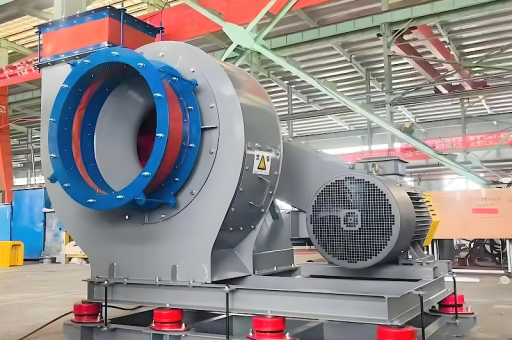
A company like Zibo Jingye Environmental Protection Fan Co., Ltd. is a good example of a manufacturer specializing in this niche. They produce a "Medium Pressure Centrifugal Fan" series (e.g., their C, L, or 9-19/9-26 series adapted for low noise) that directly targets this market.
- Model: 9-26 (a standard Chinese medium-pressure fan) OR their custom "Low Noise" version. Note: The standard 9-26 is efficient but not the quietest. You would need to request their "low-noise" impeller design (e.g., airfoil or high-efficiency BC) for your application.
- Key Feature: They can offer a backward-curved airfoil impeller for noise-sensitive applications and equip it with a soundproof housing (an enclosure) for maximum noise reduction.
Final Verdict: You are looking for a Backward-Curved (preferably Airfoil) Centrifugal Fan. Do not accept a Radial Bladed or Forward-Curved fan, as they will fail your low-noise requirement. Demand a sound power specification and consider an attenuator.





