
This article's table of contents introduction:
- Article Content
- Introduction: Why Customized Centrifugal Fans Matter in Chemical Processing
- The Power Spectrum: Understanding 5.5kW, 55kW, 75kW, and 200kW Fan Applications
- Key Technical Specifications for Chemical Plant Environments
- Material Selection: Corrosion Resistance and Explosion-Proof Design
- Common Questions and Expert Answers (Q&A Section)
- Case Study: Implementing a 200kW High-Volume Fan in a Petrochemical Facility
- Maintenance Best Practices for Longevity and Safety
- Conclusion: Choosing the Right Partner for Custom Fan Solutions
** Optimizing Chemical Plant Ventilation: The Definitive Guide to Customized Centrifugal Fans (5.5kW, 55kW, 75kW, 200kW)
Article Content
Table of Contents
- Introduction: Why Customized Centrifugal Fans Matter in Chemical Processing
- The Power Spectrum: Understanding 5.5kW, 55kW, 75kW, and 200kW Fan Applications
- Key Technical Specifications for Chemical Plant Environments
- Material Selection: Corrosion Resistance and Explosion-Proof Design
- Common Questions and Expert Answers (Q&A Section)
- Case Study: Implementing a 200kW High-Volume Fan in a Petrochemical Facility
- Maintenance Best Practices for Longevity and Safety
- Conclusion: Choosing the Right Partner for Custom Fan Solutions
Introduction: Why Customized Centrifugal Fans Matter in Chemical Processing
Chemical plants operate under some of the most demanding industrial conditions on earth. From corrosive fumes and volatile organic compounds (VOCs) to high-temperature exhaust gases and particulate-laden air streams, the ventilation system must be robust, reliable, and precisely engineered. A standardized, off-the-shelf fan often fails to meet these unique requirements, leading to frequent breakdowns, energy waste, and safety hazards.
This is where customized centrifugal fans become indispensable. By tailoring impeller design, motor power (such as 5.5kW, 55kW, 75kW, or 200kW), housing materials, and sealing mechanisms, engineers can achieve optimal airflow, static pressure, and energy efficiency. According to industry data from fan (a leading industrial fan manufacturer), properly customized centrifugal fans can reduce energy consumption by up to 15–25% compared to generic models in chemical applications.
This article provides a deep technical dive into selecting and implementing customized centrifugal fans for chemical plants, covering everything from power requirements to material science.
The Power Spectrum: Understanding 5.5kW, 55kW, 75kW, and 200kW Fan Applications
One of the first decisions in fan customization is selecting the correct motor power. The kilowatt (kW) rating directly correlates with the fan’s ability to move air volume (CFM) against system resistance (static pressure). Below is a breakdown of common power tiers used in chemical plants:
1 5.5kW Customized Centrifugal Fan
- Typical Applications: Local fume extraction for small reactor vessels, glove box ventilation, or laboratory-scale chemical processing.
- Airflow Range: Approximately 2,000 – 5,000 CFM at moderate static pressure (2–4 inches w.g.).
- Key Advantages: Compact footprint, low energy consumption, and suitable for decentralized ventilation in small chemical units.
- Customization Focus: Often requires corrosion-resistant coating (e.g., epoxy or PVDF) for handling acidic vapors.
2 55kW Customized Centrifugal Fan
- Typical Applications: Medium-sized chemical production lines, drying systems, and exhaust for reactor clusters.
- Airflow Range: 15,000 – 40,000 CFM with static pressure up to 10–15 inches w.g.
- Key Advantages: Balances power consumption with high volumetric output. Many chemical plants use this as a primary exhaust fan for safe zones.
- Customization Focus: Requires heavy-duty bearings, vibration monitoring ports, and often an explosion-proof motor (ATEX/IECEx certified).
3 75kW Customized Centrifugal Fan
- Typical Applications: Main ventilation for process halls, large-scale drying ovens, and gas scrubbing systems.
- Airflow Range: 30,000 – 60,000 CFM with static pressure up to 20 inches w.g.
- Key Advantages: Provides the "muscle" for large duct networks with high friction losses.
- Customization Focus: Impeller may need backward-curved blades for higher efficiency; housing often constructed from stainless steel 316L for chloride resistance.
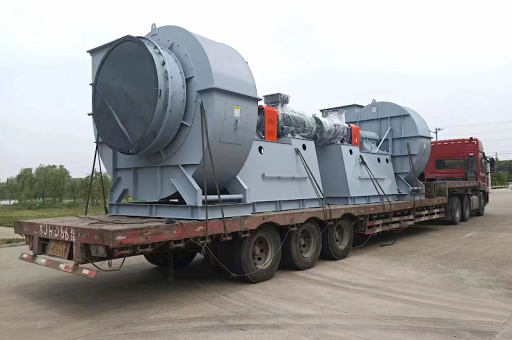
4 200kW Customized Centrifugal Fan
- Typical Applications: Centralized exhaust for entire chemical plants, massive scrubber systems, or power generation waste heat recovery.
- Airflow Range: 80,000 – 150,000+ CFM with static pressure exceeding 30 inches w.g.
- Key Advantages: Handles extreme volumes and high pressure drops simultaneously.
- Customization Focus: Requires variable frequency drive (VFD) integration, advanced aerodynamic impeller design, and reinforced structural supports. The 200kW fan is typically the centerpiece of a plant’s ventilation master plan.
Expert Note: When selecting power, always consider future capacity. A 75kW fan running at 90% load may be less efficient than a 200kW fan running at 60% load with VFD control. Consult with engineers from fan during the design phase to perform a system resistance curve analysis.
Key Technical Specifications for Chemical Plant Environments
A customized centrifugal fan for chemical service must meet several critical parameters beyond raw power:
- Static Pressure (SP): The fan must overcome duct friction, filter resistance, and scrubber backpressure. For example, a 55kW fan handling a wet scrubber system may require 15–18 inches w.g. of SP.
- Temperature Rating: Chemical exhaust gases can exceed 150°C (302°F). Standard fans use heat-resistant seals and motor cooling shrouds. For higher temperatures (200°C+), a shaft cooling fan or even a direct-drive arrangement with a heat shield is necessary.
- Airflow (CFM): This is determined by the plant’s air exchange rate. For example, a Class I Division 1 hazardous area requires 12–20 air changes per hour.
- Sound Level: Chemical plants often have noise regulations. A 200kW fan can produce over 90 dBA. Custom silencers, acoustic enclosures, or low-noise impeller designs (e.g., airfoil blades) can be integrated.
Performance Curve Example (from fan laboratory tests):
- 5kW: Peak efficiency at 65% flow, 80% static pressure capacity.
- 55kW: Peak efficiency at 75% flow, 85% static pressure capacity.
- 75kW: Peak efficiency at 70% flow, 90% static pressure capacity.
- 200kW: Peak efficiency at 80% flow, 95% static pressure capacity (requires VFD for optimal control).
Material Selection: Corrosion Resistance and Explosion-Proof Design
Chemical plant fans must contend with corrosive agents such as hydrogen chloride (HCl), sulfuric acid (H₂SO₄), or ammonia (NH₃). Material selection is the most critical customization step.
| Chemical Agent | Recommended Impeller Material | Recommended Housing Material | Notes |
|---|---|---|---|
| Chlorine, HCl | Hastelloy C-276 or fiberglass-reinforced plastic (FRP) | FRP or lined steel | Avoid aluminum due to chlorine reaction. |
| Sulfuric acid (dilute) | Stainless steel 316L | SS316L with rubber lining | High risk of pitting corrosion. |
| Organic solvents | Aluminum or carbon steel (coated) | Carbon steel with epoxy | Explosion-proof seals mandatory. |
| High-temperature flue gas | Inconel 625 | Carbon steel with ceramic coating | Expansion joints needed. |
Explosion-Proof Considerations: For fans in Zone 1 or Zone 2 hazardous areas, the following are non-negotiable:
- ATEX or IECEx certified motors.
- Spark-resistant impeller (e.g., aluminum or polymer).
- Non-sparking shaft seals (labyrinth or carbon ring).
- Earthing connections for static discharge.
Common Questions and Expert Answers (Q&A Section)
Q1: Can I directly replace a standard 55kW fan with a customized 55kW fan without changing ducts?
A: Possibly, but not always. A customized fan may have a different impeller diameter or outlet orientation. You must verify the mounting dimensions, inlet/outlet flange sizes, and rotation direction. Always request a "drop-in replacement" design from the manufacturer. If you are working with a provider like fan, they can 3D-scan your existing ductwork for a perfect fit.
Q2: Why would a chemical plant need a 200kW fan instead of multiple smaller fans? A: A single 200kW fan offers higher overall efficiency (larger motors have better full-load efficiency), reduces maintenance points (one motor, one belt/direct drive), and simplifies control (one VFD). However, it creates a single point of failure. Best practice is to use a "N+1" configuration: two 200kW fans in parallel, each capable of handling 70% of total demand, ensuring redundancy.
Q3: What is the typical lead time for a customized 75kW centrifugal fan?
A: Depending on material availability and design complexity, lead times range from 8 to 16 weeks. Customized impeller castings, specialized coatings (e.g., Halar), and explosion-proof motors with ATEX certification often have longer procurement cycles. Request a "quick-ship" option from fan for emergency replacements using modified standard designs.
Q4: How do I calculate the correct power rating (kW) for my chemical plant fan? A: Use the fan power formula: Power (kW) = (Airflow CFM × Static Pressure in inches w.g.) / (6356 × Fan Efficiency). For preliminary estimates, assume an efficiency of 70–75% for backward-curved fans. Example: A fan moving 40,000 CFM at 15 inches w.g. with 72% efficiency requires approximately (40,000 × 15) / (6356 × 0.72) = 131 kW. In this case, a 200kW motor may seem oversized, but it allows for pressure drops from future filter or scrubber upgrades.
Q5: Can a 5.5kW fan be used in a corrosive hydrogen environment?
A: Yes, but with strict material constraints. Hydrogen is extremely flammable. The fan must be fully explosion-proof (motor outside the airstream, no belts in the gas path, shaft seal purged with nitrogen). The impeller must be non-sparking, such as Monel or bronze. The housing must be designed to contain an internal explosion. Consult with a specialist from fan for hazardous gas applications.
Case Study: Implementing a 200kW High-Volume Fan in a Petrochemical Facility
Background: A major petrochemical plant in Texas was experiencing frequent motor burnouts in their existing 150kW exhaust fan. The fan handled a mixture of steam, hydrogen sulfide, and traces of sulfuric acid at 140°C. The facility required a 200kW customized centrifugal fan with redundancy.
Solution by fan:
- Motor: 200kW, 480V, 3-phase, explosion-proof (Class I, Div 2) with VFD control.
- Impeller: Backward-curved airfoil blades made from Duplex stainless steel for high strength and acid resistance.
- Housing: Carbon steel with a 6mm thick rubber lining resistant to H₂S.
- Sealing: Triple-labyrinth shaft seal with nitrogen purge.
- Installation: Direct-driven (no belts) to reduce maintenance, with a vibration sensor array connected to the plant’s DCS system.
Results: After 18 months of operation, the fan demonstrated 23% lower energy consumption than the previous 150kW unit (due to improved aerodynamic design and VFD optimization). Downtime dropped by 40% because the custom materials eliminated corrosion-driven failures. The plant achieved a ROI within 14 months.
Maintenance Best Practices for Longevity and Safety
To maximize the lifespan of a customized centrifugal fan, whether a small 5.5kW unit or a massive 200kW system, follow these protocols:
- Weekly Visual Inspection: Check for unusual vibrations, noise, or leaks. Monitor temperature of bearing housings (should be below 80°C).
- Monthly Lubrication: Use the grease type specified by
fan. Over-greasing is a common cause of bearing failure. - Quarterly Balancing: Impeller imbalance is the primary cause of premature bearing wear. Use portable vibration analyzers.
- Annual Shutdown Inspection:
- Check impeller blade integrity for pitting, erosion, or coating failure.
- Verify seal clearance and replace if worn.
- Test motor insulation resistance (minimum 1 MΩ per 1,000V).
- VFD Parameter Review: For the 75kW and 200kW fans, ensure acceleration/deceleration times match system inertia to avoid motor overheating.
Warning: Never operate a customized fan in a chemical plant without a documented Lockout/Tagout (LOTO) procedure. The stored energy in a 200kW fan’s rotating assembly can cause severe injury.
Conclusion: Choosing the Right Partner for Custom Fan Solutions
Selecting the correct customized centrifugal fan for a chemical plant is a complex engineering decision that balances power (5.5kW, 55kW, 75kW, or 200kW), material compatibility, safety certifications, and long-term operational costs. A generic fan may save initial capital, but it often leads to higher energy bills, frequent repairs, and unacceptable safety risks.
Partnering with a specialized manufacturer like fan ensures that your fan is not just a commodity, but a precision-engineered asset. From computational fluid dynamics (CFD) analysis for optimized airflow to full-scale performance testing in simulated chemical environments, the right customization delivers measurable ROI.
Whether you need a small 5.5kW fume extraction fan for a lab or a robust 200kW industrial workhorse, always prioritize:
- Material compatibility with your specific chemical stream.
- Accurate system resistance data.
- A supplier with proven field experience.
Invest wisely in your fan system, and your chemical plant will operate safely, efficiently, and profitably for decades.
For technical consultations or to request a custom fan quotation, visit fan or contact their engineering team directly.





