
This article's table of contents introduction:
- Function in the Boiler System
- Decoding "High Flow, Low Noise"
- Preferred Fan Type: Backward Curved Centrifugal
- Noise Reduction Engineering (Key to "Low Noise")
- Critical Design & Material Considerations (ID Fan Specifics)
- Typical Specifications (Example Datasheet)
- Control & VFD Integration
- Key Manufacturers for this Specification
- Procurement Checklist
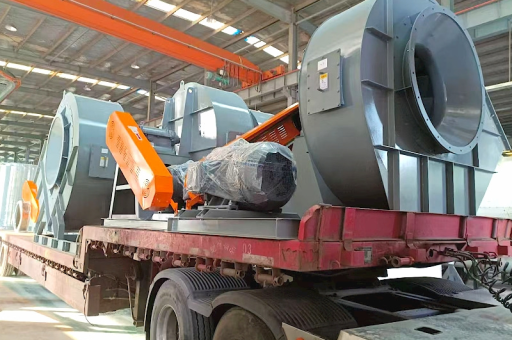
This is a specific industrial equipment specification. A 132kW High Flow Low Noise Induced Draft Fan is a critical component for medium-to-large boiler systems, particularly in power plants, industrial steam generation, or large commercial HVAC.
Here is a detailed breakdown of what this specification implies, the typical design, and key considerations for procurement or application.
Function in the Boiler System
- Induced Draft (ID): The fan is located after the boiler (between the boiler outlet and the chimney). It creates a negative pressure (vacuum) inside the furnace. This pulls hot flue gases through the boiler, economizer, and scrubbers/filters.
- Why 132kW? This power rating (approx. 177 HP) suggests a large industrial boiler (e.g., 50-100+ ton/hour steam capacity) moving a high volume of gas against a moderate resistance (draft loss from the boiler and pollution control equipment).
Decoding "High Flow, Low Noise"
- High Flow: Moving a large volume of flue gas (typically measured in m³/h or CFM). For a 132kW fan, airflow could be in the range of 150,000 – 300,000 m³/h (88,000 – 176,000 CFM), depending on the system pressure.
- Low Noise: This is the key challenge. ID fans handle hot, often dusty gas. Achieving low noise (< 85 dBA typically) at 132kW requires specific design choices.
Preferred Fan Type: Backward Curved Centrifugal
For a 132kW, high-flow, low-noise ID fan, the single-width, single-inlet (SWSI) or double-width, double-inlet (DWDI) centrifugal fan with backward-curved (BC) or backward-inclined (BI) airfoil blades is the standard.
Why this type?
- High Efficiency (80-85%): Converts motor power into airflow with less waste heat, reducing noise from turbulence.
- Non-Overloading Power Curve: The motor cannot be overloaded if the ductwork is blocked.
- Lower Tip Speed: Can achieve high flow with lower rotational speed (RPM) compared to a radial/forward-curved fan, which is the primary method for noise reduction.
Noise Reduction Engineering (Key to "Low Noise")
A standard 132kW fan can be very loud (95-105 dBA). To hit "low noise" targets, manufacturers must incorporate:
- Airfoil Blades: Hollow, aerodynamic blades create less turbulence than flat or single-thickness blades.
- Low Peripheral Speed: Designing the impeller with a larger diameter to allow for lower RPM at the target flow (e.g., 900-1200 RPM instead of 1500-1800 RPM).
- Sound Attenuation:
- Inlet & Outlet Silencers: Reactive or absorptive silencers on the ductwork.
- Acoustic Enclosure: A fully enclosed fan casing with acoustic insulation.
- Acoustic Lagging: Wrapping the fan housing and nearby ductwork.
- Vibration Dampening: A heavy-duty, vibration-isolated base. Imbalance is a massive source of low-frequency noise.
- Motor Selection: High-efficiency (IE3/IE4/NEMA Premium) motors run cooler and quieter. A direct-drive (motor shaft to impeller shaft) is quieter than a belt-driven system (belt whine).
Critical Design & Material Considerations (ID Fan Specifics)
Because this is an Induced Draft fan handling hot flue gas:
| Parameter | Requirement for 132kW ID Fan |
|---|---|
| Temperature | Flue gas can be 140°C - 200°C (standard) or up to 400°C if there is no economizer. The impeller and shaft must be rated for this. |
| Corrosion | Flue gas contains acid (Sulfuric, Nitric) below dew point. Requires Corten steel or stainless steel (SS316L) impeller. |
| Erosion | Fly ash particles act like sandpaper. Requires wear-resistant liners at leading edges and housing throat. |
| Shaft Seal | Must prevent hot, corrosive gas from leaking along the shaft to the bearings. A labyrinth or purge seal is standard. |
| Bearings | Heavy-duty spherical roller bearings with external cooling (a cooling fan or water jacket on the bearing pedestal) to handle heat soak. |
Typical Specifications (Example Datasheet)
- Application: Industrial Boiler Induced Draft
- Type: Centrifugal, Single Inlet, Single Width, Backward Curved Airfoil
- Motor: 132 kW, 400V / 690V / 6.6kV (High Voltage common for this size), 3-Phase, 50/60Hz, IE4
- Drive Type: Direct Drive (preferred for noise/Direct coupled) or V-Belt (provides speed flexibility but louder).
- Speed: ~ 1180 RPM (example for a large impeller)
- Airflow (max): ~ 200,000 m³/h
- Static Pressure (SP): ~ 4000 Pa (16" w.g.)
- Noise Level: < 85 dBA @ 1m (with silencers)
- Impeller Material: Weathering Steel (Corten) or Stainless Steel 316L
- Construction: Arrangement 3 (Impeller overhung on shaft with separate bearing pedestal) or Arrangement 1 (Shaft between bearings – more stable for large sizes).
Control & VFD Integration
A 132kW fan should always be paired with a Variable Frequency Drive (VFD).
- Benefit: Allows precise control of furnace draft. Instead of choking flow with a damper (loud, inefficient), the VFD reduces speed.
- Low Noise Operation: At 80% speed, the fan is significantly quieter than at 100% speed (noise falls off exponentially with RPM).
Key Manufacturers for this Specification
Leading global and regional manufacturers for heavy-duty, low-noise ID fans include:
- Howden (Global leader in heavy-duty fans)
- TLT-Turbo / Siemens Process Industries
- Greenheck (Commercial/Industrial, high quality)
- New York Blower (DuraFoil series)
- Chongqing General Industry / Zhejiang Shangfeng (Chinese OEMs with cost advantages)
- Flakt Woods (European high-efficiency designs)
Procurement Checklist
If you are specifying this fan, ask the manufacturer for:
- Airfoil Profile Drawing: Verify aerodynamic design.
- Sound Power Level (Lw) not just Sound Pressure: For noise control engineering.
- Impeller Weight & Moment of Inertia: For VFD tuning.
- Critical Speed Analysis: Ensure the operating speed is not near a natural frequency of the shaft.
- Wheel Balance Report: Grade G2.5 or G1.0 (G1.0 is best for low noise).
- Motor Frame Size: Ensure shaft fitment is correct for direct-drive.
In summary: A 132kW High Flow Low Noise Induced Draft Fan is a specialized, heavy-duty centrifugal fan. Its success depends on using an airfoil backward curved impeller, running at a low rotational speed, with robust material selection for corrosion/erosion, and an engineered acoustic treatment package. For this power level, a direct-drive setup with VFD control is the optimal configuration for both noise reduction and energy efficiency.





