
This article's table of contents introduction:
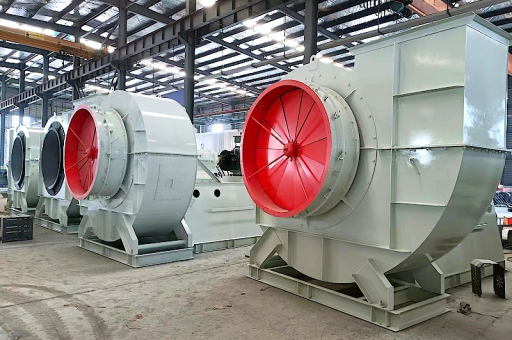
- What does 11,000 Pa mean?
- The Physics: 11,000 Pa = ?
- Applications for an 11,000 Pa Centrifugal Fan
- How will this fan behave? (Performance Curve)
- Types of Centrifugal Fans that achieve 11,000 Pa
- Key Selection Criteria
- Summary for Practical Use
Here’s a detailed breakdown of what a 11,000 Pa (Pascal) centrifugal fan is, its applications, how it compares to other fans, and key selection criteria.
What does 11,000 Pa mean?
In the context of fans, Pressure (Pa) is a measure of the force the fan can generate to overcome resistance in a duct or system.
- 11,000 Pa is very high pressure.
- Context: A standard household box fan generates about 50–100 Pa. A typical HVAC fan might be 500–1,000 Pa. An industrial dust collection fan might be 2,000–5,000 Pa. 11,000 Pa is in the "high static pressure" or "medium-compressed air" range.
The Physics: 11,000 Pa = ?
- 1 Pa = 0.000145 psi
- 11,000 Pa = 1.595 psi
- In mmH₂O: 11,000 Pa = ~1,122 mmH₂O (the common unit for fan pressures).
- In inches w.g. (water gauge): 11,000 Pa = ~44.1 in w.g.
To visualize 44 inches of water gauge: This is sufficient pressure to push water up a 3.6 ft (1.1 m) vertical column. It is also roughly equivalent to 11 Bar (just over 1/10th of atmospheric pressure).
Applications for an 11,000 Pa Centrifugal Fan
This pressure rating defines a specific niche of industrial applications where you need to move air through high-resistance circuits:
- Pneumatic Conveying (Dense Phase): Moving powders, pellets, or granular materials (e.g., plastic, cement, grain) through small-diameter pipes over long distances or vertical lifts. The high pressure pushes the material forward.
- Industrial Dust Collection (High Static): Systems with long duct runs, multiple filters (HEPA/pleated), and small-diameter pickup points (e.g., woodworking shops with a central cyclone, welding fume extraction).
- Combustion Air Blowers: For industrial burners, boilers, or furnaces that require a forced draft to push air against the natural draft or through a narrow burner nozzle.
- Air Knife Systems: In industrial drying or cleaning, high-pressure air is forced through a narrow slot (air knife) to blast debris or water off a conveyor belt.
- Clean Rooms & Fume Hoods: To overcome the high resistance of HEPA/ULPA filters, fume hood fans often need substantial static pressure (typically 2,000–5,000 Pa, but 11,000 Pa would be for larger, more restrictive filters).
- Spray Booths: Forcing air through a water curtain or dry filter bank.
- Soil Vapor Extraction (SVE): Pulling vacuum on wells to extract soil gas from contaminated ground.
How will this fan behave? (Performance Curve)
A centrifugal fan with 11,000 Pa (44" w.g.) will have a very steep performance curve.
- At low flow (e.g., 500 CFM): It can deliver the full 11,000 Pa.
- At high flow (e.g., 2,000 CFM): The available pressure drops significantly (e.g., to 5,000 Pa).
- At its free air rating: The pressure drops to zero (0 Pa).
System Resistance is Critical: For a 11,000 Pa fan, you must match the fan's curve to your system's resistance. If the system resistance is too low (e.g., a short, large-diameter duct), the fan will move a massive amount of air, the motor will likely overload, and the fan may stall (causing noise, vibration, and potential motor burnout).
Types of Centrifugal Fans that achieve 11,000 Pa
- Backward Curved / Backward Inclined (BC/BI): Most efficient for this pressure range. Best for clean air. Can handle up to moderate static pressure. Typical for HVAC/combustion.
- Radial (Paddlewheel / Radial Blade): Best for high pressure and handling dust/dirty air. The blades face directly outward. Generates very high pressure but is less efficient and noisier than BC.
- Forward Curved (Squirrel Cage): Less common for 11,000 Pa because they are best for high flow, low pressure. They can achieve this pressure but will be large, inefficient, and may have stability issues (surge).
- Inline Radial / Mixed Flow: Design that combines axial flow with centrifugal pressure. Good for compact installations and medium-high pressure.
- Regenerative (Ring Blower / Side Channel): This is not a true centrifugal fan. A regenerative blower generates much higher pressure (20,000–60,000 Pa) but at very low flow. It's a common choice if you need 11,000 Pa and a low CFM.
Key Selection Criteria
If you are designing a system around an 11,000 Pa fan, consider:
- Airflow (CFM / m³/h): What volume of air do you need to move at that pressure? The fan will have a specific curve.
- Air Type:
- Clean: Backward Curved (efficiency).
- Dusty / Particulate: Radial or Paddlewheel (tough, can handle abrasion).
- Hot / Corrosive: Special materials (stainless steel, high-temp seal) for chemical or high-temperature exhaust.
- Motor Power: A fan at 11,000 Pa requires significant power.
- Approximate Formula: Power (kW) = Pressure (Pa) × Flow (m³/s) / (1,000 × Efficiency).
- For example: 11,000 Pa × 1 m³/s (2,120 CFM) / 1,000 / 0.65 (65% efficiency) = ~17 kW (22.5 HP) motor.
- You will likely need a 3-phase motor (208/230/460V or 575V).
- Drive Type:
- Belt Drive: Most common. Allows RPM change to adjust pressure and flow.
- Direct Drive: More efficient, less maintenance, but specific RPM/curve.
- Variable Frequency Drive (VFD): Highly recommended for controlling flow/pressure and saving energy.
- Construction:
- Housing: Steel (painted, galvanized), aluminum, stainless steel.
- Wheel: Steel, aluminum, stainless, or coated for corrosive/abrasive environments.
- Shaft & Bearings: Robust, oversized ball bearings for radial loads.
- Inlet/Outlet: Typically a rectangular or circular connection. Orientation (Clockwise/Counterclockwise, discharge angle) is design-critical.
Summary for Practical Use
If you need 11,000 Pa: You are doing a heavy-duty industrial job.
- Not suitable for: General ventilation, small dust collectors, swimming pool pumps, leaf blowers.
- Suitable for: Pneumatic conveying, high-static dust collection, combustion air, fume extraction over long distances or through restrictive filters, air knife systems.
- Warning: Do not buy a fan for this pressure without knowing your System Resistance Curve. If your duct is too open, the fan will move too much air and overload the motor.
Example of a common fan type matching 11,000 Pa: A New York Blower (or equivalent) Size 30" Radial Fan running at ~2,400 RPM with a 20-25 HP motor could deliver approximately 3,000-4,000 CFM at 11,000 Pa (44" w.g.).
Next Step: If you can provide your desired airflow (CFM) and details of the system (duct length, diameter, filters, elbows), I can help you imagine a specific fan model or confirm if a fan is already appropriate.





